
Transcriptsyncs with video
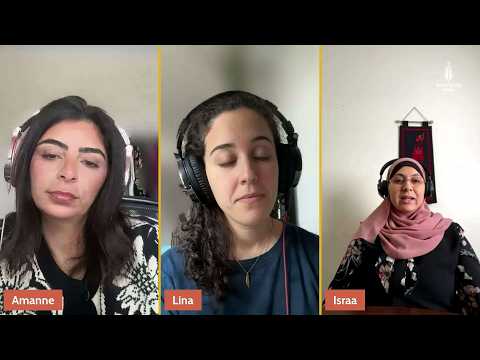
Hi stitchers, welcome to Tatreez Talk where we share conversations about Palestinian embroidery. I'm Lina here with my co-host Amani chatting with the talented embroiderers and artists sharing their stories, inspirations, and the cultural significance behind their work. And on today's episode we are chatting with Isra, a Tatreez artist who is thriving to learn more about Tatreez and is also teaching Tatreez and building local community. So welcome to Tatreez Talk, Isra. Hi, welcome.
Thank you for hosting me. Of course, we're glad to have you here. Uh, Isra is a friend of mine, so she has been part of my community. She is making her own thobe, and she's also connected with other folks in my community. So it's such a pleasure to see her on the podcast because I knew, um, after seeing it— actually, Amani, one of our dear friends from the from the retreat last year did an article, featured her in an article.
So we'll have to talk about that too. Yes, yes, very cool, very cool. But Israa, maybe to kick us off, we would love to hear about you and your family's connection to Palestine.
Oh, it's a long story. As all Palestinians, we have a rich kind of story to tell. I'm originally from a village called Al-Falujah. My grandfather was kicked out from the village in 1948. He went kind of seek refugee at Gaza Strip.
So my father, my uncles all grew up in a refugee camp in Gaza.
And it's kind of like a journey for all Palestinians at that stage of life. Most of my dad's generation went to the Gulf or went to other countries to build a life. So my dad went to Saudi. I was born there. I spent all of my primary school there, but then we went back to Gaza.
I finished high school, university. In Gaza, but then I got married, moved into Canada. So my life is a journey. I have a bit of each country in my life, but nothing like Gaza. Nothing has shaped me the way I am like Gaza right now.
And for the funny part, I grew up in Gaza, never been stitching or never touched a piece. I just learned Tetris when I, when I came to Canada, and I found out that I am missing that part in my life. That's really interesting. Okay, so we definitely are going to touch on that, but before we do, I'm curious. So you left, um, you moved to Canada, you got married, moved to Canada.
Um, how long ago did you leave, and have you been able to kind of continue to go back and visit family, obviously prior to the start of this current genocide? Yes. So I left almost 15 years ago from Gaza. I visited Gaza twice during the 15 years. The latest one is in 2022.
It was really recent.
I was happy. I feel I was lucky, but at the same time, it was more painful because I saw Gaza the way it was right before the genocide. It was beautiful. There's a lot of things happening. People are building a life from nothing, like literally nothing.
It just blew my mind of how the youth, the young people there are trying to prove to the world that we can do it. I felt proud there to the point I'm like, I actually want to move back and live in there. Like, I thought about it seriously. Since my family, my parents were there too, I was like, why am I alone there? Gaza looks beautiful.
I feel like my kids loved it. Everything was awesome. But then the whole genocide happens and it just took another turn in my life. I don't like to go there, but we lost my brother. In there, Allah Rahmo.
And after I think nine months of the genocide or ten months, I managed to evacuate my family to Egypt. And then finally they're here in in Canada. Alhamdulillah! My parents arrived in November of this year after almost two years of processing. Yeah, but um.
It doesn't feel right, neither for me, neither for them. They still think about going back. They still think, why would we leave? We, like, even though all of my uncles and aunts still there, they're telling them, you're lucky that you're safe and you're in a better place right now. But, you know, it's their home.
It's everything they know. So it's a big adjust, especially for my parents. Yeah, yeah, yeah, I can imagine. I remember you fighting for that, for them to get processed to Canada, which is just unreal that we're in this experience, having this experience, you know. Um, but I'm happy that they made it and they're with you.
I know there's a lot of families who have been separated and would be still struggling, and unfortunately that, that program was not much helping even for the family that made it there to Canada. They still feel like left out. So a lot of things need to be done. Well, maybe we can start talking about your Totris journey because I know that it started when you were there last in 2022. Do you want to share more about how you got started with Totris?
Um, so I, I just felt like when I had— so I bought my house I was in a rental for a long time, but when I bought my house, I felt like I'm missing my identity. I want stuff that is having Tatris in my house. So when I went to visit in 2022, I saw all of the things that you can imagine of Tatris, like this little pillows, like the map that I have in the back here, um, even the car accessories was made of Tatris. It just blew my mind, and I was like wanted to buy everything. And my mom looked at me and she's like, you know, you can do that by yourself.
You know how, you know, like you can do it. It just, you need to learn. And it just clicked in my head. And I said, why not? Yes.
Like instead of waiting for the chance I'm back home to buy something, why would I make it myself? And it just still there in my mind until I came back. And for a coincidence, I saw a page of a girl from Gaza. It's called Kinar. And she's like amazing.
And she was like, I'm doing online courses. So I'm like, oh, let me take an online course and see. Even though my mom is a tatooezer, my sisters are tatooezers, I never been into tattoos. I never wanted to learn. And I think my mom had that idea of like, you can do it.
I remember when I was a kid, the first time she gave me like a big map and she's like, yeah, do it. I'm like, ah, does it work with my brain? I can't function this way. But, um, this lady, I, I love the way she teach me tatreez. She like took it bit by bit.
The second I had the hang of it, I was into it. And then I saw Lina and it just like inspired me of like, oh, I need to have my own thobe. I need to have my own thobe. But it was like in the back of my head of I want to have my own soap. And, um, so I started like only on Aida fabric, just like doing some stuff, decoration, some stuff for my friends and stuff like that.
But then when the genocide happens and we lost every picture of my grandma, and like I felt that little thing that holds me to know how her soap looks like just And I'm like, I don't, I like, I don't have any picture of her. I don't know how her thobzeh look like. And these kind of the things like you feel you have it for granted, but then out of nowhere you lose it. So I started the questions. I asked Lina.
I asked people like, I need something from Al-Faluja. I need to know more, to learn more. I need to find motifs. I even asked relatives about their grandmas' Like soaps and all of that just like kept me going. And then like, I— Lena thankfully made me join her community, um, and it just blew my mind the amount of tattoos that have the same feelings as me.
Like, we just felt immediate bond right away because the, the second one of us talking, we know how it feels. So I felt like I'm home in that community. I felt like the second I'm speaking up, it just— I don't have to explain more. Like, people are getting it. Unfortunately, did not finish my TOEFL yet.
That's okay. Because of all of the things I've been doing for the past 2 years and a half, it's— it was a lot. It was advocacy, it was teaching Tatris, it was— it was— I was spread thin, so I never had a chance to, to finish my thobe, unfortunately. But, um, I, I can say that I succeeded in different aspects in the community locally in Ottawa. So I, I feel that is okay, I didn't finish my thobe yet, but I did this and this.
So, um, these kind of things that I'm, I'm kind of proud of it because I, I just touched a lot of youth lives around me, a lot of ladies that they needed to learn, and they have their own pages right now. They teach the trees right now. It's just like that domino effect that you just start with teaching someone, but that someone can teach another one, and I, and I love that. Yeah, let's talk a little bit about that community that you've been building. You know, you mentioned it.
Um, how did this start? How did it start that you decided, like, I want to build a local community, and what did you do to start It started when we had the talks with youth meeting up in protests and meeting up in advocacy meetings and stuff like that. A lot of youth felt that we want to learn more about our heritage. I don't know how to do tatrees. I never touched tatrees.
I love to have tatrees in my life. And I think it's a, it's kind of like a result of the genocide, people were more like feeling thirsty to feel that connection to our roots. And I just felt, why not? Why not I teach them how to do a little kind of a motif just to feel that connection? And it started from there.
It started having here and there sessions with the advocacy and the youth, but then later a friend of mine, she's like, you know what, I'm gonna create the page for you. I'm gonna post, post that you are holding, um, learning sessions for beginners. She helped me pushing that aspect, and she's one of my students too, the first group. Um, so I feel like very, very close to that first group because we're kind of like bond a lot in a way that allow us to be friends right now and see each other. Um, and, and she's now doing her own sessions too.
Like, I stopped because I— because of my personal, like, life, I stopped having more sessions like that. But I see her now advertising for having, like, little cafes, uh, sessions with a lot of ladies that just want to talk and have their own tatris with them. So I feel like it just kicked a start of a series of events that could bring the community together. And we did this map. Actually, this map, I got it from Gaza, but then when they saw it, they're like, we want to have this map.
So we planned the sessions to have these maps, and we delivered at the end, I think around 11 maps. And most of these maps have been sold out. For Gaza. Like, the benefits of that map went to Gaza for donation. But the ladies felt really proud.
I was really proud of them that they finished it. They worked on it, and they saw the final product.
Going through the faces when I meet the ladies or the youth the first time, but then see them again while they're showing me off their, their tattoos, like beautiful tattoos, I just feel like, oh, that's so nice, you know. It's just, it's just the part of the healing journey that I want people to be in, and it really helped everybody around me I know, and, and to feel that connection and feel the healing.
Introducing the drop that nobody asked for: Resolute RGL, the sneaker that takes centuries of Palestinian resistance and sells it back to you in leather. Co-founder Yossi Levin calls it empowerment. We call it exploitation. Same guy who once erased Palestinians from his projects in Haifa, now stitching tatreez into a shoe to build his quote-unquote multi-million-dollar brand. They say it's bridging local and global.
Translation: Palestinian women stitch, Europe profits, Israel wins. Limited edition, unlimited hypocrisy. Don't buy the hype, boycott Resolute RGL. This anti-ad was produced by Tatreez Talk. We stitch, we talk, we boycott.
Yeah, that's so beautiful. And these are— are these women all Palestinian, or did you have like allies in the community who were Yeah, they're mixed. They're mixed. Uh, I have, uh, 2 Turkish sisters. I had, um, uh, Yemeni, uh, uh, girls.
I had, I had an actual session with only non-Arab, non-Palestinian, non-Muslim. Like, it was like just allies. And, and these people were unique because some of them actually visited Palestine and they are pro-Palestinian right now. So for them, it is to learn the history part of Tatreez. I was able to put that in the session, make it very interesting.
Yeah, I know, that's so beautiful. A lot of the allies are, are doing really good work, which, you know, we're, you know, I think it's beautiful to see and It's beautiful to share tatreez with allies who are respecting it in a way that makes sense and they're learning from Palestinians. And so it's really powerful that you're able to kind of curate that experience in Ottawa. So is this account that you mentioned, I know that maybe you're not teaching as much, but is it still up and live? What's the name of the account for people who maybe are in Ottawa?
Tatreez by Isra. I can't share the the link with you? Yeah, we can do that after. We'll put it on the show, in the show notes. Yeah.
So it's Tatreez by Isra. Yes. Okay. Okay. So that's the one that you created for yourself and it just became more of like a hub.
Perfect. I love it. Yeah. So now we can tell people, if you're in Ottawa and you're listening, you have your resource to go learn from and practice with. I'm also curious because you mentioned that your mom and your sister practice Tatreez.
How has that relationship maybe changed as you've gotten into tatreez? Are they— do you now practice with them now that you guys are together? Yeah, actually, yes. I didn't expect that. So my mom is very, very like neat and specific in her tatreez, and it was making it hard for me to compete with her.
It's not a competition. For her it is. It's like, no, you got it right, you know? But she did her own thobe. Without the waste canvas, you know, the type of fabric that you do.
They call it tatriz albat. So, and she did it like a long time ago, like when she was in her 20s. I still have that film. And, uh, yeah, and I love that fabric. I know it's— you can't find this fabric anymore.
I know. Oh yeah, it's so frustrating. But, um, I had a friend Her daughter was graduating in June, and she's like, I would love to have like these graduation sashes, but with tatrees. Can you make me one? And I'm like, yeah, sure.
But I didn't have the time to finish it. Oh, because she came like her graduation like mid-June, and she's like 1st of June. I'm like, ah. Oh, wow. Yeah.
Yeah. So I told my mom, I need your help. I need your help right now, and we work together. So I finish a part and she's like finishing the other part and we switch. But it was, it was interesting, um, to see my mom doing tatris with me and just for her to see my tatris and she's like, oh, I like your tatris now.
Have you improved? Yeah, kind of the approval that you're looking for. Yeah, that's funny. She gave her stamp of approval. That is— that's a big one when you get like your elder's approval.
It's like, yes, I didn't embarrass them. I didn't embarrass my ancestors. Yes. And even my dad, he looked at me while I'm doing tatrees and he's like, you look like your grandma. And that alone just— it just, you know, so cute.
Make me— I never saw her in my life. Like, she passed away when I was young, so I don't remember anything. But like him saying that, and he's like, your grandma was really good tatreezer. She used to do a few projects in Gaza, and the lady of the project, I think her name was known, but I can't remember her name right now. Um, she specifically went to my grandmother to finish some of the important part that she wants to finish because she liked the way she did her tatrees.
And he's like, Oh, I see you're like your grandma. I'm like, haha, that's so cute. Oh, that's really sweet. You know that connection that you feel that's finally there? I just felt that proud.
Yeah. Oh, I love that. That's really beautiful. I think a lot of us can relate to having those moments and those experiences. So you talked also about your sob and your kind of journey to find something that is traditional to like your region.
Can you talk a little bit about your thobe and, you know, the inspiration behind it, your journey so far? So I started with Lina. I practiced cutting the thobe, practiced all like all of the steps, but the tatrees part is not done yet. I did the digital form of the vision of the tatrees, and I think I just told Lina before, my IT background kicked in into having that digitalized. So I looked at one of— in the beginning, I didn't have a lot of resources, but one of the motifs is Khent el-Basha that was like done on the side panel of a thobe from al-Falujah.
And the picture was like really not detailed, so I tried to mimic it and make it digitalized. That's my first vision of the thobe. I wanted to have the qabba with but using it with that unit, all the way here and on, on the sleeves. And the rest, I want— I didn't want to put much. I wanted to look like kind of like a simple dress more than a thobe.
But then I knew about the Majdawi fabric in, in Egypt. I jumped into it. I bought my own Majdawi fabric, and now I have a different idea of it. So Yes, right, using, uh, the Kaaba of Gaza on it. But I was thinking to add that side panel maybe on the side, and the idea is that's my roots coming in from Fallujah, but I'm a Gaza daughter.
That's representing the Kaaba. That's the idea of, of the thobe. I'm hesitant to cut the fabric. That's why I'm still Scared a bit. I contacted the lady, Palestinian lady, that she's doing some sort of sewing and stuff, and I'm like, maybe I want you to cut the fabric because it's really expensive and I don't want to damage it.
I understand that. Yeah, but we're waiting for that. How was that experience? Because I also ordered the Majd al-Awli fabric from Hussam, is his name, right? Yes.
It's wonderful, absolutely wonderful. Did you see him in person or you just ordered online? I can't remember. No, ordered online, but my parents back then were in Egypt, so I just like did the connection between the two parties. They, they delivered the fabric to my family, but I waited until my family came in, uh, November, and I had the chance to touch it.
My mom laughed at me because the second I touched it, I'm like, oh my God, it's just a fabric. And I'm like, no, you don't understand, it's not just a fabric. That fabric is special. It is, it is, it is. And going through fabric stores in Ottawa, it was some sort of a pain.
It just like either you see the right fabric but you don't like the color and you're waiting for them to have the color that you want. And it's just like that circle versus that one, I just, I loved it without even put the tweeds on it. I love the fabric.
This season's hottest look: genocide. From the brand that brought you fast fashion comes fast-track complicity. Zara just opened its largest ever store in Israel, 45 square meters of settler chic, while Gaza buries its dead. Their Israeli franchisee hosted far-right minister Itamar Ben-Gvir, who calls for shooting civilians and expelling Palestinians. His review: beautiful clothes, beautiful Israelis.
Our review: ugly politics. And yes, the jacket ad? Mannequins shrouded like Palestinian bodies next to rubble? Zara called it a misunderstanding and kept cashing apartheid checks. Boycott Zara and all Inditex brands: Bershka, Massimo Dutti, Pull&Bear, Stradivarius, Oysho, Zara Home.
Because genocide is never in season. This anti-ad was produced by Taltree's Talk. We stitch, we talk, we boycott.
Yeah, I can understand that. I also do not like cutting fabric. I'm always scared I'm going to mess that up, and especially with something, as you're saying, like it's so precious. I know it's a different type of fabric. It's it's very it's very precious.
Okay, so now you have multiple thulbs in the work. Is that what I'm hearing? Yes. That's typical of me having multiple projects running at the same time. It's all right.
I feel like that's a typical, like, Tatreezer thing. So you're fine. No judgment. This is like a no judgment zone.
So for you now, like, you have gained this community online. You've built this community in person. And you've mentioned kind of the fact that your mom, your sisters, your alt-Tatreezers How has your tatreez journey shaped or reshaped your relationship with them, with your own family? Um, I just felt closer, and I just felt, wow, my mom is an amazing lady doing all of that tatreez. You know, it just— the second you do tatreez, you understand how much effort and how much you put from your soul in that piece.
And, and for my mom, I, I grow up seeing my mom doing tatris for, for other family members and, um, as a gift. So for me, it's like when I was young, I didn't understand it well, you know. It's just like, oh, my mom doing her own thing, you know. But now I see her as like, you're an amazing lady doing that for people around you and putting that effort and give them beautiful pieces to decorate their houses. It just means a lot.
And it just— tatooage brought me closer to mom, to grandma, to my roots. I just felt that connection immediately being better. And yeah. So special. It's so, so special, I think.
And we need those connections more than ever now. So I'm so happy that you were able to tap into this and tap into your lineage and to your family and all of these people. So I know you're working on these different athwab, but what are you like currently working on? What's— is the priority the thobe, or do you have other projects that you're working on? They could also be not necessarily potlatch-specific, but more advocacy-specific in Ottawa.
Curious what you're working on. Advocacy, I took a break. Yeah, fair enough. It's for a health reason. I just felt I needed to pushed it away a little bit.
Yeah, but because of, um, the articles, the interviews have been done, I've been introduced to that artist. Her name is Hala, and, uh, Hala Mahdi, she's, she's amazing. She just randomly contacted me and she's like, I would love to learn how to do tatris because I'm thinking of this project. She's working on a project to make paintings and tatris in together. And her idea is she wanted to do her own tatrees, but she wants to bring different ladies from Ottawa and have their pieces added to that painting too.
And we met, we met so many times, and she met the community that I have been like, have relationship with. And the ladies were very, very like, it just touched my heart the second she said I just want your tatrees and your story to be added. Ladies, like, just give her everything. And it just touched my heart a lot that we all see the same vision and we all wanted it to show Palestine in the best beautiful way. So I think her gallery will be held in Ottawa around October.
I don't have a date exactly, but That's what's happening. And I am eager to see the, the, the, like, the last version of her work because it have multiple tatrees pieces from multiple ladies and me. So that's what we're— we were doing with her. I'm thinking recently to go back in a kind of like sessions that have a finished product at the end of it with the ladies, um, joining. So for example, instead of only teaching how the techniques, maybe we can do a little bookmark, a little mirror that have your tatooeries on it.
So just to have them have that final results that they can be proud of, I think that's what I'm aiming for now to plan for. But still in the planning, beside the soap, I'm still Waiting for that lady to respond to me.
Oh, I actually— oh, I forgot. I did want to ask about your— you said you have kids. Are you teaching them Tetris? Um, not yet. I have 2 boys, but the youngest is really into Tetris.
But, uh, I don't know if you can hear them. No, no. No, that's good. Uh, the youngest is into Tetris, and it's so funny, he got me his teddy bear. It was, it was, um, like need to be sued, but he's like, can you do the Tetris thing on it?
Oh, that's so sweet. I love it. He wants to cover it, but not with the actual sewing. He wanted it with the Tetris, and he's like, I want to learn Tetris. I'm like, okay, we'll learn, but I'm I'm looking for materials that make the trees easy for kids because I remember as a kid it was really hard for me to follow the small openings in the fabric, like the Aida fabric.
It was harder for a kid to hold the needle, and I remember that was my struggle. I'm, I'm thinking of how can I help them, and I was thinking about the mesh kind of like wider opening. Maybe we have materials like that, but I didn't look into details for the market if we have anything or we need to custom make some sort of stuff. But that's what I'm thinking of, like these kids, what I want them to enjoy it, not feel the pressure of, of that details in the tatris. Yeah, I know several people have talked about you too, Amani.
You've talked about your nephew and using like plastic needles and yeah, yeah, yeah. But there has to be better options honestly because it is hard for kids and so many of them, especially when they see you do it, they do get interested and they do want to learn and play with it. And I think it's good to get them off of their little iPads and get them doing things. Of course, of course, yes.
So, Isra, what is, you know, you have your, your thobe, you have, um, you know, you have this like exhibit. What do you want to do next in your Tatreez journey down the line? Like, what's your long-term goal with your Tatreez world, your Tatreez community? The, the long-term goal is to build more community around us in Ottawa that learn about the trees, that know about the trees. But the thing I'm facing right now is that eagerness once the genocide started, it faded a little bit right now.
And it just— maybe Lena touched into these in her videos. And the second I saw Lena's videos, I'm like, yes, I feel the same. I feel like If people never tried tatrees, they don't know the value of it or the amount of work that you put into it. So I'm facing these kind of things too, not because just thinking about it as a project, just in thinking about it perspective of when you actually advertising for a session, the, the, the people are coming to register is not the same as before, even though It's still going on. It's— it— the genocide never ends.
But I guess it's a human being, um, I don't know, just get used to it. We shouldn't get used to it, but this is what's happening unfortunately. So I feel that— I feel the struggle in that part. I don't know how to overcome that part. Yeah, I actually completely relate to that, and I've seen the same thing because I teach classes pretty regularly, um, and definitely seen a slowdown down this year, even within our own community, honestly.
So it's interesting to see that, but hopefully it is a short-lived issue because I think we all know how important this is to our culture and the preservation of our culture in the long term. Yes, 100%. Yes. Yeah, I know, Amani, you and I have spoken about that a lot together. Privately.
Mm-hmm. Like the interest is like no longer there. It's, it's, yeah. Mm-hmm. Yeah.
It's very, it's just, it's interesting. Like I said, it's, it's very interesting to see that shift. Um, and I'm not sure exactly when it happened too. Like, you know what I mean? Like, I know it happened this year.
I've definitely seen that shift this year. But, um, again, hopefully it is something that's short-lived. Um, because I think I think this is, it's just such a beautiful way to connect. You talked yourself throughout this conversation of connecting with people in your new community locally and also connecting deeper with your own family. And we talk about it all the time, Lina and I, about this connection that we get with other Palestinians and non-Palestinians through tatweez.
And that, I think, is one of the most beautiful parts of tatreez. Yes, 100%. And it's just a beautiful side of Palestine because all the time when you say Palestine, people are getting either scared or don't want to talk about politics, or I don't want to get involved in this, right? But the second you talk about arts, about tatreez, it's kind of a calm, a beautiful way to introduce Palestine, to talk about your heritage and your history Without going into much of the details of the politics and all the bad things that could trigger unwanted emotions for people. And I understand it's not an easy thing to go through.
Yeah, yeah, definitely. Well, it's not— this has been a great conversation. Um, now one thing that we always ask people, um, is Are there any major life lessons that you have gained from tatris that you would like to share with everyone? Patience. I learned how to be patient with tatris.
It just— I'm a kind of a person who wants to do projects and did projects, did learn hobbies and left these hobbies and unfinished projects around the house. But Tatriz always had that in it of, I know I can do a few stitches today and a few stitches tomorrow, and by the end of the month I'm gonna have my result, right? And that, that— and I think it's an important skill that you need in life, and I didn't have it, to be honest. I just learned it with Tatriz. I learned how to ground myself Even though when I'm tired or don't feel it, it's just I feel the Tetris is like, I'm here for you where you left me.
The second you start, I'm gonna finish, right? So yeah. Yeah. Oh, it's so— and it's so real. I love hearing because there's so obviously patience comes up a lot with this question.
But it's always so wonderful to hear how people describe patience like as more than just the word. Because it's true. It is a really important skill with for many things in life, you know. It's— you do have to have some sort of faith in the end, you know, or the goal, or like accomplishing whatever it is. And feltrees is a very nice way to experience that.
It does force you to wait, but as long as you do like one stitch a day, one stitch at a time, it does complete itself if you stick with it. So it's— I like the way you described that. And I want to add that to the way I see people tatooe online, it just inspired me of color matching. And you feel like there's no wrong color in tattoos. Like, whatever you put colors together, it's an amazing end result.
So that too, it was a struggle for me in the beginning. I hesitated because I, I struggle in matching the colors that are good together. But seeing people around me have amazing tatreez results, it just made me more, um, encouraged to use whatever colors I see could be fitting together. Yeah, yeah, absolutely. Such a great tip as well.
Like, don't get— hopefully folks who are listening, because I know a lot of people struggle with the colors. It's, uh, you just wanna, you just wanna know that this is right or this— but there's no right or wrong. It's just just a preference. And exactly, yeah. Oh, it's so beautiful.
Thank you, Isra, so much for making it on here with us. Uh, we've just so enjoyed having you. I've— I love having you as part of my own community, um, and being in community with you and learning from you and what you're doing in Ottawa. Uh, we'll need to link the article that you were featured in. If there are also other articles that, uh, that I don't know about, please like send them over.
We'll— I'll be in touch with you after the— after we record. Um, but in the meantime, you mentioned the Toltriz account, but do you want to share it again, the name, and if there are other ways for people to follow or get in touch with you besides that account. I have my WhatsApp number that people can reach out to me, but I don't like to put it on public. Yeah, I wouldn't either. You could start with the Instagram page and I can give you my number when you DM.
Perfect. Amazing. Okay, so we'll link that Instagram account for sure. Yeah, thank you so much, Isra. Thank you for having me.
Thank you, Isra. We'll talk to you soon. Talk to you. Bye. Bye.
Oh, I love talking to Isra. She's so calming and so beautiful, and I just, I love hearing her story. Um, and I wanted to, I wanted to actually put a plug in for her. Like, if you are from Al-Falujah or you know someone who's from Al-Falujah, please Please let us know if you have resources or photos of your Tatas Athwab or people, you know, from the village, because I'm sure that— I know, I know another person also whose family hails from Al-Faluja, and it's just hard to find those types of resources. So for anyone listening, if you do happen to have anything, uh, please let us know.
We can connect you to Isra. I know she would be forever grateful to have some sort of inspiration to finish the thobe that she started, inshallah. But it was so, it was so lovely to, to hear from her. And for those who are listening, she's our first guest for the new season using this new platform. So it was very to kind of experiment here.
Um, but oh, it was so great. Uh, yeah, yeah. You know, as you were saying that, it made me think of something because I have— I personally, I've seen plenty of thob from Ramleh, but not from specifically my mom's village, Al-Aqbab. And I'm always like, oh, that'd be like— I would probably just replicate it exactly if I found one. So yeah, we need a digital archive of all these thobes because as we know, so many of us have had our history ripped from us.
So I think that— I'm not gonna say that that's a project we should take on. I'm not, don't worry. That's 100% a project we should take on. Oh my God, Leila. Well, it doesn't have to be— listen, it doesn't have to be like anything super formal.
It's like a community like contributed type of digital library. That's what I'm imagining is something. Oh, maybe we could do something like that on the website eventually. Yeah, that could be phase 3 of the website. Okay, okay, planning as we go.
Anyways, yeah, no, it was a great conversation. I always love hearing about people using tatris to create local communities. So it's cool, and it's cool, like it started with the You know, look at that. Yeah, yeah. Uh, but always a fun conversation.
Excited for the rest of the conversations we're having this season. Um, and as always, you know, we thank you so much for listening, but we do want to hear from you, and we want to hear about your Thothities journeys. Um, so feel free to share your stories with us at thothitiestalk@gmail.com, and we might have you on an upcoming episode. Don't forget to subscribe, um, to the podcast on your favorite listening platform, and of course leave us a 5-star review. You could follow me @minamani, and you could follow Lina @linastob.
And of course, follow the podcast at The Ladies Talk. We'll talk to you soon.
About this episode
ISRAA IS A TATREEZ ARTIST AND TEACHER BUILDING COMMUNITY IN OTTAWA (@tatreez.by.israa). Her family's story stretches from Al-Falouja to a refugee camp in Gaza, then Saudi Arabia, and eventually Canada — and it wasn't until she left Gaza that she discovered tatreez as a way to reconnect with a part of her identity she felt was missing.
What started as a personal desire to fill her new home with tatreez turned into teaching sessions for local youth and allies, a ripple effect of students who've since gone on to teach others, and a deep, ongoing relationship with her own family's craft. Check out this article Israa was featured in!
We talk about the devastating loss of family photos and heirlooms during the genocide, the recent arrival of her parents in Canada after nearly two years of processing, and how tatreez became a thread back to a grandmother she never had the chance to know. Israa also shares her multi-thobe journey in progress and an exciting upcoming community art collaboration with artist Hala Al-Madi (her website), bringing together tatreez pieces from women across Ottawa into a single gallery installation this fall.
You’ll hear about:
>> 1:29: Israa’s roots in Gaza
>> 6:14: Connecting to Gaza by learning tatreez
>> 11:12: Starting tatreez community in Ottawa
>> 20:35: Israa’s (ongoing) thobe journey
>> 27:29: Art collaboration with Hala Madi
>> 30:10: Teaching kiddos tatreez
>> 32:36: Growing community while energy around the Palestinian cause has waned
>> 36:40: Israa’s life lesson from tatreez
Rate, Review, & Follow on Your Favorite Podcast Platform
“I love Palestinian embroidery and Tatreez Talk.” <– If that sounds like you, please consider rating and reviewing our show! This helps us elevate the vibrant narratives of Palestinian embroiderers and support more tatreez-ers — just like you — in learning more about tatreez and connecting with each other. You can find us on Spotify, Apple Podcast, and others -- just scroll to the bottom, tap to rate with five stars, and select “Write a Review.” Then be sure to let us know what you loved most about the episode!
Also, if you haven’t done so already, follow the podcast. We’re adding a bunch of bonus episodes to the feed and, if you’re not following, there’s a good chance you’ll miss out. Follow now!
Links Mentioned
>> Local tatreezer builds community through Palestinian embroidery article about Israa
Boycott Resolute RGL. Click here for more information.
Boycott ZARA and all Inditex brands—Bershka, Massimo Dutti, Pull & Bear, Stradivarius, Oysho, ZARA Home. Click here for more information.
Follow us @tatreeztalk
Follow Amanne @minamanne & Lina @linasthobe
Links mentioned