Transcriptsyncs with video
Hi stitchers, welcome to Thaqri's Talk where we share conversations about Palestinian embroidery. I'm Amani here with my co-host Lina chatting with talented embroiderers and artists sharing their stories, inspirations, and the cultural significance behind their work. On today's episode, we are chatting with Watfa, a Thaqri artist, educator, high school principal, fiber arts teacher, and photographer. Welcome to Thaqri's Talk, Watfa. I'm so excited to have you on the podcast.
Woop woop! Hello everyone. I love all the "and, and, and." You are very, very busy, and I'm excited to talk to you about all of your projects. But before we do that, Wadfa, can you start off by introducing yourselves to our audience by sharing you and your family's connection to Palestine? Sure, um, so I'm Palestinian-Brazilian.
I'm born in New York. My dad is from Palestine. He's from a village that has become well known, um, Deir el-Bahri. It's outside of Ramallah. He went over in his teens to Brazil, found my mom, stayed in Brazil, and then came over to the United States.
But, um, yeah, I— my dad's from Deir el-Bahri, and my whole family family lived in our neighborhood in the Bronx. So it was like the little, like, little Palestine Street in the Bronx. Um, and, uh, he met my mom and they came to the U.S. He left, um, Palestine right around '48. His older bro— his oldest brother had died in the '48, um, war, and his, uh His dad, my granddad, had him leave to Brazil.
And that's where a lot of Arabs were going and Palestinians were going during that time to Brazil because they were allowing them to enter. Yeah, my, my maternal family also wound up in Brazil. Where did your father wind up going in Brazil? He went to a place called Teresópolis. Okay.
In the state of Rio de Janeiro. Okay. So it's a mountain. It's It's a mountain suburb in Rio. Okay, so he was there and that's where he met my mom.
Yeah. And did he— because so my mom grew up in— my grandparents wound up in southern— in the south, in southern Brazil, in a very, very small random town in the middle of nowhere. Um, but there was also a ton of Palestinians in this small random town in the middle of nowhere. Um, so I'm curious if Did— do you know, like, did your dad have a Palestinian community while he was in Brazil? He did.
He had a very strong one, and they all came over together. So there was my cousin. My dad got there, and I think there was a couple of other people, but my cousin came over and a couple of other cousins came over to my dad, to Brazil with my dad. They opened up a fabric store, kind of general store. And they all were in the same community on the kind of same street.
And then they all came over to the— came over to New York together to the South Bronx. They lived in the South Bronx at the time. And they, you know, as any immigrant family does, right, they all go into one apartment. Everybody has their own room until their families start to expand. So my mom, when she came to this country, my dad, they lived in a 3-bedroom, I think, in the South Bronx.
And the other two couples were also Palestinian-Brazilian families. And my, you know, my mom's still friends with them today. Well, not, not friends, but they're, you know, and they talk all the time for a long time. My mom's going to be 90, so it's kind of hard to say still friends still today. But, you know, they remained in contact and it was a beautiful community.
It just, it allowed us to see that we weren't very different than, you know, Palestinians. Like, we were Palestinian Brazilians and there were other Palestinian Brazilians. Yeah. So awesome. But I always am interested to learn more about the Palestinian diaspora communities outside of North America, honestly.
So it's always interesting to hear. Yeah, it's funny because when I took a class in college, we talked about the Catholic Church bringing over lots of Lebanese, Syrians, and Palestinians into Brazil, Venezuela, and Chile, Colombia, Ecuador, and trying to whiten their society, right? So they found, you know, Arabs that were very light-skinned, right? Which I was like, my dad didn't fall into that category, but okay, he got through. He got through.
So, but, you know, and I tell people that they're like, Well, how did you have a— And I'm like, well, there was this large community of Arabs that went into South America because these countries were trying to whiten their societies. And this is as awful, it's awful, but it also helped my dad find another community. They were welcomed in those countries. And they created these beautiful communities throughout Brazil, Venezuela, Chile. I meet people and I'm like, oh my God, you're half and half, right?
You like, you know, people are like, oh, you like Shakira? I'm like, yeah, sort of, kind of like Shakira. I wish I was Shakira, but I'm not. But that kind of people, people then let it click like, oh yeah, it's not just, you know, people like Shakira. It's like lots of different South American countries and Arabs.
That's so funny. Actually, I've gotten that as well. Oh, you're like Shakira. I'm like, okay, yeah, sure, whatever, whatever you'd like to think, you know. Yep, that's awesome.
Well, so how was it like growing up in the Bronx as a Palestinian Brazilian? Like, well, I mean, I don't know if there's like vivid memories that you have, but I'm curious about that experience, uh, because I'm, I'm newer to New York. I came to New York much older, right? Like, I came around in my late 20s early 30s. So I'm curious about that experience, also a different time.
So proud Bronx girl. We grew up, and I would say if you think about Palestine, like in a village, all your families around, like the house next door, down the block, right down the road in the village. Our street in the Bronx was the same thing, a block away, We had my aunt and her sons and their children. And then on the other block, we had my Aunt Nassima, who was with her 5 children. And then down the block from her, we had my Aunt Shama and my Aunt Fahima.
And we have Sakina, and then we had Uthman, right? We were literally enclosed with my father's family and cousins. So we grew up in that.
I think, and this is something I think people need to hear, people weren't always kind to halfers. They were, "You're not really Palestinian." And sort of like, "No, I am. I am. My dad is Palestinian." So there was a little bit of that growing up of being able to say, "No, your mother's Brazilian though. You're half Brazilian." It's sort of like, "Then I celebrate." At that time, you didn't know how to say it.
But as you grew older, you're like, I celebrate both my cultures, and it makes me who I am. And, you know, but we grew up in this like, like capsule of our family, of Deb Dubois, a little Deb Dubois. I know how you did one year, right? We were like, it was all of us squished in, and we all did the same, right? The weddings on Sundays, and we all, everybody saw each other.
So it was We grew up knowing who we were. There was no second guessing that we were Palestinian. I will say that sometimes we were taught to not say we were Palestinian, but to say we were Jordanian because there was such this negative connotation with Palestinians. And people would say, "Where are you from?" "Uh." And people would be like, "Oh, you're Jordanian." And we're like, "No, we're Palestinian." And they're like, "No, no, no, there's no such thing." And you're like, "Ah." Dad, Baba, what are they talking about? So there was a lot of that, people not understanding, and still to today, right?
When it's better now in the past 4 years with Instagram and all of the media attention. But at that time, people were like, oh, Palestinian, Pakistani? No, not Pakistani, my friend, Palestinian. Oh, Jordanian? There's no such thing as Palestine.
So you, at that, at a young age, you're not giving a history lesson. You're just trying to figure out, okay, how do I tell these people, like, I know what I am. And it helped. Having my cousins around us, right? It helped having this community of people, even though it was like, you know, your brothers and sisters, everybody's fighting on the corner and, you know, kind of thing.
Um, it was nice to have that. And then, um, as I— we grew older and with the weddings, going to the weddings and, um, building those stronger relationships with our cousins, um, really helped to find my identity. And it wasn't until— I didn't go to Palestine until I was 16. And that's when I really understood, for me, what being Palestinian was, what it meant to me, what my identity was, and how to explain to people. And going back to my aunt and going back to my community and be like, "Hey, you guys left out all of this information.
What's up with that?" And it was little stuff. It was stuff like, you know, the thobes, right? I didn't understand, right? When I got there, I was like, oh, it's not just my, you know, my aunts that wear them. Everybody wears them, right?
It wasn't just for a wedding. It's everyday wear, um, you know. And it— not under— beginning to understand the differences in the dressing of the everyday, um, of my aunts in the United States, right? Because they wore thobes right in the South Bronx. They walked around in their thobes.
They hiked them up. They were walking in the streets. And you're like, oh my God, these people are wearing this in the in New York. I love it. And then you understood, like, "Okay, this is how they live over here.
They're just bringing it." It didn't change. And I think that was, for me then, it was beautiful to understand that they brought that culture with them. They didn't just leave it, right? They didn't leave it at the door and say goodbye to it. I'm gonna assimilate to being American.
I'm gonna continue to carry my heritage with me. Yeah, I know, Dubwaniyya, you guys do not play about tatreez, and I love that. So you said kind of the first time you went to Palestine, it really changed a lot of things, including obviously how you view thobz and stuff. So is that when you started doing tatreez on your own, or how did your relationship and your tatreez journey begin?
Introducing the drop that nobody asked for. Resolute RGL. The sneaker that takes centuries of Palestinian resistance and sells it back to you in leather. Co-founder Yossi Levin calls it empowerment. We call it exploitation.
Same guy who once erased Palestinians from his projects in Haifa, now stitching tatrees into a shoe to build his quote-unquote multimillion-dollar brand. They say it's bridging local and global. Translation: Palestinian women stitch, Europe profits, Israel wins. Limited edition, unlimited hypocrisy. Don't buy the hype, boycott Resolute RGL.
This anti-ad was produced by Tautriz Talk. We stitch, we talk, we boycott.
So it started when I was 4 or 5. One of my neighbors was doing, at that time, cross-stitch, right? She was doing cross-stitch. She was a Brazilian woman who was my across the street and I had only seen it on my aunt's dress. And I was just like, oh, that's what my aunt's wearing.
She's like, yes, it's, you know, so I was like, I want to learn. And so she taught me. So at 5, I started, right? But I didn't understand like the motifs. I didn't understand, right, the background.
I just knew it made pretty flowers. It made pretty bookmarks, right? So I continued to do it. And then, and you know, you start on the 10-count, then I went to 12, like 12, blah blah blah. Um, and I would do little things.
I would do flowers, and then sometimes I would see their thobes and I would see like a, like the grapevine, and I try to copy it and do it in here and there. And, um, at that time, by the time I started to really get into it, I was 14 and I started to do photography in high school. I picked up a camera and I was not the best student. I will say that. People who— anyone who knows me, I was a horrible high school student.
It was horrible to my parents. I was horrible high school student. I am an amazing principal now because of my experiences. But, right, I was— I picked up photography and I started to photograph things. I started to photograph pieces of Dobbs whenever we went to a wedding and started to look at them and not understanding completely how they were different, just knew that they were beautiful, right?
That these pieces that I wanted to make.
And so I started photographing different things at weddings, at different events, mostly weddings, right? Weddings, hennas, engagement parties, faces, stories. And then when I was 16, I had raised enough money. Like I said, I was not a good student. And so my parents kind of refused to like— they were like, we're not doing any giving you any money.
God knows where it's going to go. So no money for you. So I started working and selling things like I would sell my embroidery. I was selling scarves. I was doing everything, you know, I was hustling as a 16-year-old.
And there was a group called the Palestinian American Youth Organization in Washington, D.C. And at that time, my older sister worked for ADC in Washington. And she's like, you got to let her go. So I went with 16 other, 7, maybe even more than that. I can't even remember. There was a bunch of us who went to Palestine, all teenagers ranging from the age of 14 to about 18, from all over the country, from Kansas, Texas.
I can't even remember. There was so many of us from so many different places. I think I was the only New Yorker. That went. We went and it was 20 days from top to bottom in Palestine.
I went to places I never thought I would go to, people. Then when we got there, of course, the first introduction is the airport. We were held for 22 hours, and that was my beginning of Wait, there's something wrong here. I'm not treated like everybody else. This is not right.
And so when we left the airport and then, you know, we started off in Jerusalem and I started seeing the tovs, I started seeing tatris in the stores and in the souk. And I'm like, hmm, do that. People are like, you don't do that. I'm like, no, look, I have my own tatris. Look.
And they're like, well, you do. I'm like, yes, I do. And, and people— then it became my mission of like finding places that had it and buying a pillow. And then I discovered, um, at that time I had discovered the, um, the DMC, uh, cotton, um, size 8, the balls. Yeah, I was using the skeins.
Yeah. Um, and I was like, oh my God, it's crazy. I have money for this and I have money for this material. And the difference between the Aida cloth and seeing the thobes. And then I started to really start taking pictures of different motifs.
And I met a woman who began to explain to me like, oh, that motif is from this city. I'm like, what do you mean from this city? They have different thobes from different cities. And she's like, yes. She's like, everybody's different.
And I was like, huh. So then I began to become more aware of it. And I think the biggest shocker for me was the, the thob in Bethlehem at the time. We went to Bethlehem and I'm seeing these very shiny, very like, it wasn't the tris, it was, and I didn't know the name of it then, but it was the couching stitch. And I was like, wow, those are different.
Those aren't thob, those are, and my family would wear those on like those High Holy Wedding, those high class weddings we would go to, you know, the big fancy ones that you couldn't wear your normal thobs to. So I was like, oh, this is interesting. And during my time there, though, I did experience things with the Israeli soldiers and with other in that environment. And I'll talk a little bit about that. But it also began to awaken that, where is my right?
Where's my justice? Where's my equality? Where's my right to exist in this country? Can I be here? Why am I treated this way?
And then learning about the different villages and how they differed, right? At that time, at 16, I didn't know that there were Palestinian Christians. I had no idea that there was. I thought everybody was Muslim. I thought I was an oddity, that my parents were, you know, my mom was Catholic, my father was Muslim.
I thought we were, I was like, whoa, what are you talking about? There's Palestinian Christians? And learning that. So there was a lot of that learning as well as learning about myself. And then I just photographed everything and when the different doobs.
So I have like this, I'll have to find it. And now in these conversations, I've been like, I got to pull out my negatives from that trip because I still have the pictures. I was going to ask about that. Yeah. Yeah.
So, you know, you know, I hate to break it like 40 years later, I thank God for negatives, but going through and seeing these, not knowing that you can do tatris on, right, the doobs. It became tatris on pillows, tatris on wall hangings, right? And handkerchiefs, I saw handkerchiefs. Like my, one of my aunts that lived in Dubuque had a tatris handkerchief and I'm like, why is she like using that to blow her nose? Like, what's wrong with her?
And you know, then learning about the pocket inside the chest panel. And I'm like, well, what is this? You can have a pocket there. So then, right, these motifs are happening and I'm falling in love with them and photographing them and then going to Gaza at that time. Right.
I still think about that and seeing the, the, the tris there and how different and vibrant it was. Right. And seeing the silks. Right. They took us everywhere.
We went to ceramic shops, silk shops, different places. Um, what an amazing experience. Yeah, for— yes, for a 16-year-old teenager, um, we went everywhere. We went every possible place, um, that they could take us. Um, and so, and when I was in Gaza, I remember we were walking and an Israeli soldier had come up upon us, and I was taking photographs, and he's like, put away your camera.
No, we, you know, we were being kind of 16-year-old smartasses. I don't know if I can say that here, but I'm gonna say it. You can. And, you know, he turns around to me, goes, I will kill you, rape you, kill you, and throw you in a ditch, and no one will ever know, my friend. And I'm thinking to myself, wow.
And he was like, he was, he had a great American accent, you know. We were joking. I, you know, a piece of my memory where my— tells me he was like from Brooklyn. Like something keeps popping up like he was a Brooklyn New Yorker. I don't remember if that's actually, but I remember that story because, you know, here I am walking around with my camera just photographing things, and this person told me he can take my life just like that and dump my passport, and I meant nothing.
And I think that was a point where, when I came back to New York, I became very active in politics in Palestine. I was going to protests. I joined a youth group. I did a lot more art with my tatris. I was photographing.
I started to photograph and then add tatris to my photographs. So I photograph on a, you know, produce my own black and white and then do my tatreez right on the photograph, right? And here I was doing all of these things because I needed that outlet and it brought me peace to do that and it brought me closer to being the experience I had in Palestine. And then I continued to that. I went off to college and I continued to do tatreez and I was doing it this time, I think I posted a couple of weeks ago, pillow I found, and I'm going to date myself here, from 1994 that I did when I was college.
And I did this motif of oranges and blues. And I was— and I at that time I was dating my stuff and I don't— I never thought to do that again, but I was putting dates on it. And I'm so glad I did because I would have never— like 1994, this is the work I was doing. And so my art took off very differently after that trip. I was photographing more.
I was putting more content on my travels in New York as I saw Palestinians, as I went to protests, photographing protests. When we would go to weddings, the tatris that I would see at the weddings and trying to document the motifs because I would then come home and look for them in the— my books that I bought when I was there, right? So I bought a couple of, um, Tatris books, all in Arabic. I know that nothing was in English, um, and I would try to find the villages, and I would ask my dad, what village is this from? What village is this from?
And I would try to, um, piece together my own story, um, with my photographs and my Tatris, like whatever was inspiring me at the time. And then as time went on, I just continued to do different, very different things with my Tetris. I wouldn't— I didn't do a quilt only because I felt overwhelmed by that type of project. Pillows were my things, photographing on silk, printing on silk, and then trying to embroider on— do my embroidery on silk, trying to learn from my aunt the couching.
Stitch. And then as I— right, as you grow older, you know, children come into play, you know, you put down, you pick it up. And then about around COVID, I had this, I don't know, epiphany, awakening of like, I really haven't um, tatreez in a long time. And, uh, and I picked it up. I picked it, picked it up, and I started doing it, and I started, um, making little things again.
Um, I took a class with Wafa on the history of the different, um, motifs to better understand it. Um, and then I came across Lina's class, the Vogue class, and I was like, I'm going to try to make a throw, but I'm not going to harp on that one because still, I think with her class— well, because I— because her class brought me to a new level of my fiber arts that I didn't know I was missing. So I didn't know how to sew before Lina's class. I was like, oh, I'm going to hand sew a throw. Yes.
And then I'm like, well, what if I took a sewing class? And what if I made this the tobe with the machine. I know some people in her class were like, I'm gonna hand sew it. I'm like, I'm not doing that. I don't have— if I can get the tupperies and the material, I'm gonna hand— I'm gonna learn to sew.
And I think that was another big escape for me was learning how to— I did my practice tobe, my mock-up, and really then began to understand Right? How a story is told, right? What did I want on there? I wasn't making it for myself because I have several thobes. Wanted to make it for my daughter, and I said it was going to be her graduation thobe from college.
So I got 2 years, Lena. I got 2 years to finish it. You're right on time. You're right on time. You got this.
And so those were some— that was when I started to really think about her story and my story, um, and what I wanted to put on there and thinking about the motifs that meant something to me and what they look like in different colors. And I think I then just started to, um, do small projects. I have— I was— and finishing projects because I had a ton of projects from when my kids were little that were still kind of laying around. And I just started to finish up projects and think about the motifs that meant something to me. And I know Lena had spoken about her thobe and the orchids.
I think it was orchids, right, Lena, that you put on your thobe? Yeah, yeah, yeah. To represent Panama.
And then I thought, well, why can't I put butterflies? And I started to look for butterflies, but I wanted butterflies. I did not like the butterflies that I was finding. And I remember seeing a thobe in one of my photographs of my aunt who had butterflies. So here I went digging in through all my pictures to find this picture of this thobe with the butterflies, and I found it.
And so that has become my, my thing, right? So I go through the story of trying to find those pieces from my aunt's thobes and from the thobes that my sisters and my mom and people I know still have, to pull out those pieces that I think mean something to me that I can place on my daughter's stove. So I have the roses from one of my aunt's stoves. I found this very old picture of my aunt's stove with butterflies on it in orange, all in orange, which I thought was amazing that, you know, black and orange. I was like, oh, wow, she did a black and orange stove.
And then just really looking for those motifs that mean something to me.
So, and— I love this. I think that I'm going to push you on this. We need— everyone needs to see these pictures. I feel like we need to, like, it just sounds so amazing. It sounds like, you know, I feel like right now because the trees historically has has not necessarily been documented.
So many of us, we just kind of stitch like what we find in the books, like, um, or what people see in dresses or, you know, old dresses. Um, but really, people— so people are limited to what they have in front of them. So I, I need to see those pictures. Yeah, I— and, and I think, and I think that was one of the things that I'm so thankful that I did Lena's class was because I I did not understand the whole storyboarding of it. I knew there was a story behind it.
And I think I'm thankful because she pushed that like, hey, you had like, like, I'm like, I'm going to go free artist. That's how I do. I'm a free artist. I'm going to stitch whatever I want. And then I started thinking about some of the words that resonated with me from that time and, you know, seeing some of the thoughts and thinking to myself, no, if I'm going to tell a story and I'm going to put I put my love into this stobe for my daughter.
I want to tell my story and her story in this stobe. And then, and finding those pictures. So I do have them. I've been pulling them out and finding them and finding past things that I did when I was 16, 17. I sound like a hoarder.
I'm not a hoarder. It's all very well documented on slides and on negatives and in picture boxes, all on a nice good thumb drive. But like really finding this stuff and trying to put pieces together and document it because as I— and I'm so thankful for Instagram also— as I open it, when I open my Instagram, there's always a piece about the triz on it, right? There's always a story. Someone's documenting it.
Someone is putting something on there they made. And while I've been finding these pieces, I've been putting them on clothing. So I made a jean jacket with one of the motifs. I did a sweatshirt. I do a lot of sweatshirts for my daughter so she can wear them at school.
So I've done a lot of my motifs on sweatshirts for her. I've done jeans. I do bags. I do project bags, makeup bags. Like, I try all of my motifs because I want to wear my tatris every day.
I want people to see, um, the tatris. I want people to ask me, oh my God, how— where did— where did you buy that? Where'd you get that from? And be able to say, this is Palestinian tatris. Um, and this past year I went to a, a sewing camp.
I know it sounds crazy. I went to a sewing camp, like a sleepaway camp for, for sewing, for to sew. And I did a workshop. It was so much fun. I have to say, I have not had that much fun in such a long time.
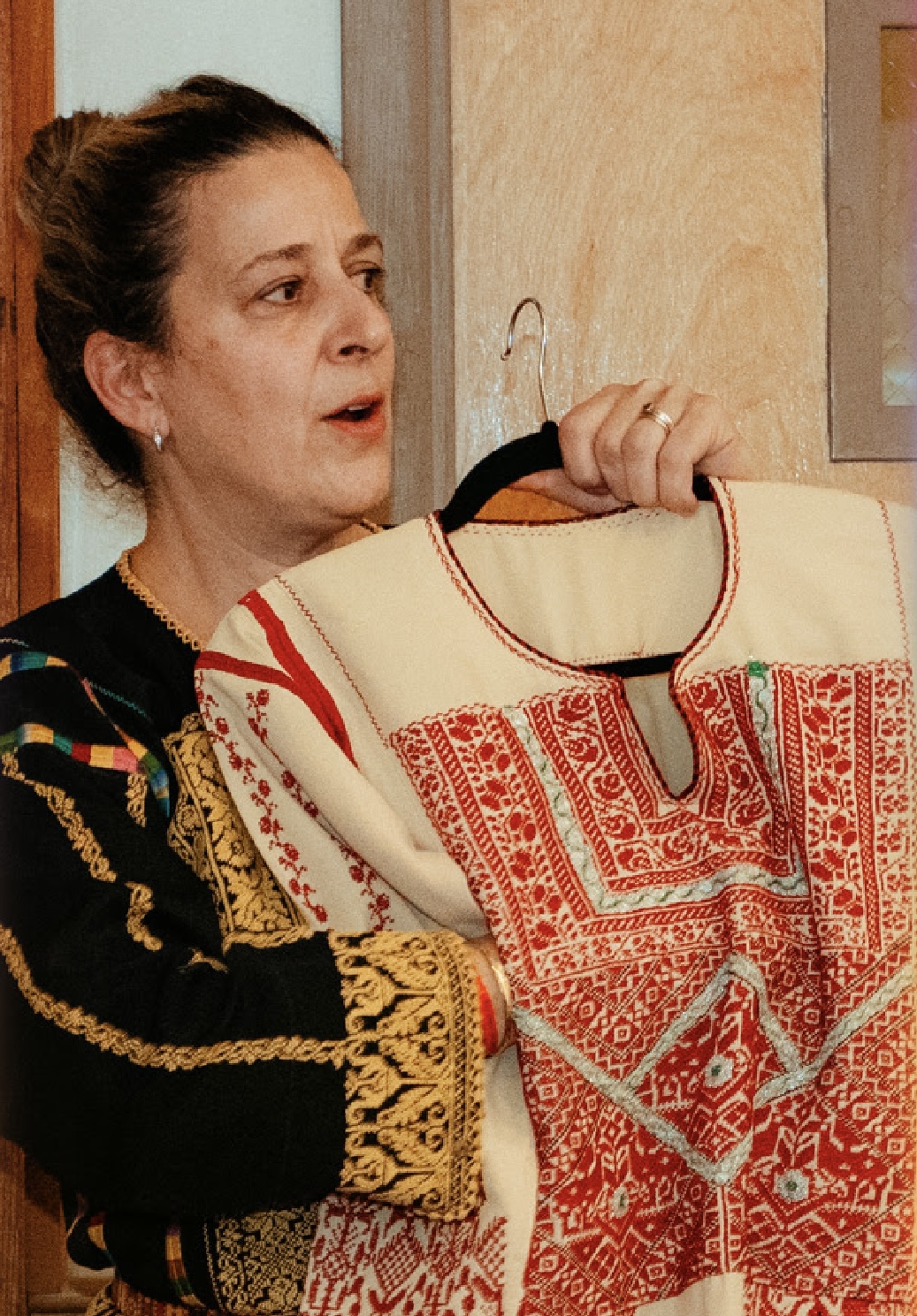
But I did this workshop, sewing workshop, up in, um, the Catskills with a great group of women. Um, and I did a workshop on Tataris, and I spoke about the dresses, and I wore my thobe, and We did a lesson on how to embroider and waste canvas and, you know, all the different things. And people were like, oh my God, I had no idea. And reclaiming the Bethlehem Star, right? And saying like, this is our star.
This whole thing is not someone else. This is ours. This is our Bethlehem Star, right? And they were like, wow. And people walked away Understanding more about the Tewiis and the T'olb and the identity, our identity, right?
And making us real. I feel like that is so important for people to understand, like, we're human, we have culture, we have heritage. Like, you can't just wipe us away, right? This This is who we are. And this is not just now.
This is my dress that I am wearing. And I had a dress on from 1986 that was— and I still fit into it. So I just want to put that out there for everyone. I had to let out the sides. I showed them like, you know how they put in the pieces where you can let the dress out a little bit.
So I was like, listen, guys, listen, this is how we make our dresses. You can let it out. If you get heavier and if you get shorter, you could take it up. And, and it was interesting because they did not realize that. And they're like, that dress is over 40 years old.
I'm like, yes, it's over 40 years old. And this is 40 years of my heritage that I got when I was 16. I got this dress. So let's just talk about this. Let's just talk.
And it was important for me for people to understand, right, that this is not just the now. It is embedded in our history. It is embedded in our culture. Women have been wearing these dresses for years, right? Hundreds of years.
And, and it's not going to be taken away from us. So for it was, it's really important for me and all the projects that I'm currently sewing that I add a piece of tapris to it. So that has been my big thing is adding it to clothing, adding it to bags, adding it to whatever I can to keep those motifs alive and that tradition alive.
This season's hottest look: genocide. From the brand that brought you fast fashion comes fast-track complicity. Zara just opened its largest-ever store in Israel, 45 square meters of settler chic, while Gaza buries its dead. Their Israeli franchisee hosted far-right minister Itamar Ben-Gvir, who calls for shooting civilians and expelling Palestinians. His review: "Beautiful clothes, beautiful Israelis." Our review: ugly politics.
And yes, the jacket ad, mannequins shrouded like Palestinian bodies next to rubble? Zara called it a "misunderstanding" and kept cashing apartheid checks. Boycott Zara and all Inditex brands: Bershka, Massimo Dutti, Pull&Bear, Stradivarius, Oysho, Zara Home. Because genocide is never in season. This anti-ad was produced by Tautrice Talk.
We stitch, we talk, we boycott.
Oh my goodness, uh, I had no idea you didn't know how to sew, uh, and this is so funny because you now teach fiber arts classes to high school students. Can we— yeah, can we talk about that? Yeah, so I didn't know how to sew, and I was determined to do my thobe and learn how to sew that draft panel dress. And I was like, I'm gonna do this. So I went out and bought a sewing machine, and I'm like, okay, this is a lot harder than I thought.
Um, I found a private, uh, lesson, um, a woman who did private lessons not far from me, and I took a sewing class, and I learned the basics. And then I started, I did the thobe, and I was like, okay, the first one I scratched, it didn't work out. I did the second one and it worked, and my daughter tried it on. So I had her measurements and they worked out fine. But it then became my, my passion, right?
It became something I enjoyed doing. So I, I crochet, I knit, I sew. An embroiderer. I just learned how to do Japanese embroidery, the sashiko. I did a class on the couching, and I got the Palestinian embroidery book from Sumbela.
So I think I'm saying that right. And so I've learned all those stitches and have been incorporating them into different things. And I decided this year, this is my 18th year as a principal.
And so I needed something with everything going on in the world, I needed to find joy, right? And I need to bring joy to people. And Tetris brings me joy. It brings me a sense of peace. That brings me closer to my identity.
And I decided against everybody's wishes at my job, all my assistant principals were like, you can't do this. I'm like, I have to. I started teaching a class. So I teach a class. We have done knitting, crocheting, embroidery, sewing.
We have just started a unit on quilting.
They're quilting a piece. And so it is really important to me for them to understand how we carry on our traditions. I can't— I'm in New York City. I can't run around saying, oh, here's Palestinian embroidery, because It isn't that easy to do, right? I have to, especially in the past 3 years, there's this tension there that I think I walked very carefully along the line of it so that, right, I don't lose my job, right?
I don't get in trouble for being Palestinian, and it's sad that I have to say that. We kind of keep our heads down and try not to cause problems because, right, we, you know, anything we say sometimes is taken out of context. But I had my thobe hanging in my office, and I talk about my thobe, and I talk about— I brought it in for my students to see, and I said, we're going to learn how to do cross stitch. And this is what we're going to do. But I make it so that they understand that, right?
This is my culture. This is my goal. This is my heritage. But cross stitch is something that lots of different people do. But this is how we incorporate cross stitch into our culture.
And I think it's been very good for me to kind of find ways to incorporate pieces of me into my class as a teacher and build relationships around fiber arts. With my students, and then right, bringing it to adults, right, doing these smaller workshops and talks in Westchester, and at my, you know, with my sewing group now, and right, spreading the word about what it is and how we do it has been very— it helps me. I think the word I've I'm trying to find the way to say it, but I find peace in it. I find joy and peace in this work that helps when I hear all the things that are happening now in Gaza and in Palestine. It helps heal my heart knowing that we've resisted and we continue to resist and that the triste is bringing us closer and closer.
Right across, across the world in the diaspora. Very, very beautifully said. I wholeheartedly agree with that. Like, I, I feel that, and I think a lot of people, um, who listen to this will definitely connect with that as well. I was going to ask you how you balance incorporating Tathreez into your classes, um, at school while, you know, I, you know, being in a public school and what that means and all of that.
But you answered a little bit of that. And I'm just curious, like, since you have been teaching workshops, both, you know, in high school with your high school students as well as these adult students, has that changed or evolved the way you personally engage with Tátriz?
Um, I think— I don't think it's changed it. I think it's made it more of my everyday. Um, in the past it's been whenever, you know, I had time, um, I would do it if I wasn't running around. Um, now it's not that. I'm on the train, the Metro-North into work.
I'm, I'm embroidering. I don't care who's watching. I'm doing my embroidery. If I have to finish a project to show students, You know, I'm knitting, I'm figuring out stuff, so I'm adding it into my daily commute, right? Yeah, it's part of my day.
I'm making sure that it's, it's something I do every day to find, to find— like, people do yoga, people do meditation. That's my time for myself. So I think it has changed my relationship in terms of It's my happy place where I find time for myself. Right. It's not, it's not like, oh, whenever I get a chance, it's like, this is what I do.
This is my 20 minutes of day. I am working on this piece. So I think it, yeah, I think it has changed. I love that. I love that so much.
And I've been meaning to ask, how about your daughter? Have you taught her? Does she practice? Yeah. No, I think at one point she may try to.
She likes to do jewelry and beading and— Oh, cool. Yeah. So I think at some point I'm going to be like, hey, let's add some beads to this dress. Yeah. Yes.
That's cool. Yeah. So she does that. So. Right.
But she's 19 in college, focused on school, which is where I need her to be. Mm-hmm. So I think she does very much look for things. She'll see things and she's like, oh my God, look at this, Mom. Put this on my dress.
I saw this on Instagram. Or, hey, Mom, can you find something that represents this to put on my dress? And I think at some point she'll turn to it. I think my thing was I should have done it when she was 5 or 6 or 7 younger. Right?
Because that's when I was taught. Um, but, you know, if she chooses to, she chooses to. I think, um, her beading is very much her thing. Um, so hopefully she'll incorporate it if, um, into her— into, you know, my embroidery at some point as she gets older and finishes up her coursework.
Yeah, no, that's beautiful. I love that. Okay, so speaking of, of your daughter's stulb as well. That is still a work in progress. We're going to be keeping tabs on it.
Yes. Yes. But, but what is next for your tatris journey? Is it her tulb or do you have other projects that you're working on as well? So I have a couple of projects I'm working on.
I, I've been doing these project bags with repurposed pieces of, like, I find, if I find a piece of my tatris from 20 years ago, and some of it has not made— has not fared well as some of the other pieces. So repurposing it into a project bag or a purse or, I don't know, I don't like doing pillows anymore because I want people to see it. I want it out in the world. So I'm trying to find ways of putting it out in the world. So those are the things I'm working on.
I have 4 or 5 pieces, chest panels that I'm working on that I started working on, ooh, maybe 10 years ago that I'm determined to finish. But the problem is they're on 18-count canvas. Oh, I love that. Oh my God. Yes, I know, I know, I know.
Yes. So I'm working on that slowly. Um, and then my daughter's piece, I pick it up when I find a new motif. I'm almost done with my chest panel, which I will be posting shortly. Um, I have designed, I have figured out what I'm putting on her sleeves.
So that is going to be the easiest. The chest panel for me was the hardest because it's the first thing people see. And I wanted to make sure that it told her story as well as my story to her as the first piece. So I have one more motif that's going up and then I'll be posting that. And I think once the arms are done, this— the— oh my God, the side panel should be relatively easy.
I would like to— I've been working on a pattern for a dress but a very modern dress. I'm trying to put the tris on like my dresses, so I did a— I don't want to call it a caftan, but it was my summer dress, a white linen dress that I made, and I put the tris on the sleeves, on the neck, on the neck, and on the bottom of the skirt. So it is adding— my next one is doing a, um, sort of a sleeveless dress for the summer out of linen, um, but very simple, right? One— I'm one person who likes one color, one or two colors on a dress, keeping it very simple, keeping my reds. I tend to go to the reds, the pinks, and the purples, keeping those colors straight through, um, on a linen dress is, is my hope, um, because I feel like I can stitch one color faster and, um, get that done.
But let's see, those are— that's— those are my projects. I have lots of little projects everywhere. I got a knitted hat, I had crocheting, you know, uh, granny squares with the Palestinian colors, um, doing a watermelon crochet thing for my daughter, um, so keeping yourself very busy. I am, I am. I, I, I find And my train time is very precious to me.
I hear that. When I lived in New York and took the subway, I got so much reading done. It was actually really great for my reading. Yeah. Um, so, you know, we could probably talk to you for hours and hours, but, um, we can't.
Um, so before we kind of wrap up, we always like to ask, what is a a major life lesson that you have gained from Tatris? Telling my story, telling, sharing my identity, not being shy about who I am, and not being shy even if a piece doesn't work out well. It was how I was feeling. If it's crooked, it's fine. It's my story, it's my piece, and it's what I'm sharing with people.
And it's my outlet of sharing myself with others and my story. So that's what I would like people— like, my storyline is it brings me joy and it's part of me.
The best lesson ever. I love it. That is so beautiful, Watfa. I love it so much. It's such a joy to hear more of story, even though I knew you a little bit before this.
But these, these conversations are always incredible. I learned so much about our guests and, um, it was so lovely to hear more of your story and your daughter's story and your journey, um, and all of the things. So thank you for taking the time and, and spending it with us. Uh, one last question before we kind of close out. Um, I know that you're starting to post a little bit more.
Where can people find you if they wanna keep up? Up, uh, see more of your work, get inspired by all the projects that you're up to, see those pictures that you're eventually going to develop. Those are going to go up now. Now I feel like I have to get them up. I will help you, you let me know, I got you.
Um, it's Stitched by Foof. Um, so it's, uh, stitch_byfoof, F-O-O-F. Um, and it's from watufa, that's what they used to call me as a kid, so Foof is my, um, nickname. I love it. So on Instagram, and I think Threads is the new one, but yeah, Instagram, it's Stitch by Foof. Cool.
Amazing. We'll make sure to link it so people can find you. I love it. Amazing. This was so much fun.
Thank you. Thank you. Thank you for taking the time.
That was such a great conversation. We could have definitely continued talking more and more and more, which sometimes is a problem for me. But it was, yeah, it was so interesting to hear about her experience. And oh, one thing I need to correct. So she said that she had a dress from 1986 and it was over 40— or yeah, 1986, and it was over 40 years old.
I am from 1986 and I am I was just doing the math.
So yeah, that's just a personal thing. I wanted to mention that. You look a little bit triggered. Very triggered. I was like, yo, chill.
But I'm a vintage thobe.
You're something else. That's what you are. You are something, that's for sure. You know what? They call me a lot of things.
Um, ah, too funny, too funny. Oh my goodness. Yeah, no, but the stories are incredible. I mean, just everything she shared was so— I just, the one thing I couldn't stop, I get, couldn't get out of my head, I didn't say it in the moment, but I've been thinking about it, it's like she'd had photos from Gaza. Yeah, like photos of And she just like, she went at a time where you just mosey on in, like, yeah, I mean, wild, like such a— especially for us, like, you know, obviously there is like a generational gap between us.
And so to be— anytime I hear about people's experiences in Palestine, I think I feel like we always hear about like '48 or before '48 or '67 and the war, but hearing about like life in like the '80s and '90s, um, and Palestine is also always interesting, um, and how quickly it's changed. Unfortunately, I just know, but like those— what she captured is no longer— like, that's, that's all I can think about. And I'm like, she literally captured something that we will never be able to witness. And like, it's, it's so— I don't know, it's just wild to me. I just, I, I I can't get it out of my head.
And I just, I'm just so grateful that she shared that experience with us so that we could have a little bit of kind of what's been taken from Palestinians. And, ugh, yeah. I mean, like she said, it's so important that we like stand rooted in our identity, that we stay connected to Palestine, that we, you know, continue. Like, this is how we like resist truly. It's when they say, I mean, like when we say that they are literally erasing a people, like this is, this is it.
This is the, like the proof, the evidence, whatever you want. Like, and not that we, that you need it, you know, but it just hits so much harder when like you can start to imagine someone that we're talking to over Zoom walking through Gaza at a time when she could and ugh. I'm gonna stop now. I just— yeah, no, I hear you. But, and also, like, the fact that she was taking pictures of all these different motifs at all these different events without really, like, thinking about it, and now she look— can look at those pictures and reference them.
Like, the fact that she referenced a butterfly motif from one of her aunt's thobes for her daughter's, like, that's, that's amazing. And that's exactly what the Threes has always been. Yeah. Um, and yeah, we gotta push her to make sure she develops those pictures, and she needs to put them online on a website so everyone can see them. And then you're gonna print them out and do some feltrees on them.
Dead. Well, I'll leave that to her because she's also a photographer, so, you know, I love it. She does stitch her own pics, I'm sure. Oh, so good. Oh my goodness.
Okay, dear listeners, It's time to wrap up. So can I say, you've been saying this recently, dear listeners, and it always gives Bridgerton, and I kind of love it. Dear readers, dear Thelphrisers, thank you for listening to another episode of Thelphris Talk. I wish I could do a voice. Um, uh, don't disrespect.
Don't, don't do that. I'll do that. I'll do that after the recording. I'll just like a sad, a ask you on WhatsApp. Oh Lord.
Yeah. Okay, cool. So we want to hear about your Talkris journey. So please, please, please share your stories with us at talkristalk@gmail.com and we just might have you on an upcoming episode. Don't forget to subscribe to the podcast on your favorite listening platform and be sure to leave us a 5-star review.
You can follow me @linasthobe and Amani @minamani and of course the pod @talkristalk. We will talk to you soon.
About this episode
WATFA IS A TATREEZ ARTIST, EDUCATOR/HIGH SCHOOL PRINCIPAL, FIBER ARTS TEACHER AND PHOTOGRAPHER (@stitched_by_foof). She shares her deep family connection to Palestine, tracing her father's journey from Dirar Al-Ba'ain near Ramallah to Brazil, where he met her mother, and eventually settling in the South Bronx. For her, growing up in a tight-knit Palestinian community that mirrored village life in Palestine created a cultural "little Deir Al-Ba'ain" in New York.
As a dedicated embroiderer, Watfa learned from her father's sister and preserved traditional motifs while also innovating. She shares fascinating stories about her photography work capturing tatreez in Gaza during the 1980s-90s, documenting patterns that may no longer exist today. She passes on these traditions, using butterfly motifs from her aunt's dresses for her daughter's projects, making her work a living bridge between generations and preserving cultural heritage that faces ongoing erasure.
Watfa shares her life lesson that "telling [her] story" through embroidery has been transformative, helping her embrace her dual identity and express herself authentically. Despite her busy life as an educator and mother, she finds precious moments to create, using train rides for crafting and keeping multiple projects underway. This episode is a reminder to share your stories, because tatreez serves as both personal expression and cultural resistance in the face of ongoing Palestinian displacement and erasure.
You’ll hear about:
>> 0:58: Watfa’s connection to Palestine
>> 6:32: Growing up Palestinian-Brazilian in the Bronx
>> 11:43: Learning tatreez and herself visiting Palestine
>> 19:36: Photographing tatreez at home and in Gaza
>> 22:30: Watfa’s art upon returning
>> 25:43: Embarking on a thobe
>> 36:07: Teaching fiber arts
>> 41:36: How engaging with tatreez has shifted
>> 44:50: Current projects
>> 48:36: Life lesson from tatreez
Rate, Review, & Follow on Your Favorite Podcast Platform
“I love Palestinian embroidery and Tatreez Talk.” <– If that sounds like you, please consider rating and reviewing our show! This helps us elevate the vibrant narratives of Palestinian embroiderers and support more tatreez-ers — just like you — in learning more about tatreez and connecting with each other. You can find us on Spotify, Apple Podcast, and others -- just scroll to the bottom, tap to rate with five stars, and select “Write a Review.” Then be sure to let us know what you loved most about the episode!
Also, if you haven’t done so already, follow the podcast. We’re adding a bunch of bonus episodes to the feed and, if you’re not following, there’s a good chance you’ll miss out. Follow now!
Boycott Resolute RGL. Click here for more information.
Boycott ZARA and all Inditex brands—Bershka, Massimo Dutti, Pull & Bear, Stradivarius, Oysho, ZARA Home. Click here for more information.
Follow us @tatreeztalk
Follow Amanne @minamanne & Lina @linasthobe
Links mentioned