Transcriptsyncs with video
Hi stitchers, welcome to Tatreez Talk, where we share conversations about Palestinian embroidery. I'm Lina, here with my co-host Amani, chatting with talented embroiderers and artists, sharing their stories, inspirations, and the cultural significance behind their work. On today's episode, we are chatting with Sara, a microbiology student and beginner Tatreez artist. Welcome to Tatreez Talk, Sara, and you're joining us all the way from Australia, so thank you. Thank you so much for having me.
Yay. I love the accent. This is awesome. By BTW, we have an accent to her, by the way. I know, I know, I know.
I know I have a very California accent. I love it. We'll both just exaggerate our accents to the maximum. Beautiful, beautiful, beautiful. Amazing.
Well, Sarah, thank you so much for joining us. Like Imani said, we're so excited to have this conversation. We always like to kick off our episodes by getting to know about you and your family's connection to Palestine? Absolutely. So my family is from the north of Palestine.
My mom's side is from Haifa, which is a coastal city. My dad's side is— well, actually, my mom's from a village near Haifa. Both of my parents, we always say the major cities because that's what people recognize, but my mom's from Sharab. My dad is from Sarsa, which is near Safed. And these villages were both ethnically cleansed in 1948.
So I know that in my dad's village, for example, in both February and October of that year, there were massacres in the village. So basically by the end of 1948, almost everybody had fled. So I only really get pieces of my family's history in Palestine, especially because my grandparents, they then fled north to Lebanon. So that's where my parents were born. They both grew up in Palestinian refugee camps in Lebanon and Eventually my mom's family moved to Beirut, so that's where during my youth I'd sort of visit.
I visited like every several years to meet my grandparents, to meet my cousins. And so that sort of chain of transmission, because then my parents grew up, they got married and they migrated to Australia where me and most of my siblings were born. It means that we kind of have this piecemeal family history across the world, which is very common for the Palestinian diaspora. And so connecting to Palestine physically hasn't been easy. The closest that I've been physically is when I went to Lebanon.
We went all the way up to the border, so I was able to see Palestine, but I couldn't go because the border is closed on that side. Or another time, there is a Shrine of Remembrance for the Anzacs in Melbourne, and there's one little plot of soil from Palestine where they had battles.. And so I have stood on that soil and said, ah, I have stood on Palestinian soil. And that is the closest I have been physically in both of these cases. But of course, insha'Allah, I would love to actually visit.
I'd love to see my parents' homes, my grandparents' homes, and to actually have that physical connection. So until I can have that, that's where I've sort of just tried to seek that spiritual connection. And that is partly through through that cultural practice. Yeah. Oh, I love that.
That's so beautiful. I also have not been to Palestine. The closest I have gotten is seeing it across the Dead Sea from Jordan. But to be able to— I know it's like a little piece standing on the soil, but that's— I don't know. That's so beautiful to me.
And you're right, it is very much the piecemeal history or the piecemeal story, really, of Palestinians in diaspora. Did you grow up because I, I know there's like a pretty, uh, big Lebanese community in Australia. Did you grow up with a Palestinian community, um, in diaspora out there? Yes, actually. My mom is very social, so she has a massive network.
She knows— I already love your mom, by the way. Yeah, she is a party person. Yeah. So we had this massive Palestinian family and all of their cousins and aunts and things that were in Melbourne, and we were just sort of integrated into their family. We were the only ones who weren't related but were showing up to their family barbecues and things.
So that was our like small little Palestinian bubble in Melbourne, and it's why they sort of chose to live in the areas that they chose to live in. It was to get closer and to have that little bubble of community. That's cute, Lena. We gotta go, uh, make a visit to Melbourne. I haven't been to Australia, so now we have a reason.
Yeah, I'll show you all the spots. I've always wanted to say that I'm gonna go down under.
I recommend it. And I have to put it on the record, Melbourne is better than Sydney. So I'll show you the good one. Okay, okay. But I've got sisters spread around, so I've got my Sydney sister, she'll be the ambassador for Sydney.
Okay, all right, all right, I'm ready, I'm ready for this trip. Um, all right, back on subject though. So how Obviously, I know you're a new tatreez-er, so definitely want to talk about how you started your tatreez journey. But before you started stitching yourself, like, what was your relationship to tatreez as a Palestinian woman? As a child, I feel like there was almost little to no relationship there because it wasn't something that my mom necessarily passed on or taught us about.
But as I grew up, I'm someone who always has loved art, so I've always engaged with different art forms. And I had my older sisters around me who sort of started to express some interest in tatris. Specifically, my older sister Henin was the first one. She really wanted to learn it. So for her birthday, I gifted her all of these tatris materials and kits and resources.
And then I had my sister-in-law after that who said she wanted to learn. So then I got her a gift for her birthday where it was all of the materials. And then eventually I'm like, okay, it's my turn. Why am I gifting it to other people without also trying it myself? This is perfect for me.
I love art, I love my country. This is the perfect fusion of the two things. So that's when I finally started to pick up the needle and thread. And this was especially, like many people, after the genocide in October 2023 began. It's like you needed multiple ways to connect to Palestine.
It felt like maybe just speaking about it didn't feel like enough, especially in the moments where you're angry and upset. You need to have a million different outlets and a million different ways to connect. So for me, as someone who has always been an artist since I was a kid, this was another outlet, and it was so important for me to carry on. And I have full intention of completely carrying it on through my life and passing that on to my daughter as well. That's The part that is so important to me is that intergenerational story.
Oh, I love that. That's so— yeah, and 100%, like, yeah, Al Jazeera was my life, like my lifeline, especially the first few months of the genocide. It continues to be, but those in particular. I'm curious, oh, how it felt, you know, as you started practicing, like how did, how did your connection to Palestine, connection to your Palestinian identity, did it shift or evolve, um, and even maybe when you were gifting it versus when you started practicing, like, I'm curious the role that tatris played in, in how it changed over time. Hmm.
So I guess one way was it played a role in my advocacy because I would always take my tatris out in public. And every time I'm stitching, people are very curious. People would always come up to me and ask me questions. So it was a way for me to open up conversations with strangers, which is something that I loved because having those conversations with your family, it's like preaching to the choir. They already know everything.
They already have that same burning passion. But speaking to strangers in Australia, it meant that I was able to like continue sharing my story with others as well. And then another important part of shaping myself and my identity as a Palestinian is the fact that you need to have this intergenerational narrative when you're forming your sense of self. And this is something that has been researched in a general context outside of the context of Palestine, about how stories that are passed on from grandparents to their grandchildren about their lives and their stories actually help your psychosocial development, and it helps shape your own identity and your own sense of generativity, which is that desire to create value and contribute to future generations. As Palestinians, that generativity is all the more important now, especially after we have just seen the total destruction of all of the infrastructure in Gaza.
You need to have that desire to invest and nourish in future generations of Palestinians if we're going to rebuild our country. So having that narrative where you're actually passing on a practice that your grandmother practiced, her grandmother practiced, and has been continually teaching their daughters and daughters through generations, that instills a narrative in you of who you are and how you connect to the grand scheme, especially when you are in the diaspora, completely cut off like a limb cut off from its body. You have lost a part of that connection. So now it's almost like learning Tetris independently was my way of reconnecting that narrative. Beautifully said, really beautifully said.
And kind of taking it further, you know, obviously you mentioned you started gifting people in your own family, um, but how has Tetris now shaped community for you?
So I have loved, even though I am so early in my, like, Tatris learning practice, to actually have workshops and to teach other people. And the way that it first came about for me was very spontaneously. I was just in a cafe by myself having breakfast, and then afterwards when I went to pay, the owner was like, oh, what were you doing there, by the way? And I explained to her that it was Palestinian tatreez, and she asked if I wanted to host a workshop there at the restaurant. So that's how that first workshop came to be, and it was so fun and so fulfilling, and I loved having people there that I could connect to and who could connect to each other, because something that I always am like instilling when I am doing any workshop is the fact that tatreez is a community practice.
So while you're doing it, you should be getting to know each other, talking to each other, learning each other's stories. So I loved that day. And then after that, I ended up doing another workshop. Someone reached out to me from a mosque in Melbourne, and so I went there and did a little circle for the ladies there. And again, like, having those little connections— there was also one participant who was at that second workshop who had also been at the first one.
So seeing familiar faces again was so rewarding. And then most recently, there was Palestine National Day, and it was raining and pouring. It was so cold. I thought, oh my gosh, no one's going to come because it was in the city outdoors. So I went and it was so beautiful to see the dedicated people there who not only are Palestinian themselves but also allies and are happy to come out in the cold, cold rain to celebrate Palestine.
And so the connections that you're making there are so strong because these are people who share that same level of passion and dedication. And in fact, the Following week was the Run for Palestine, which is a fundraiser run. And while I was running, I ran into a student of mine who was at Palestine National Day and saw a bunch of the people that were there. And it was so rewarding. And you know what?
Shout out to Badr because he motivated me to cross the finish line. Every time I would like stop and walk, he would push me to keep running. So it's so beautiful the way that like having this shared connection of this art practice forges these connections between people that are so, so strong because you share that same love for Palestine. And that's exactly what we need when it comes to that advocacy and trying to invest in a future for Palestine. Oh my gosh, so beautiful.
I love it. I love it. And it just goes to show how important it is to continue practicing in person with other people too. Like there's something so special about that because then you can run into each other like you're actually building community where you are. And you, you know, develop better connections.
And I'm curious to see where it ends up taking everyone. Like, they might meet someone at a circle and then a year later there's an opportunity to connect further. You know, it's, it's so beautiful to kind of see how that was reflected in such a short period of time for you as well. I'm, I'm curious to go back to kind of what you were talking about in terms of like the intergenerational knowledge and how that helps form someone's identity and gives them essentially purpose to keep going and show up ultimately for Palestine and beyond. And I'm curious about how Tal Tris has kind of shifted your relationship with your grandparents who, you know, I know you mentioned when you were sharing a bit about yourself before we started recording around, you know, like they've now since passed, Ali and Hamhom.
I'm curious about how Tal Tris has kind of helped with that because I know for a lot of Palestinians in diaspora, Maybe it's not even just through Taqreez. Like, I know some people are able to get the knowledge of Taqreez through their grandparents or through their parents. But really, it's the stories that our grandparents have told us that has kept the Palestinian, you know, dream or the Palestinian, like, history alive. Ultimately, that's how we've maintained such a strong Palestinian culture globally. I'm curious about kind of that impact of Taqreez with your own grandparents.
Introducing the drop that nobody asked for. Resolute RGL, the sneaker that takes centuries of Palestinian resistance and sells it back to you in leather. Co-founder Yossi Levin calls it empowerment. We call it exploitation. Same guy who once erased Palestinians from his projects in Haifa, now stitching tatreez into a shoe to build his quote unquote multimillion dollar brand.
They say it's bridging local and global. Translation: Palestinian women stitch, Europe profits, Israel wins. Limited edition, unlimited hypocrisy. Don't buy the hype, boycott Resolute RGL. This anti-ad was produced by Tautree's Talk.
We stitch, we talk, we boycott.
Hmm, 100%. So with my grandparents, Aliya and Khanhom, I never really got to grow up with having them around because they were in Lebanon, I was in Australia. And when I did visit as a child, my Arabic was very broken. So I feel like even then I wasn't able to connect with them in the way that I wish I could have. So when I visited most recently in 2022, I had my grandmother, my mother's mother, she was still alive at the time, and I remember feeling so determined to speak to and to get stories and to understand what her life was like.
And so I would ask her like, what was your life like in Palestine? You know, what do you remember? And unfortunately at that point she was 94, so she had dementia. She didn't really— she didn't even know who I was or who my mum was at that point. And I remember the first time I tried to ask her a question about her life, my cousin just immediately jumped in and said, she, she's not gonna tell you anything that's like really accurate or what you want to hear.
Like, she doesn't remember. And that was so upsetting to me at the time, but also it's, it's part of the Palestinian story in a way, because that is kind of the consequence of the Nakba, it has so many different consequences in terms of how it manifests into your life for people who remained in Palestine and for people whose families were exiled across the world. So for me, this is one manifestation of it, is that a lot of those stories aren't present. And when it comes to the stories that I then try to get from my parents, my parents, like many Arab parents, are not very good at telling you stories in the sense that you will just randomly unlock the most crazy piece of lore just having coffee one day. And it's like, how did you never mention this ever?
That is what my parents are like. You have to ask the very, very niche specific question if you want to find out the story that you're looking for. So even, even recently, it's kind of funny, I just found out through a letter that my uncle had written 10 years ago. This whole story about how my other uncle, he wanted to work as an accountant, so he got a job as an accountant in Libya after high school. And so he was planning to go there for 3 months and then come back for his university entrance exams.
Turns out he was actually scammed, and when he went to Libya, they took his ID, they took his documents, and they made him work as a concrete worker in the desert for a whole year. So he was just stuck there. And my parents— my grandparents, they only found out through a letter that came in the mail later. And it's funny because when my uncle was writing about this, he said only Mr. Hadi, the postman, was happy with this letter because he received a tip from my dad. So it was just this devastating piece of news.
And luckily, eventually he was able to come back to take his university entrance exams. But I remember after learning this story, I went to my mom and I'm like, how did you never— like, did you know? Did you know that this whole thing happened? How come you never mentioned it? She's like, yeah, yeah, he was stuck in the desert for a year.
Yeah. And I'm like, they're so nonchalant, right? I'm like, yeah, okay, sure, that's a normal thing that happens. Okay, so when we bring that back to the idea of the trees, it's like this— it's a physical connection that is in your hand when maybe the specific stories are gone. And there's actually this, this concept of inhabitation.
So are you familiar with Samah Sabawi, the author? She wrote Cactus Pear for My Beloved: Tales of a City by the Sea. She's a Palestinian Australian author. I would recommend But I was recently reading her PhD thesis, which was about Inheriting Exile: Transgenerational Trauma in Palestinian Australian Identity. And in it, she kind of connects these different ideas.
She talks about Exile by Edward Said, and she talks about the idea of post-memory by Marianne Hirsch. And post-memory is about the transmission of trauma from you know, second and third generation Holocaust survivors. So even though those third generations never experienced the Holocaust firsthand, they were able to, I guess, inherit those memories from their grandparents. So in her work, when she's talking about inhabitation, she's kind of connecting those ideas, and it's talking about how Palestinians internalize both place of Palestine and displacement when they're in exile, when they're denied the right to return, and how inside you have this like imaginary inhabitation of both like the desire to return but then also the denial to return to your homeland. So having your own kind of memory culture in physical objects, through images, through stories, or through embroidery is a piece of the past as well that you can hold in your hands.
So having these sorts of symbols in your home and on your body is part of that connection and part of, I guess, feeding that, that desire to return in this really complex, you know, situation that you're in where you don't have the right to. Mm-hmm. Yeah, I, I can definitely resonate with everything that you just said. I think it's something that unfortunately so many of us in diaspora And I'm sure people who are still at home experience all of what you're talking about with that generational trauma, unfortunately. You mentioned a little bit earlier about wanting to be able— this tatreez being the skill that you wanted to pass down to your daughter.
And I think that ties in with what we're talking about, passing down this Palestinian story through generations. What do you hope when you are able to kind of pass down the threes to the next generation? What do you hope that that generation, your daughter, takes away from learning the threes from you?
I hope that it creates a strong, strong connection to Palestine, as if she was almost born or just left yesterday. Because when you are born and raised in a completely foreign country, especially, you know, the nuance of being born in Australia or in a Western country that does historically support Israel. It is so important that you have this strong internal identity and this firm, you know, comfort and confidence in your Palestinianhood. So for her to be able to learn that from me is like my way of passing on a family story, even if, you know, some of those limbs have been severed and some of those stories have been cut from transmission. That would be her way of now picking up the needle and thread and then connecting it herself so that she is still as strong in her advocacy and her voice for Palestine, no matter where she is in the world, whether Australia or any other country.
I love that. Well, what are you working on? I'm actually curious. So you started in October 2023. What was that first project that you decided to do and what have you been working on since?
I think all of my first projects were gifts. So each of my sisters, they, they all got married in a very short span of time within each other. So it was a gift for this person's house and a gift for this person's house. And I think right now is probably the first piece that I'm working on that is not for anybody else. It's a piece for an art exhibit by Made in Palestine, where it's going to be based in Naarm, Melbourne, Wollongong, Perth, and then also in the West Bank as well, where they're collecting all of these different Tottrees pieces.
So my piece is— I think I'm going to name it like Family Tree because I have two ghazlan, gazelles or deers, and both of my grandmothers were actually named Ghazali. So in the center of the piece, I have these two Ghasslan that are looking at each other and this big massive tree. I've also stitched on these like coins that were from a Palestinian headdress. So it's talking about, I guess, that family connection in the trees through their names and through how that's kind of connecting the past, present, and future. I love, love, love, love that.
Actually, that brings me to— I was going to ask you, because as an artist, and clearly gave us a sneak peek already. Um, you've definitely taken your own approach to tathagata, which I personally love. Um, how has your— how has your background as an artist before you stepped into tathagata shaped your tathagata practice and continues to shape your tathagata practice? I definitely love mixing medias. So with this one, even the way that I've made the tree is.
So I had these pieces of like wool that I've kind of like stitched on and then also just kind of glued on in other ways where I'm like trying to combine the traditional cross-stitch embroidery with these other forms of like incorporating the thread into the work. And I really wanted to paint as well. I didn't have the fabric medium. I was like, this piece is traveling, it's not going to survive the commute. So I'd like to think of like creative ways to incorporate these other more, which is something that I can see you also do as well.
I love your works where you have the photographs and then you stitch onto them as well. Something like that where you get to combine all of your different, like, passions and interests and takuti, and you have your own sort of personal flair and connection with this traditional work. It's a way of connecting, like, the past and the present and forging your own sort of narrative within that as well, which I really enjoy.
This season's hottest look: genocide. From the brand that brought you fast fashion comes fast-track complicity. Zara just opened its largest-ever store in Israel, 45 square meters of settler chic, while Gaza buries its dead. Their Israeli franchisee hosted far-right minister Itamar Ben-Gvir, who calls for shooting civilians and expelling Palestinians. His review: "Beautiful clothes, beautiful Israelis." Our review: ugly politics.
And yes, the jacket ad, mannequins shrouded like Palestinian bodies next to rubble? Zara called it a "misunderstanding" and kept cashing apartheid checks. Boycott Zara and all Inditex brands: Bershka, Massimo Dutti, Pull&Bear, Stradivarius, Oysho, Zara Home. Because genocide is never in season. This anti-ad was produced by Tatreez Talk.
We stitch, we talk, we boycott.
Yeah, I am the same way. I do love that mixed medium. And I do, as I said, I love seeing especially Palestinians really push, push what Tatreez is and make it their own. So excited. I'm really excited to see this family tree piece that you have.
When is it going to be done? When are you— when is it going to be something that people can see and can people— like, will it be available, like, to see online, or how does that work? Do you know yet? I'm not sure if it's going to be available online. I know there'll definitely be in-person exhibits in each of the 3 cities.
Um, yeah, but it'll be in late January, will be the Melbourne exhibit, and then I'll go around. So I need to— I just finished it last night, so I need to frame it and send it off so that it can start its journey around the world. Yeah. Uh, okay, you're gonna have to share pictures with us of— if I can't they're in person, they can at least see it virtually.
Definitely. All right, so what is next on your Thothry's journey? Obviously, you talked about the project that you're, um, currently finishing up or just finished, um, but what do you see next for your Thothry's journey as we get into 2026?
I think I'm finally going to take the plunge and start working on a Thorpe. In my head, I thought I had, I had so many barriers of thinking I, I need to be an expert first, or I need to, you know, have all of the knowledge before I can actually embark on it. But now I think I can just go for it. And even if my first Thorpe is maybe a little bit chopped, it's part of the journey. I've already, I've started thinking about, I guess, what I want on the epi, and that particular motif I described of el ghuzn, the two gazelles, I think I'll definitely have that in the middle of the chest panel.
And yeah, now I, I do need to, I do need to do a bit more research. That part is fair because I'm not a big sewer, not since year 10 textiles class, but I think I just need to jump into it. I can't dilly-dally. Yes, yes, yes, yes, 100%. I'm so excited to see this come to life, and I love I love the, like, the base that you have there, the idea of the tour Eslane.
And oh, it's going to look so good. It's going to look so good. Yeah. Honestly, the hardest part is going to be picking the colors and like committing to fabric. After that, it'll just fly.
It'll just happen. I love that. I have a document where I've been trying to like plan, I guess, what kind of color scheme I want to go for. The colors is the one area where I have, I have a million different color palettes laid out. I just, I just can't commit.
I guess I'll just have to commit to making many, many, many thulbs. Yes. Oh yeah, Leda just got so excited. Yes, yes, yes, that's exactly the answer. That's exactly the answer.
Yes. Yeah, if you're— yeah, and it's so funny, like everyone who's— everyone who I know who's working on their thulb, like once they do the first one, they're like, okay, I actually— I'm not done, I need to do a second and a third and a fourth. And I— someone had told me this this, they're like, um, yeah, I think I'm just forever going to be working on a thobe. And that's 100% accurate. That is the dream.
Exactly. Yeah. And there's always going to be opportunities. Yeah. You'll make one for yourself, and then you're going to want to make one for your daughter, and then you're going to want to make one for Mama.
And then it's just gonna, you know, you won't have it. I feel like that is the perfect gift, like that, to receive a handmade thobe from someone. That is the ultimate sign of love. That's okay. That's a big sign of love.
That's a lot of work.
Maybe your daughter, Amani, one day. Yes. The face is— I mean, honestly, I commend people like you, Sarah, who like give gifts, especially as your first few projects, as you mentioned. Like, that's, that's very generous of you. Um, it's funny because because people outside of the cities, they just won't ever really understand how much labor it is.
Yep. I remember the very first piece that I completed, I sent a picture to my family chat and my sister was like, oh my God, Sarah, that is so amazing. I would pay $20 for that. And like, that's 20 Australian dollars, mind you. That's like 10 bucks over in America.
And I was like, oh, the frame is worth more than that. That's insane. But thank you.
Oh my goodness, that's it. Wow, that's— yeah, you need to have them watch you do it. So you, you can only work on the thing that you gift them when they're watching you do it. That way they'll really value the time. True.
But then I think on the second gift, I went a little bit too hard because then, well, my sister Nour, I'm telling her like, okay, you know, you know, this takes a lot of time, by the way. You know, this is, this is a lot of effort, okay? And she was like, do you want me to pay you? Like, is that what you're trying to say? I'm like, okay, I need to find a balance now.
I need Reel it in a little bit. There's also like, it's so difficult. I don't know how anyone prices their pieces when they sell them. I like, I'll never, I'll never know how you do that, you know, because it's really, it's too attached. Yeah, yeah.
Oh my goodness. Well, okay, we always, always, always like to ask our guests about one major life lesson that they've gained from Tatris. Do you have one or two or a few or 10 or 10? Yeah, constant. It's a life, life practice.
Yeah, totally, totally. I feel like for me, the big lesson that I have learned and I'm still learning is about making and accepting mistakes. I remember the very first piece that I did where I had one stitch out of place and I was Googling how to fix one stitch out of place in cross stitch because I thought, okay, maybe this is where I can cut it out and then I can just tie the thread. But no, no, you just have to accept it if you want to. Go back all the way to redo it, you can, but at a certain point you have to just accept it.
And now I have come to accept it when it comes to making the art itself. And like when I'm teaching someone and they're like, oh my God, I stuffed up following the pattern, what do I do? I'm like, well, it's yours, it's your art. So you choose how you want it to look. You can just like change the pattern.
You can do it however you like to do it. Or if you really want to, you could unstitch it but it is a practice that you need to incorporate into life as well, of being able to accept that you'll make mistakes and it's part of the bigger picture. It's part of the story. It's not something that you do need to panic about and try to like erase and chop out and sew back together. It is just a normal part of life and art.
So that's something that I still have to kind of learn and grapple with because it's ongoing. Yeah, that's a lesson I still have not learned, um, but great lesson for other people to learn. I love that for you. Like, in my head I know it, but then in practice, any tiny mistake, I'm like, oh my God, it's over, this is the end, this is the end. The way some of the techrisers have seen me crash out.
Totally valid. Totally shit. No, but thank you so much for sharing your story and your thoughts with us, Sana. This has been an absolute pleasure. I know also one thing we didn't talk about, but I know we had talked about before we started recording, you have a desire for 2026 to start some Tatreez circles locally.
Is that right? Mm-hmm. 100%. Because after doing those workshops and seeing the familiar faces because it's so beautiful, like we were talking about, it's so rewarding. So if you are in Melbourne and you love tatris or you have an interest to get engaged, let me know.
So my social media handle is @stitching.intifada. Let's do a tatris circle. Let's start to meet regularly and build that community in Melbourne. Cause that's something that I was really looking for when I started out and we need to have it both for the people who already practice and for people who are interested. To start getting involved.
Yes, I love that. And we will make sure, um, we link your contact so anyone who's local who wants to connect up and stitch together, hopefully they can connect with you through Tatery's Talk. Beautiful. I'm excited to meet everyone, and I'm excited to maybe one day meet you guys in person as well. Let me know when you're down under.
Down under. I'll let you know. But yes, inshallah, we will come to Australia soon. We'll let you know for sure. Beautiful.
Thank you. Thank you so much. This is so fun.
Oh, that was so much fun. And I have to say, I'm really bummed because we had a really great follow-up conversation after stopping the recording. But maybe we'll just have to bring Sarah back on for a follow-up conversation. This was such such a lovely conversation. It was like fun, just like having a great chat.
Um, yeah, I, I completely agree with you. I am also— she was so sweet. It was really great to hear her perspective on things. Honestly, even as like a quote-unquote newer Tatreezer, like, it— she just clearly has a very deep connection to Tatreez already so quickly, um, which is really, really nice to hear. And, uh, yeah, Let's go to Australia.
Yes, yes, 100%. Boom. Put it on the list. Put it on the list.
Well, hopefully we can have her back soon because what you guys didn't hear after the recording, we talked a little bit about Indigenous art in Australia and some of the Indigenous weaving practices. So yeah, I just, I think we can have, as I said when we were talking, like we could probably have multiple episodes just talking to people from all over the world and talking about the indigenous practices, specifically the fiber art practices that are done in their culture. Because I just, there's so much of it and there's so much connection between it. And like I said when we were not recording, it's kind of crazy to me to always see this connection when I'm like, There was no internet. Like, these, like, people were not sharing this stuff.
Like, how are they sharing this stuff? And you just, you see this connection through the art, which I think just reinforces the connection that Indigenous people all over the world have to the land, um, because the art really does come from the land. Um, but yeah, I can go on forever on that. That's a whole other— again, that's a whole other episode. Yeah, or a season, like, or series.
Or whatever. No, so actually, really, for our listeners, please let us know if that's something that you're interested in, if you have a reference or someone that you recommend. Um, I think what's— for me, like, what's really interesting, especially with what she had shared as well— unfortunately we did not hit record— was that— people, I'm sorry. Um, but yeah, but like, there's so many connections with, like, being in solidarity with Palestinians, and I think there's something really powerful and, um, and necessary, honestly, for liberation It's so necessary to find these connections and be in line for liberation for everybody, not just Palestine, but like for everybody. And I think, I think there's such a beautiful, big role that Tel Aviv can play in making those connections.
So anyways, Imani and I will, we'll think about it even if nobody cares. But do, but do help us out if you're listening to this and this is piquing your interest and you're curious. And want to hear more, you know how to reach us. And Imani will, you know, close us off. So you have all the ways to reach us now.
Boom. And on that note, thank you for listening to The Three's Talk. Like Leda said, we want to hear about from you. We want to hear about your The Three's journey, your opinions, your— well, actually, I don't really want to hear your opinions, but your thoughts. You can share your stories with us at thethreestalk@gmail.com, and we might have you on an upcoming episode.
Do not forget to subscribe to the podcast on your favorite listening platform and be sure to leave a 5-star review. You could follow me @minamani and Lina @linastove and follow the pod @thethreestalk.
About this episode
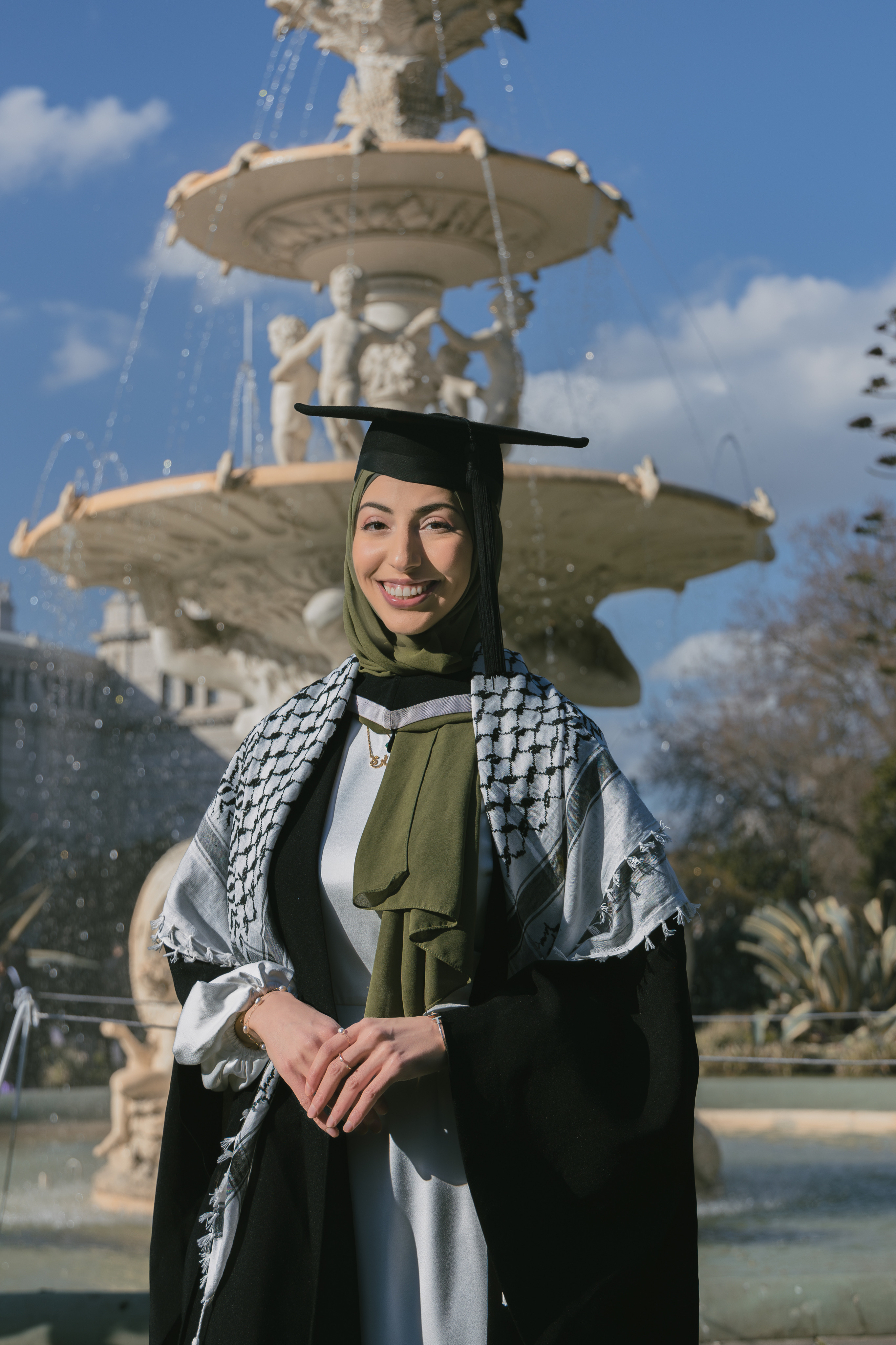
SARAH IS A MICROBIOLOGY STUDENT AND BEGINNER TATREEZ ARTIST FROM AUSTRALIA (@stitching.intifada). Originally from villages near Haifa and Safad that were ethnically cleansed in 1948, Sarah's parents grew up in Lebanese refugee camps before migrating to Australia where she and most siblings were born. Despite never having physically visited Palestine, Sarah has found the "perfect fusion" of her love for art and country through Tatreez.
Sarah's Tatreez journey began when she gifted materials to family members who wanted to learn, and after October 2023, she felt compelled to pick up the needle herself as another way to connect with Palestine amid the genocide. She quickly discovered how her public stitching sparked conversations with strangers about Palestinian culture, turning her art into a form of advocacy. Despite being a beginner, she has already hosted workshops and is hosting regular Tatreez Circles in Melbourne in 2026 (if you're Melbourne-based, reach out!).
Sarah shares how Tatreez has taught her to embrace imperfection, learning that mistakes in stitching—and in life—are part of the bigger narrative rather than something to be erased. As she works on her first tatreez dress (thobe), she envisions a lifelong commitment to the art, eventually passing it to her daughter while continuing to build community and use her needle as both a connection to heritage and a tool for cultural preservation and advocacy.
You’ll hear about:
>> 1:02: Sarah’s connection to Palestine
>> 4:08: Palestinian community in Australia
>> 5:25: Relationship to tatreez before and after beginning
>> 10:26: Finding community through tatreez
>> 13:36: Unlocking intergenerational connections
>> 22:01: What Sarah hopes the next generation gets through tatreez
>> 23:30: Sarah’s tatreez projects
>> 28:33: What’s next
>> 32:42: Sarah’s life lesson from tatreez
Rate, Review, & Follow on Your Favorite Podcast Platform
“I love Palestinian embroidery and Tatreez Talk.” <– If that sounds like you, please consider rating and reviewing our show! This helps us elevate the vibrant narratives of Palestinian embroiderers and support more tatreez-ers — just like you — in learning more about tatreez and connecting with each other. You can find us on Spotify, Apple Podcast, and others -- just scroll to the bottom, tap to rate with five stars, and select “Write a Review.” Then be sure to let us know what you loved most about the episode!
Also, if you haven’t done so already, follow the podcast. We’re adding a bunch of bonus episodes to the feed and, if you’re not following, there’s a good chance you’ll miss out. Follow now!
Boycott Resolute RGL. Click here for more information.
Boycott ZARA and all Inditex brands—Bershka, Massimo Dutti, Pull & Bear, Stradivarius, Oysho, ZARA Home. Click here for more information.
Follow us @tatreeztalk
Follow Amanne @minamanne & Lina @linasthobe
Links mentioned