Transcriptsyncs with video
Hi stitchers, welcome to Tatreez Talk where we share conversations about Palestinian embroidery. I'm Amani here with my co-host Lina chatting with talented embroiderers and artists sharing their stories, inspirations, and the cultural significance behind their work. On today's episode, we are chatting with Giovanna, a Tatreez artist, poet, and student activist. Welcome to Tatreez Talk, Giovanna. We're so happy to have you.
Hi. Yay. We are so excited to chat with you and learn a lot more about you. So let's start off by having you share with our listeners a little bit about you and your family's connection to Palestine. Yeah, sure.
So my grandmother is from Jerusalem, and after 1948, she and her family were forced to flee to Lebanon, and they stayed there for some time. And then they went back to Jerusalem, and then eventually my grandmother went to Jordan, and that is where my dad is from. And on my grandfather's side, he was from Jaffa, and then his family in 1948 went to Ramallah and then Jordan, and my dad grew up in Jordan, and I was born and raised here in the United States. Have you had a chance to, um, go back to either Palestine or go to Jordan to visit family there and kind of where your, your father grew up? I haven't been to Palestine, but I have been to Jordan.
I went with my family and my little sisters. It was really fun, and I got to meet my dad's best friends and their families. And yeah, it was amazing. I love that. Yeah, it's so, it's so special to kind of also learn more about how how your father was raised, be in kind of a place where he may have— have, like, I have— I've had that with my father.
He was raised most of his life in Kuwait, like his childhood, and it's really special to kind of be in the restaurants that he used to go to as a kid or his school. You get a little— you get to learn a little bit about your, your family through those experiences. Um, well, Giovanna, we obviously here talk about tatreez. Uh, would love to hear about your journey. How did you get started with tatreez?
How— what does your practice look like? So for those of you who don't know, I actually learned from Hala and Sabrine. They did a workshop together back in December 2023, I think, and that's how I started. And my first project was a little Palestinian flag. It was terrible, but I got better over time.
And yeah, I got obsessed like right after that. Yeah, no, we, we could definitely relate to that. And I love that the little connection with our other tatris sisters, our other Seattle tatris girlies. So I'm curious, when you were growing up, what role did tatris play in your life? Like, was it something that was a part of your household or something that you wore or were interested in before you actually started picking up the needle and thread?
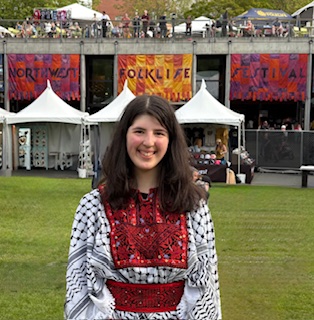
Honestly, when I was younger, I didn't really know that much about tatris. But I did have a little fob that I would wear at, like, my elementary school culture night and things like that. And it had tatris on the chest panel. But that was, like, the only tatris thing I ever really saw as a kid. Yeah.
Do you know who made it or where you got it from? I think my grandmother got it in Jordan, but I don't know who made it. Yeah. Okay, so you didn't grow up with people practicing tatris either? Around you.
Yeah, yeah, yeah. I hear you. I hear you. There's, um, something really special also about kind of coming to Tahrir without having seen it. I think there is something really special about that, even though it feels maybe a bit isolating or, um, I don't know, like you should have known this forever.
But actually it's really beautiful to see how you can connect to it when you haven't been exposed in the same way as other people. Um, do you remember how you felt when you made that first Palestinian flag? Yeah, I had so much fun with it even though I wasn't doing that great. Like, I was jumping between all the spaces because I didn't know you're supposed to go like only one space at a time, and I was just like jumping across. But even though it didn't really look that great, I still had a lot of fun with it.
Yeah, no, we hear you. Yeah, very, very common things that happen with Dotris when you first start out. I always, I always show my very first piece that I ever did in my classes because it was such a hot mess. But from the front, doesn't look that hot of a mess. And then I also like to show like, this is a more recent piece and just the progress of— excuse me, I have a bad cough.
If you try and you practice it with patience, your Tiffany's definitely improves. I'm curious too, like, as you started practicing the— obviously you went to this first class and like got hooked. How did— how has your Tatreez practice evolved and how has it evolved within community? Because I know in Seattle you guys have a really beautiful growing community of Palestinians as well as Tatreezers. Yeah, I think over time, like, I started getting better at the 3s because, like, that first project was a mess.
But I've been going to, like, all the workshops that Hala and Sabrine have been having. And I just wanted to say, like, they are really, really amazing people and I love them so much. They do a lot of really great things for the community. And they inspire me and a lot of people as well. So yeah, I really admire everything that Hala and Sabrine are doing.
And yeah, every time they have a workshop, I get like really excited and I bring whatever project that I'm working on. And right now I'm actually working on this project here. It's for my mom. It has a peacock in the middle. And then I'm going to do like the tile patterns around.
And yeah, I've been like trying to work on all these different, like learning the different motifs and things like that. And I'm also working, so I can't, I don't, I can't say who it's for because the person who it's for is probably listening to this, but I'm working on a gift that's a surprise. And, uh, if you want to see it, I have it right here. It's like the bird motif. Oh, that's really beautiful.
Wow. Okay, we're gonna have to show a picture of that. Oh, I love that. Really, really beautiful. Yeah, thank you.
And very, very intricate. There's— it's, it's quite filled with tatouages. Yeah, I like to make it really dense. Same, sis, same.
That is awesome. That's a special person that's getting that. That's awesome. Yeah. Wow, it looks like your, like, your personal practice has really grown.
I mean, just from the, like, the few pieces you're showing us, from you telling us that your first flag was a hot mess to what you're showing us now, um, your practice has definitely, definitely grown. How do you feel like your practice has evolved since you first started stitching? Um, I think It, like, the actual technique, I feel like, has improved, but also I was able to get more involved with the Palestinian community in Seattle through Tatreez, which really, like, influenced me a lot. And I feel like Tatreez made me more connected to the community because whenever we have the workshops and the Tatreez circles, I get to meet all these new people, which is really amazing. Yeah, totally.
And I know that you are also a student, right? Where are you studying? Yeah. Where are you studying? What are you studying?
I'm doing international studies and I'm in my first year. So, yeah, it's been pretty fun. Yeah. Yeah. I graduated high school Recently, and then I had my first quarter, so like that was kind of tough and I didn't really do much tatris during that first quarter because it was just like really hard and a lot of studying, but I'm on break now, so I've been like doing more embroidery.
Yeah, well, I remember in your form you were talking about how tatris is also, it's been a way for you to share more about Palestine at school or in other places. Like, how has tatreez made it possible to talk about Palestine or to share also Palestinian culture with those around you? So when I was in high school, I would bring my tatreez with me to school and I would be working on it during lunch. And then all my friends would see it and they were like, wow, what is this? What are you doing?
And then I would explain to them, it's tatreez, it's like a Palestinian embroidery. And then after that, I actually had a tatreez workshop at my high school where I taught my friends how to do tatreez, and they really loved it. And then I was able to also host a tatreez workshop at the University of Washington, and that was really fun. And I think it allowed people to learn more about Palestine and the culture. Because Tatreez isn't really something that that many people know about.
It's like, like there's definitely a lot more people who know about it now, but still it's like something that you have to be aware of what's happening in Palestine to know about. But when people learn about Tatreez, then it also allows them to learn about what's happening in Palestine, which is really great. No, I for sure hear that because I also love that connection that you can build with people through tatreez. I always say that like art is this universal language and it's less intimidating for a lot of people than just like sitting and having a straight up conversation about what the hell's going on. So it's always a nice entryway for a lot of people into the conversation about Palestine and into the knowledge about Palestine too.
How have you, like, well, I should say, what conversations have you had, especially like, I'm curious, especially like, you know, with your friends that you were teaching in school, like what conversations have, has Tatreez brought up for you with your non-Palestinian friends about Palestine? So whenever like people would ask me like what I'm working on, I would tell them like about Tatreez and then they would like get really interested in it. So I would tell them about how the different patterns are from the different regions. And then like I had conversations where I would tell people about like how tatris is a form of resistance. And then from there they started like learning more about the occupation and When I had the Tatreez workshop at my high school, we had this conversation about like how Tatreez is a form of resistance.
And I had a presentation and I would present about like how Tatreez and the culture and keeping the culture alive is an act of resistance because when we practice our Tatreez or literally like anything else that relates to Palestinian culture, like whether it's cooking or dabke or poetry or anything like that, it all allows us to experience the imagery of Palestine and it grounds us in the land of Palestine in a way where we don't have to actually be there. So I feel like that's really interesting. Yeah, and I feel like there's some, maybe some parallels with poetry as well. Curious to hear more about, about your work with poetry and maybe the intersection of poetry and Tatris, if there is one. Yeah, sure.
So I started writing poetry kind of around the same time where I started learning how to do Tatris. And there was this book that I really love. It's what got me into poetry. It's called "Branded: The Poetry of a So-called Terrorist" by Rana Al-Khateeb. And after that, I started writing my own poetry.
And there was also a video of Hala Alyan performing her poetry that I saw around that time, and that really got me inspired to start writing poetry. And I actually met Hala recently, so that was really fun. And I feel like poetry is connected to tatreez because they're both forms of resistance and they're both forms of expression as well. Like we can express how we feel through our art and tatreez and poetry, and that expression allows us to resist against the colonial erasure of Palestinian identity. And when I first started doing poetry, I performed for my first time on stage in front of an audience of like 6 people.
And it was at this place where it was like a facility for youth to come together and make art and do performances. And they had musicians and things like that. And that was like my first poetry performance. And after that, After that, I decided I wanted to, like, continue performing. And then I was able to perform at fundraisers and all these different events.
And that allowed me to become more confident. And I also performed my poetry at a fundraiser for Hugh Palestine and the Folklife Festival. And I feel like they're connected, like poetry and tatris is connected because it allows people to come together for a common cause and build community and advocate together for liberation and justice. Beautifully, beautifully said. Have you, have you played with any projects that incorporate both your poetry and your tatris?
Introducing the drop that nobody asked for. Resolute RGL, the sneaker that takes centuries of Palestinian resistance and sells it back to you in leather. Co-founder Yossi Levin calls it empowerment. We call it exploitation. Same guy who once erased Palestinians from his projects in Haifa, now stitching tatrees into a shoe to build his quote unquote multimillion dollar brand.
They say it's bridging local and global. Translation: Palestinian women stitch, Europe profits, Israel wins. Limited edition, unlimited hypocrisy. Don't buy the hype, boycott Resolute RGL. This anti-ad was produced by Tautris Talk.
We stitch, we talk, we boycott. Um, not really, but I've been wanting to like stitch some of the lines of my poetry into my Tautris projects, but I haven't done it yet.
All right, that's on your list for 2026. Yeah. Because honestly, I think that would be really, really cool to be able to incorporate that. And it kind of makes it your own. You know, we talk a lot about tatris and specifically motifs and designs that Palestinian women have created in the past and continue to create.
And there's something about you incorporating your own poetry, you know, into your tatris work that really kind of pushes the narrative of like you telling your own story. So Lina and I expect to see something like that.
No pressure. No pressure. Yeah, no pressure. This is all just— Lots of pressure.
I'm also curious to hear a little bit. I don't know if there is commonality between your creative process when it comes to like the "fidiz" and poetry. But knowing that both of them are so rooted in your Palestinian identity, I'm curious how you approach your creative process for creating creating tatris and creating poetry? I feel like the ways that I approach the creative process for tatris and poetry are a little bit different. Like tatris, I just do it whenever, like whenever I'm feeling bored, I just go stitch something.
But with poetry, I feel like I have to be in the right mindset for writing. So sometimes I just like see something and it inspires me to write. But I don't always feel like the motivation to write like how I do with tatris. Like there's times where I just spend hours doing tatris when I don't have anything else to do. But I feel like I can't really do that with poetry in the same way because I need something to like inspire me to write instead of just like being able to write like how I do with "Tatris," if that makes sense.
But there are times where I feel like I just like really, really want to write a poem. Like the poem that I wrote that I perform at pretty much every event that I perform my poetry at is called "Diaspora." And the story of how I wrote it is kind of funny because I woke up at 2:00 AM and I just like had this feeling that I really, really, really wanted to like like write something and I just wrote it in one shot without even thinking that much. And then I just went back to sleep. Um, but I feel like for poetry, I need more of a spark to create something. Whereas with tatris, I can just like do it whenever.
Yeah. Well, so what do you, how do you, how do you decide what to tatris? Like where do you get the designs or do you design them yourself? Like how do you know what colors to choose? Maybe it's a little bit less intentional.
It just kind of happens. And I'm curious, like, how do you make those kinds of decisions with your tatteries projects? Yeah, so usually I don't plan out my tatteries that much in advance. I just like go onto Tilda Zane and I find whatever motifs I like and then I start doing them. And for the colors, I really like to use blues, like for the project that I showed you.
I have a lot of like turquoise and blue on it. And I also just like to experiment with the different ways that the colors come together. Like with the other project that I showed you guys, I was like kind of finding how the red and the pink like blend together, which was really fun. And yeah, I feel like I just I find the patterns online most of the time, and then I just like assemble them together and choose whatever colors I feel like using in the moment. I can definitely say that like you, you do, you have a really good eye, uh, just again from like the, the projects that you have shown us.
You have a really good eye, um, for design as well, for color. Um, so I'm actually very, very— that's only because you like pinks and that. No, even the blues, girl. Who would you— Lena, why are you such a hater, Lena? Let's Talk about that.
Anyways, ignore the hater. Um, I am very— like, the fact that you have such a strong point of view and what you've only been stitching, you said, since December 2023, you said, is that correct? Like, yeah, I am very excited to see what you continue to create. And please, please, please do incorporate some poetry stuff because I think that's gonna be really, really cool, especially since you it seems like you tend to design with really dense designs, which, you know, I'm biased, but I love that. I think it would be really, really cool.
Okay, so what are your plans? Like, what are your Tetris plans for 2026? What do you— I know you snuck a little project that you're working on as a gift for somebody, but are there any other projects or ideas or things that you want to do with the Tetris journey that you're on for 2026? Yeah, I definitely want to do more workshops, and I want to probably have one at my university because there's a lot of people who are interested there. And yeah, I want to like continue building community, meeting more people, and going to like all the different Tathagata's workshops and events that they have here.
And I don't really know what projects I want to work on next other than just like something where I incorporate the lines from my poetry. Yes. Okay. But Giovanna, you also put in your form something about seashells. Oh yeah.
Yeah. I made a piece a while ago where, so I went on a vacation with my family and I collected seashells from the beach and After that, I decided like I could glue the seashells onto the tatris. And then I created like these flower motifs and then the seashells. And then I stitched like a beach design on top of that. And yeah, it was really fun.
Okay, we need, we need to definitely share a picture of that because I, that's what I love to see. It's like that, excuse me, that mixed media and people like pushing Tetris and making it their own. So we definitely need to see a picture of that and show that to everyone. Yeah. Amazing.
Well, all right. We always have to ask, what is a major life lesson that you have gained from Tetris? I feel like everyone says patience, so I'm going to say confidence. Yes.
So I used to get really nervous about like teaching workshops and talking in front of a bunch of people. But with practice, I started getting better at it. And I feel like I can say the same about poetry because I used to get super nervous on stage. But then I started getting more and more confident. And there was this one instance in particular where I was performing my poetry at the Folklife Festival, and my papers, like the papers that I was reading the poetry from, flew off the stand.
And I just like calmly grabbed them and put them back on. And after that, my mom was like, she was telling me she was so impressed by how chill I was when that happened. And yeah, I've been able to build confidence through Tatrīz. And then I also performed my poetry at the Palestine Will Live Forever Festival, and I was feeling a bit nervous, but I feel like I did pretty well. And it was really fun because I got to meet Macklemore and Dana Salah.
Oh, that's good. Yeah. And Nora Arakat and all these really incredible people. So yeah, that was a great experience. That's awesome.
Yeah, that looked like a really, really cool event. Um, I saw Hala and Sabrine were both a part of that too. We got it, Lena. We gotta, gotta go to Seattle and visit our Seattle crew. I know, I know.
Yeah, you guys should come. I know, it's so close to me. I've, I've never been to Seattle. It's so close. I keep telling Hala it's gonna happen, and well, it's gonna happen.
I think now as we're meeting more and more Seattle Top Readers, I think we have more and more of an excuse to go. When you guys come, I need to get your autographs. Stop it, stop it, girl. I'm such a nerd. Stop it.
You are too sweet. Uh, this has been great. It's been really great chatting with you and learning, uh, more about your Tha Tri's journey. And I think it seems like you have a very long Tha Tri's journey to come, so we're excited to see how that evolves. Uh, but can you let everyone know if they want to get in touch with you, if they want to see your beautiful work, how can they find you?
I'm on Instagram. It's @jovannawritespoetry, so it's pretty easy to remember. And yeah, that's like the only social media platform I have. That's awesome. Thank you so much, Jovanna.
It was such a pleasure talking with you. Yes, I will definitely be sharing. You're going to have to send us pictures of all that work that you showed off because we really need to share it with everyone and your poetry. I'm really curious to to see what your poetry entails. Thank you guys so much.
Thank you.
It's always great to talk to the youth, the next generation of the threesers. No, but it was great to chat with her and learn a little bit about her history with the threes. And honestly, like, I know, Lena, you're a hater, but now truly, like, the short amount of time she's been doing the threes these, the pieces that she showed. Really, really beautiful work. Really, um, I, I mean it, like, she really does have a nice eye for design and color.
So I'm excited to see those pieces finished. Yeah, yeah. And I really liked what she shared with, um, like, her lesson from Tetris and being confident, right? Yes. Because I, you know, when I reflect on, like, my journey, I feel like Tetris gave me so much confidence.
And it's, it's really true. I think with something that— where you're working with your hands, and it's— I think it's easier to maybe see progress compared to maybe other things that you're working on. Like, maybe you're not making— you're not going from like zero to a full, but you can see how your top 3 looks better on the— from the back, or you can see how you like make less mistakes because you learn how to count a little bit better. You keep track of like where you typically make mistakes, like those types of things you kind of pick up on with practice. Um, and so I really love that she called that out because it's very true.
I, I see it with— I see it in myself and my confidence in my Palestinian identity through Tawtriz. Yeah, even like with this podcast, you know, like she was talking about getting— not being as nervous now when she performs. I mean, I feel like, remember the first couple episodes that we recorded? We were— um, I was perfect. I don't know what you're talking about.
Okay, uh, girl, let's go replay them. Okay, rude, rude, rude. I was definitely nervous. I could— maybe no one else can hear it, but I can hear like a little quiver my voice sometimes. And now it's like, because we practice all the time, we have our rhythm.
And the people, like, it's, you know, the Tatreez is your, the best filter for finding the best people. So it's, it's, I really like that. I like that she shared that. It was, it was really, it was refreshing and also made me reflect a little bit more. Totally.
Yeah. No, I definitely love the confidence boost that Tatreez has given her and all of us. And I like how you just said it's like It's not just the confidence in your work, but it's like the confidence in your identity and in connection. Like so many of us, we talk about this all the time, but so many of us have literally only met because of Sattiris. And it's one of those things like, how intimidating is it to meet new people, right?
Especially as an adult. Like, I feel like it's easier when you're a kid because when you're a kid, you don't care. Like when you're an adult, you like start to care. And Sattiris is that thing that like has connected so many of us and like almost like brought down these walls of, uh, what, shame? Not shame.
Uh, wow, so dramatic. But brought down these walls of like, you know, insecurities that people might have, uh, when they first meet each other. So yes, I love the idea of Tatreez being an all-around confidence booster. So we'll take that lesson for all of us. Yes, love that, love that.
Well, thank you, dear listener, for listening to another episode of Tatreez Talk. We want to hear about your Talqarij journey. So please, please, please share your stories with us at talqarijtalk@gmail.com and we just might have you on an upcoming episode. Don't forget to subscribe to the podcast on your favorite listening platform and be sure to leave a 5-star review. You can follow me @LinaStolb, @Amani@MinAmani, and of course, please follow the pod @talqarijtalk.
We will talk to you soon.
About this episode
GIOVANNA (JO-VA-NA), A TATREEZ ARTIST, POET, AND STUDENT ACTIVIST (@giovanna_writes_poetry). She reflects on her grandparents’ displacement from Jerusalem and Yaffa in 1948 and her family’s movement through Lebanon, Jordan, and eventually the United States.
Giovanna’s journey into tatreez began relatively recently through a workshop in Seattle with Hala and Sabrene (both previous guests on Tatreez Talk!), marking a powerful moment of reconnection with her culture. Despite not growing up surrounded by tatreez practices, she recalls owning a traditional thobe as a child, which served as an early—though distant—touchpoint to the craft.
Throughout the conversation, Giovanna reflects on what it means to come to tatreez later in life, without prior exposure, and how that experience can feel both isolating and deeply meaningful. The discussion highlights themes of cultural rediscovery, intergenerational connection, and the role of art in identity and activism. Her story illustrates how tatreez can serve as a bridge between past and present, even for those who didn’t grow up immersed in the tradition.
You’ll hear about:
>> 00:41: Giovanna’s connection to Palestine
>> 2:18: How Giovanna began her tatreez journey
>> 5:18: Evolving tatreez practice and the Seattle tatreez community
>> 11:01: Conversations through tatreez
>> 12:53: Giovanna’s poetry
>> 16:25: Creative process through Palestinian identity
>> 19:27: Giovanna’s tatreez design approach
>> 21:36: Tatreez projects in 2026
>> 23:23: Major life lesson from tatreez
Rate, Review, & Follow on Your Favorite Podcast Platform
“I love Palestinian embroidery and Tatreez Talk.” <– If that sounds like you, please consider rating and reviewing our show! This helps us elevate the vibrant narratives of Palestinian embroiderers and support more tatreez-ers — just like you — in learning more about tatreez and connecting with each other. You can find us on Spotify, Apple Podcast, and others -- just scroll to the bottom, tap to rate with five stars, and select “Write a Review.” Then be sure to let us know what you loved most about the episode!
Also, if you haven’t done so already, follow the podcast. We’re adding a bunch of bonus episodes to the feed and, if you’re not following, there’s a good chance you’ll miss out. Follow now!
Boycott Resolute RGL. Click here for more information.
Follow us @tatreeztalk
Follow Amanne @minamanne & Lina @linasthobe