Transcriptsyncs with video
Hi stitchers, welcome to Tatreez Talk where we share conversations about Palestinian embroidery. I'm Amani here with my co-host Lina, chatting with talented embroiderers and artists sharing their stories, inspirations, and the cultural significance behind their work. Nice to meet you. Yes, on today's episode we are so excited to invite Haja Halime. Thank you so much for joining us.
Um, this is such a joy, such a pleasure, and, uh, really, really special because, um, Hajjah, you are the tata of two beautiful women that we met at the Tatreez retreat last year. I have 13 grandkids. Masha'Allah. We only got to meet two. I know, we still have to meet the rest of them, inshallah.
I can add you with them. I can add you. Oh, you're so sweet. I also happen to know of Hajjah Halima's, uh, nieces because I have known them since college here in the Bay Area. So it's a very small, and it's a very small world with Palestinians, which I love.
Yeah, so Hajjah, we are so excited to have you here and excited to talk to you about Tathreez and your Tathreez journey. But we wanna start by talking to you about your connection to Palestine, your family's background. We know you were born in Palestine, Palestine and spent a lot of your life in Palestine. So we'd love to hear about your story. I just came back from Palestine.
I stayed 2 months over there. Do you go back often? I love it. Alhamdulillah. I hope everything is going okay.
I grew up in Al-Jib, a small town, and we work in the the field, playing fakoush, playing bandura, playing everything. Yeah, we, we always good. Then I got married and came here. I have my kids here and alhamdulillah, everything good. And you're in the Chicago area, right?
A small town, they call it Rochelle. Okay. It's one hour to Chicago. Okay, okay, so not far, not far. No.
And you, but you still go to Palestine very regularly, you said, right? And where do you— almost every year I go. And how often, uh, or sorry, how long do you typically stay when you go, and what's your experience now when you go? I stay 2 months this time, and I love it. And but you know, the situation is, you know, nobody bothering us, you know, in our town nobody bother us.
So, you know, obviously growing up in Palestine, uh, tatreez was always a part, I'm sure, of your life. Um, can you tell us a little bit about that and tell us a little bit about, um, when you started to do tatreez? I start learning when I'm in school, when I was in school, like 6th grade, 5th grade, and I keep going, you know, I keep going. I make my dresses, I make my mom dresses, and I I love it. What was your, what was your first project?
Do you remember? I made like a, uh, sunit kahwa. I made it and I started doing it again, you know. Yeah, the teacher show us how to sew, you know, but I learned and I start doing my dresses, my mom dresses. We did the Alam Palestine.
Yeah, me and my sister, not me by myself. No, I couldn't do it by myself. Yeah, because it's too much work. I— yeah, exactly, too much work. So is it common for you to do, uh, Tatreef's projects with other people and not just do them by yourself?
It's only one, uh, Alam Palestine. Otherwise I do them by myself. Okay. And so hard to finish. Yeah.
And how long before when you started stitching? I know you mentioned that you started doing, um, tulips and started doing dresses. So how long before you went from learning, uh, stitching to actually starting to make your own dresses? I used to do, uh, like a small, you know, a small, uh, thing, you know. Then I started to learn it.
Yeah, from school. Yeah, I was in— maybe I was in 5th grade when I was doing it. You made your first dress in 5th grade? No, no, I started doing a small thing, you know. Okay.
After I finished school— I didn't finish school, but I made till 6th grade, and I start doing it. I stay home and I start doing it for me, for my mom, for anybody need help.
Yeah, that's beautiful. And how did you learn how to make dresses? Because that's different than tatris, right? Yeah, but somebody, you know, um, yeah, you can take them out and start doing it, you know. Yes.
Yeah, making the pieces of the fabric. You know, the märke? Yes, yes, yes, the waste canvas. Yes, yeah, yeah, yeah.
So yeah, I should say märke is the Arabic term for waste canvas, which a lot of people who listen who are stitching, they are familiar with the waste canvas. But yeah, it's, uh, I know, I know in the Arab world, in Palestine and Jordan, if you get your you can go to the seamstress, you go to the chayat, and you can get them to cut the pieces of your dress. So all you have to do is stitch, which for me, I love that. Right. You know, I learned how to cut the bases for the dresses too.
Yeah, my mom showed me and I started doing it. So you started doing everything yourself? Everything, yeah. And then did you use sewing machines or would you create, uh, use a menagel and hand stitch everything together? Menagel I'll do, but I can't, uh, use a sewing machine.
I have one, but I hadn't learned to do it. You're like me. I don't know how to use it. I have one. Yeah.
So what, do you remember the first thob that you made? Yeah. The small one, the electric small one. Uh-huh. To learn.
And I made it for my mom. Uh-huh. Then after that, I start making big one, you know? Yeah. After I learn, it's not hard, Yanni.
Yeah. Yeah. Yeah. What was, uh, what's your design process? How do you design them?
I used to copy from one to one. Yeah. Like an old dress. I used to copy it. And do you use the same colors as well, or do you change the colors?
No, I change color. I, uh, what I'm gonna say, um, some red, you know, the harir, you know, or some coloring like that one. It's only 3, 3 colors I made it. Yeah, yeah. So how do you choose the colors?
It's just, yeah, you just like them, or? Yeah, I like them. Yeah, very good. Yeah, some people are gifted, you know. You see it?
Only 3 colors. Beautiful. And I made the kebbe. We call it kebbe, just like the aruk. We call it aruk.
Same color, same thing, you know. See? Yeah, yeah, yeah. I love the colors that you chose. They're very vibrant and fun.
I like vibrant colors. Yeah. How long does it typically take for you to, um, to stitch your thongs? To take the, to finish the dress? Mm-hmm.
From start to finish. Long time, honey. Long time. When I was working in that, so I was working. Mm-hmm.
I was work 8 hour. When I come home at night, I start sewing. Yeah, the time, you know, but it takes time. Yeah. Yeah.
Yeah. Lina stitched her own Tovlat. Lina, how long did it take you when you stitched yours? Yeah, it took me 2 years. Only?
Yeah, 2 years. No less. Yeah, maybe it'll take me 2 years too because I have kids, I have a house, and I have, uh, work, you know, maybe take me 2 years. Yeah. Well, so you talked about how you did your dress after hours, like after working when you were first getting started in Palestine, what was— how did you stitch?
Like, was it at home? Did you— was it a certain time of day? Do you have friends who do tatris with you? How did— what was the environment?
Uh, not really. I used to sit with my mom and sewing, you know, a lot of old ladies, you come and sit with my mom on the veranda, you know. Yeah, I would sit with them and sewing with them, cutting, you know. Yeah. Yeah, alhamdulillah, we made it.
Alhamdulillah. Do you remember any of like the conversations? What were people talking about with your mom?
Uh, she was a nice lady. She's nice lady. She showed me how to cut the material to have the dress, you know. And my neighbor, they come and sit with us when we sit and sewing, you know. Before I got married.
After I got married, you know, it's a lot of work. Yeah, yeah. And I have kids, but still I was doing it same. I never stopped. I didn't stop.
I made for the girls, uh, for the graduation thing. Oh, that's so sweet. So special. Yeah, yeah. And I made the Alum Palestine and Wajahat.
That's So sweet. Yeah, for Iman and Amal. And so have you taught a lot of, uh, the younger generation in your family how to stitch, how to do tatris? Yeah, yeah, my granddaughter Amal, Iman, she is good in sewing. Yeah, yeah, she, yeah, she is.
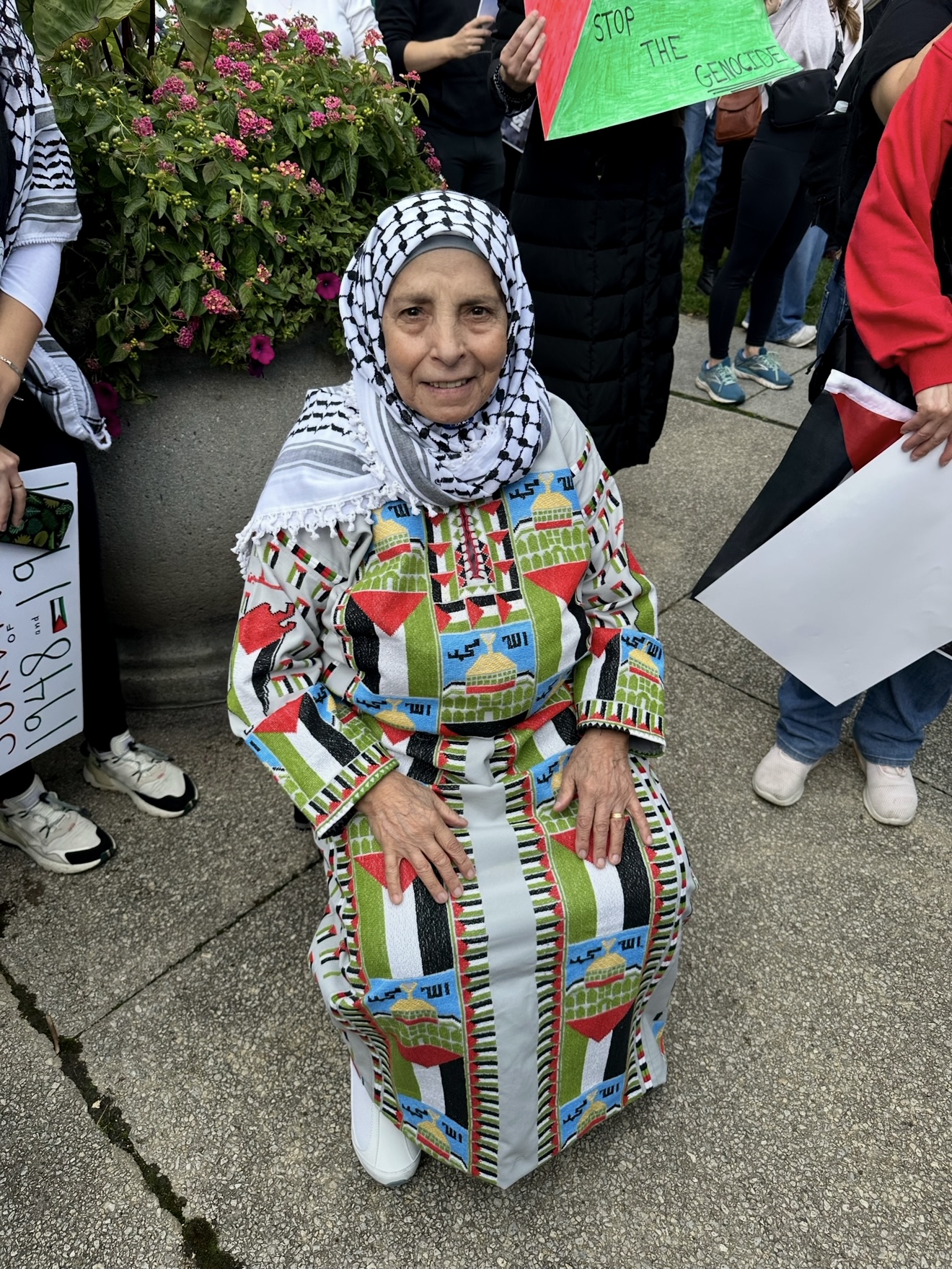
We, we got to see it in person, um, in Morocco. Yeah, yeah. And so can we talk a little bit about your intifada dress? Because you have an intifada top that you stitched, um, and we saw pictures of it from, uh, Iman and Amal, and it's— yeah, so beautiful. Um, so is this one that you, uh, copied the design, or did you kind of do the design yourself?
No, no, we copy it. Okay, tell us a little bit more about, uh, when you created it. My sister start copying it. She have one and send it to me after she did some of them, and I did the rest of it. This— it was the same thobe?
Yeah, same thobe. Oh, okay. So, uh, sorry, so both of you guys were stitching the same thobe, um, and where did you guys find— was it designs, or just like from someone that you saw wearing a dress? No, she bought one from Ramallah. Oh, okay.
And we start covering it. Oh, okay. Yeah, okay. Do you remember how long it took you to stitch that one? 3 years.
Wow. It's need a lot of stitching, right? Yeah, it's, it is. It's very dense in the design. It's really beautiful.
Yeah. And we have to put to manage it too, the same color, you know, the same color. But then Alhamdulillah, we made it.
No, I'm like you, Hajja. I will never sell anything. Never, never. I have a lot of dresses. We made them.
I made them. Yeah, for the granddaughter, any dress they want, they wearing it for wedding, for henna. Yeah, and they have so many. You made so many to choose from. So I do have a lot.
I do have a lot. Yeah. Do you have a favorite thobe that you've made? The Alum Palestine, the favorite. Okay, the Intifada.
Yeah, the Intifada one. Yeah. And did you— and you wore it to a protest, right? Yeah, I did. Yeah.
Everybody take a picture of me. Yeah, I'm famous.
We saw those pictures. So your famous friends too were like, oh, Hashem. Yeah, a lot of girls from Yemen, from anybody did come and take a picture with me. Oh, that's so sweet. Did they ask you questions?
Yeah, they said, how long it take? You know, how long it take? I told them 3 years. Yeah, 3 years too much, you know, but I didn't do it all the time. Yeah, I just, you know, when I have time.
So, um, Hajia, what are you working on now? What's your current project? No, nothing, nothing. A break, a break time.
I'm thinking about it to do something. I think I made that one. And I made one for Iman. Oh, that's beautiful. It's beautiful.
It's a tapestry. I love it. Yeah, I made one for Iman. I like those colors. I have to wear my glasses, of course, you know.
Yeah, me too. Yeah, to do it. Yeah.
Introducing the drop that nobody asked for. Resolute RGL, the sneaker that takes centuries of Palestinian resistance and sells it back to you in leather.
Cofounder Yossi Levin calls it empowerment. We call it exploitation. Same guy who once erased Palestinians from his projects in Haifa, now stitching tatrees into a shoe to build his quote-unquote multimillion-dollar brand. They say it's bridging local and global. Translation: Palestinian women stitch, Europe profits, Israel wins.
Limited edition, unlimited hypocrisy. Don't buy the hype. Boycott Resolute RGL. This anti-ad was produced by Tautree's Talk. We stitch, we talk, we boycott.
Do you— how many thobes have you made overall? How many? 14, I think. 14. Wow.
Oh, mashallah, look at this. That's such a beautiful, like, pillow Oh my God, wow, that's beautiful. I love the colors. And I have this one for my mom. That's gorgeous.
Wow. Yeah, I made it. So 14 dresses plus pillowcases plus wall tape for Stryz. Mashallah. I have 3 and 4, 7 grand good Dora and one Dora I have.
Yeah, Iman is my— Iman is mom. One daughter I have, and I have two boys. Yeah. So yeah, a lot of thobes for them to choose from. Oh yeah.
That's awesome. So yeah, it's beautiful. Like, my family, they didn't have— like, when they left, they didn't have anything to take, you know? And so I love when I see people who have things from their grandmothers, especially when it's handmade. That's so beautiful.
It's so special.
It's very, very special. Yeah, I have red. I mean, I have white dresses with red, uh, harij. Iman wearing it sometimes. Yeah, for henna, for, you know, yeah, yeah.
But I'm not doing it for Abu because I have too many. Yeah, I have too many. That's amazing. That's so great. Thank you, honey.
Thank you. Yeah, I love it. I love your bateha. Oh, thank you. I know, my sweater, it's my at-home comfortable sweater.
Yeah, a little map of Palestine. Do you— I'm, you know, you— I know you said you copied a lot of the, um, designs, what you guys saw. Uh, how do you feel? Have you seen kind of the new designs that people are doing with things like batikas and the new representations of motifs, and how do you feel about those? I can do it if I seen it, you know, the batikas, I can sew it.
Yeah, yeah, I can sew it. So you approve? I like it, I like to do it. Yeah, I like to do it. You approve of the new motifs?
I want to make a big one. Oh, you should. Lena has a design for that. Yeah, yeah, send it to email so I can copy it. Yeah, absolutely, absolutely.
Yeah, I think one of the nice things for us as like the younger, this younger generation, especially when we don't live back home, we live in diaspora, is a lot of us are able to connect through tatris, you know. Oh yeah, and that's very, very special to all of us. Yes. Yes, I love it. A new generation, they didn't do it now, like a dresses.
Yeah, yeah, they buy dress, you know, ready. Yeah, machine. Yeah, yeah, all machine. But Sana children, I mean, all my dresses, hand, the hands-on. Yeah, yeah, definitely.
Yeah, we love hands. How do you feel about that, Hajjah? Like the new generation not making their own, like Do you wish that the new generation will now make their own thobe? You know what, it takes a long time, honey. But now you go to the, you go to the Ramallah, go to the, uh, you buy a dress and that's it.
They didn't want to do anything. Yeah. Yeah. But enjoying it when you do it, you know. That's the thing.
That's the thing. Enjoying it. Yeah. Well, when you make it for yourself, it's different, you know. I used to make for my mom.
Yeah. But she passed away, alayhi rahmatullah. And that's it. Yeah. And I did a lot of dresses.
The girls can wear it. My daughter can wear it. My granddaughter can wear it. Everybody. Yeah.
Lots of treasures for them. The new generation should make them. She's— Iman said, you think the new generation, they can do it? It's going to take them a long time to do it. Yeah.
Do you think we should learn? Oh yeah, why not? Lashla. She said we can learn. I said why not?
Lashla. Ay, what? Iman, it's time to make a thobe. Yeah, maybe 10 years. Working on it.
I'm working on it. I think she can do it. I think she can do it. She have a job. I used to have a job.
I used to have kids, little kids, and I used to sew. Yeah, yeah. Especially when you're, you're doing it for yourself. It's relaxing when you have the time. Yeah, like a relaxing, you know, when you start doing it, relaxing, good.
Yeah. But alhamdulillah, I can do it. That's it. Yeah. How does it feel for you when you, you know, because, because you, I know you still visit Palestine, but you left and you, you know, you moved to the US.
When you're able to stitch the threes living so far away from home, does it help to like have you connect to Palestine by stitching, you know, in America? Yeah, when I start doing it now, if I want to do it, I feel like I'm in Palestine, you know? Yeah, yeah, yeah, yeah, yeah. Do you ever stitch with Iman? I just, I try to show her.
I show her. Yeah. Yeah. Do you guys do it together now though? Now that she knows how to stitch, do you guys sit together and stitch?
Yeah. Oh, I love that. I make a lot of stuff with her. Yeah. She's good.
She learning good. She is good. You know. Yeah. It's beautiful.
Yeah. But she working. She have time. She didn't have that much time, you know. Yeah, life is, uh, busy, but when you have the time to do it, it's very special to be able to do it together.
Come on, that's really nice tonight, all the time, you know. Yep. Yeah, because the night the kids are sleeping and I start sewing. Yeah, yeah, yeah, I, I definitely do it late night. I stay up very late stitching sometimes.
Oh yeah, oh yeah, you know how to sew in Tool? Uh, not with the sewing machine, no. By hand, yes, but not with the machine, just by hand. Yeah. So, Hajjah, we're— we'd love to hear from you.
You know, you've been doing tatris for a really long time. Uh, what is— what are things that you've learned from tatris, and maybe think something that you would want to share to somebody who's new to tatris even? Oh yeah, yeah. I show it and I keep telling them, you can do it, you can do it, don't be afraid, you can do it. Yeah, yeah, she wasn't afraid, she was doing good, alhamdulillah.
She wasn't afraid to do it. No, you just have to start. Yeah, just to start. Yeah, after you start, I, you know, I had to be safe. Yeah, true.
Yeah, I bought some Harir from Ramallah, I bought some market to try to Kamarra this time when I went to, uh, Palestine. Yeah, yeah, alhamdulillah. I love it, I love it. Okay, well, you know, we love chatting about all of this stuff with you, and, you know, we know that, uh, you have a lot of wisdom to share. So before we, uh, leave you, what— is there any, uh, major lesson you've learned from Tatreez You know, it make you feel good when you start doing it.
You didn't think about anything, just the trees, you know what I mean? Yeah. Yeah. Didn't think about problem. You didn't think about the hood.
Didn't think about nothing. Just the trees. You copy from different kind, you know? Yeah. Alhamdulillah.
Alhamdulillah. I love that. I did my best. Yeah. No, I love that.
I love that. That's a great lesson to learn. Yeah. Thank you so much, and we're gonna have to get, uh, we'll have Iman send us pictures of all the thobbs. Okay, so that we can share them on social media with everyone.
They're so beautiful. Yeah, of course, of course I will, I will. Thank you so much for your time, Hajja. We really appreciate it. Nice to see you, nice to talking to you.
You too. Hopefully we'll meet you soon in person one day.
Inshallah. Thank you, Hashem. You're welcome, and you have a good night on gym too. Yes, you too. Okay.
It was really great to chat with, um, Hajjah Harima. We, uh, for those— because we just kind of jumped into chatting with her, but for some context for everyone, uh, we met Iman and, uh, her sister Amal at the TATRIS retreat last year in Morocco, and they showed us pictures. Well, first of all, they were wearing their grandma's thobes that she handmade. And then they also showed us pictures of her thobes, in her thobes, specifically her intifada thobe, which is amazing. And we will share pictures on social of those, of that thobe.
But we were like, oh my God, this is so great. And we were talking about how we would love to chat with her and hear more about her, um, journey and her stitching experience. So it was nice to finally get her on and chat with her a bit. Uh, I also do hope that she starts stitching. I forget if we were recording or not, but we were talking about Iman.
I think we had to stop recording, but Iman is currently working on her thobe, and Hajja Halima was saying that she would stitch with Iman to help her speed up the process, and I hope she does because that would be so special. That would be amazing. Yeah, totally. It's the dream, the intergenerational practice, right? Right.
Families together on the same piece. And I also really loved how she shared such simple but we often forget advice and wisdom, like, you just have to get started, for example. After that, it'll become aadi. It'll become— Yeah. Totally.
It'll just become part of your day to day. Um, and I also loved how she shared, you know, when she stitches, she loses— like, she's not thinking about anything. There's no problems that she's thinking about. And it's so true. It's like really, uh, it's a meditative practice.
And yeah, yeah, really powerful to— if you can tap into it and give yourself the time and the space to really tap into it. I know a lot of people like have so much— like, they always want to start Tetris, or they always want to practice, but there's always so many other competing things in their lives and 100%. Life is crazy these days, but we have to make time for it. It really— it's going to, I don't know, just nourish us. And yeah, anyways, loved it.
Mm-hmm. Cosign. Exactly. Well, thank you, dear listener, for listening to another episode of Talk. We want to hear about your Talk journeys, so please share your stories with us at Talk@gmail.com and we might just have you on an upcoming episode.
Don't forget to subscribe to the podcast on your favorite listening platform and be sure to leave a 5-star review. You can follow me @LinaStaub, @Amani@MenAmani, and of course follow the pod @AltrizTalk. We will talk to you soon.
About this episode
HAJJA HALEEMAH IS A PALESTINIAN GRANDMOTHER WHOSE LIFE HAS BEEN DEEPLY INTERTWINED WITH TATREEZ. She shares stories about her upbringing in Palestine, her family, and her enduring love for returning home. Through her reflections, we get a glimpse into everyday life, community connections, and how cultural traditions are passed down across generations.
Hajja Haleemah explains how she first learned tatreez and how embroidery was historically learned by observing others. She discusses how designs were often copied from what people saw around them rather than from formal patterns, highlighting the communal and organic nature of the craft.
Over the decades, Hajja has hand-embroidered 14 traditional Palestinian dresses and tapestries, each one carrying its own story. Among these pieces is her remarkable Intifada thobe, a dress she spent three years embroidering, inspired by a garment her sister brought from Ramallah. The thobe has since become a symbol of pride and resistance, even accompanying Hajja to protests where people from many backgrounds stopped to photograph and celebrate the piece.
You’ll hear about:
>> 1:31: Hajja Haleemah’s connection to Palestine
>> 3:04: How she started tatreez
>> 4:28: Beginning to make Palestinian dresses
>> 9:26: Tatreez when living in Palestine
>> 11:10: Hajja Haleemah’s intifada thobe
>> 13:54: Hajja’s current projects
>> 20:50: Her tatreez practice now
>> 22:14: Hajja’s advice for all of us!
Rate, Review, & Follow on Your Favorite Podcast Platform
“I love Palestinian embroidery and Tatreez Talk.” <– If that sounds like you, please consider rating and reviewing our show! This helps us elevate the vibrant narratives of Palestinian embroiderers and support more tatreez-ers — just like you — in learning more about tatreez and connecting with each other. You can find us on Spotify, Apple Podcast, and others -- just scroll to the bottom, tap to rate with five stars, and select “Write a Review.” Then be sure to let us know what you loved most about the episode!
Also, if you haven’t done so already, follow the podcast. We’re adding a bunch of bonus episodes to the feed and, if you’re not following, there’s a good chance you’ll miss out. Follow now!
Boycott Resolute RGL. Click here for more information.
Follow us @tatreeztalk
Follow Amanne @minamanne & Lina @linasthobe