Transcriptsyncs with video
Hi stitchers, welcome to Tatreez Talk where we share conversations about Palestinian embroidery. I'm Amani here with my co-host Lina chatting with talented embroiderers and artists sharing their stories, inspirations, and the cultural significance behind their work. On today's episode, we are chatting with Maki, the founder of the Palestine Embroidery OB Project, and Hanine, a Muslim Palestinian and community organizer based in Tokyo. And I'm so I'm so excited to have you both on the show because I was able to meet you both in Japan just a few months ago. Welcome, welcome, welcome to Tatreez Talk, Maki and Haneen.
Thanks for having me today. Thanks for having me excited for this conversation. Yes, we are so excited to chat with both of you. And so we always start by asking people to share about their family's connection to Palestine. So Haneen, can we start with you?
If you can share with the listeners a little bit about that. Perfect. Yes, my name is Haneen, and I was born in Gaza, although I'm also from Lifta. So half my family is from Lifta and the other half is from Gaza. Although I do— my grandparents are also like— my grandfather is from Lifta and my grandmother is from Jerusalem.
So, you know, we're connected to all over Palestine. And Yeah, I was born in Gaza and raised around the tatrees and our culture. Luckily, I'm blessed to have this experience. And then I was raised abroad in Japan. So that's kind of how I'm based here now and how I've got to know Maki.
And yeah, a little bit about myself is I recently quit my full-time job and dedicated all my energy to Palestine because I really can't get myself to do anything else. And so I've been a community organizer in Tokyo, also doing a lot of fundraising efforts for Palestine in collaboration with Maki as well, trying to just amplify Palestinian voices as well as our culture because it is all really connected. And I think Tatreez is one of the clearest symbols of that. Yeah, although I've always known tatreez and always known just how special it is and its history, I never actually practiced it myself until recently when my sister taught me. So I'm really happy to now say that I know how to tatreez as well, not just wearing it all these years and appreciating its beauty and its significance, but now I know just how much work goes into it too.
So yeah, and I really have a lot of respect for Maki's work and I try my best to support that. As well. Oh, I love that so much, and you're doing such incredible work in Tokyo. I will— we'll need to dive a little bit deeper into the work that you're doing since you came back and, you know, have been dedicating your life now to, to Palestine in that capacity. Um, but also I'm excited for Maki to share her connection to Palestine because Maki, you have a connection as well.
I'm curious if you don't mind sharing how you got introduced Yeah, I'm Maki. I'm Japanese, born in Tokyo. And about 20 years ago, I met Hanyin's mom and dad in Tokyo. And Hanyin's parents opened the door to Palestine. Before that, I know Palestine, that is something like under the conflict, people live in very, very hard conditions.
That's all. But through Hanin's parents, I know that Palestine has very beautiful culture, like cut trees, very beautiful food, beautiful people. Yeah, and I, and I remember you sharing when I met you in person about kind of your experiences going to Palestine. Do you feel comfortable sharing a little bit about those, those trips? So it was my about 10 years ago I visited Palestine West Bank, and at that time Hanin's sister Dima was with me and some other Japanese group.
And that time I see the reality of Palestine. For example, that I also hit by the tear gas and, and many, many that checkpoints and the separation walls. Very— I see the reality, the very hard situation of Palestine. But this life of Palestinian people, and that was something very big for me to know that even under the conflict, people need to live daily life. So yeah, that was my first experience to visit Palestine.
And can I ask you, how did the trees become a part of your life? Because you actually, you stitch yourself beyond— we'll get into, uh, your, you know, the Palestinian, um, embroidery OB project, but you also stitch yourself. So how did that specific journey start? Yeah, yeah, yeah. So I see beautiful Palestinian Taube that because Hani's mother always wear at the some kind of the event, and I say that, oh, Palestine has very, very beautiful the tradition dress.
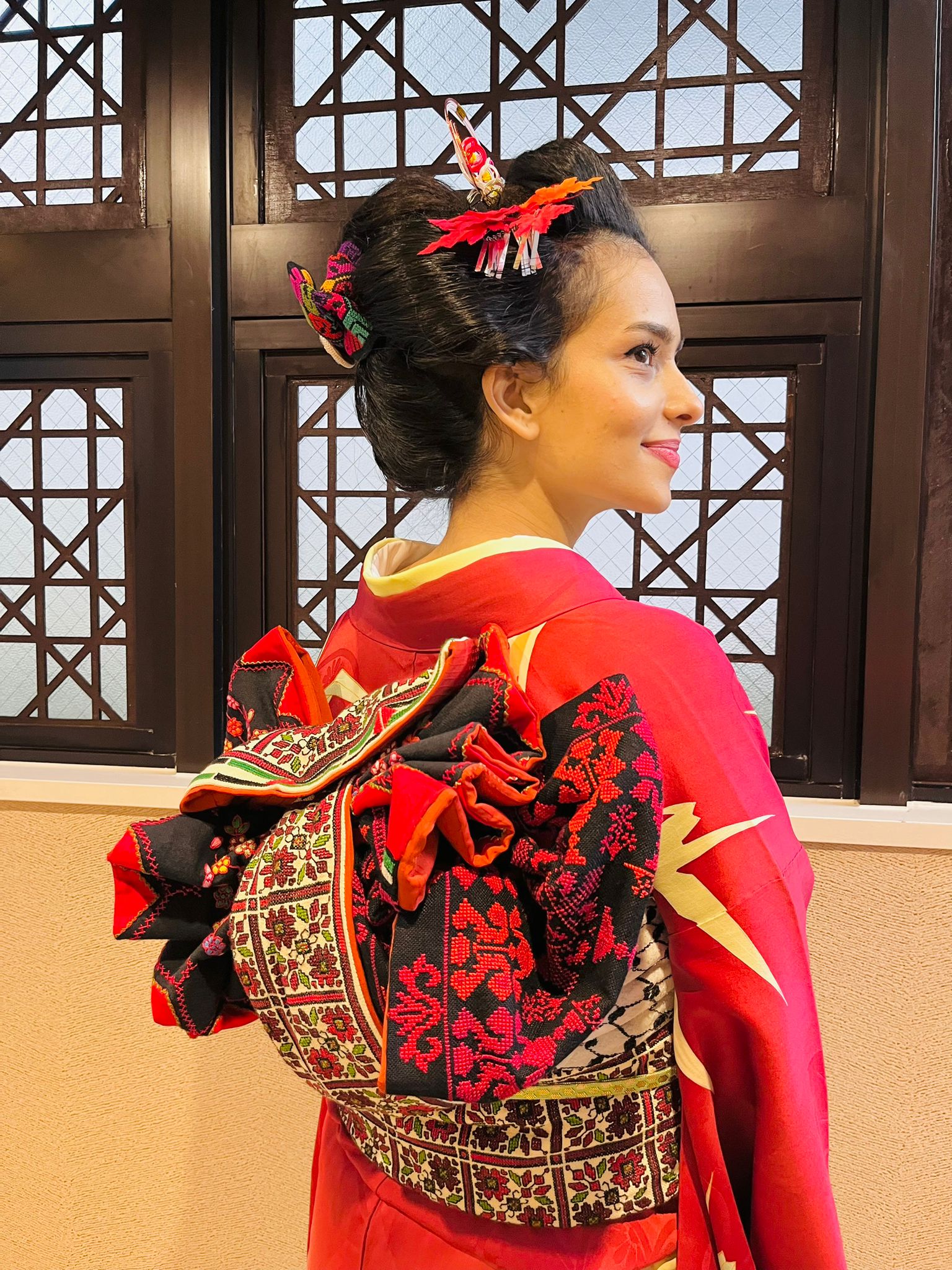
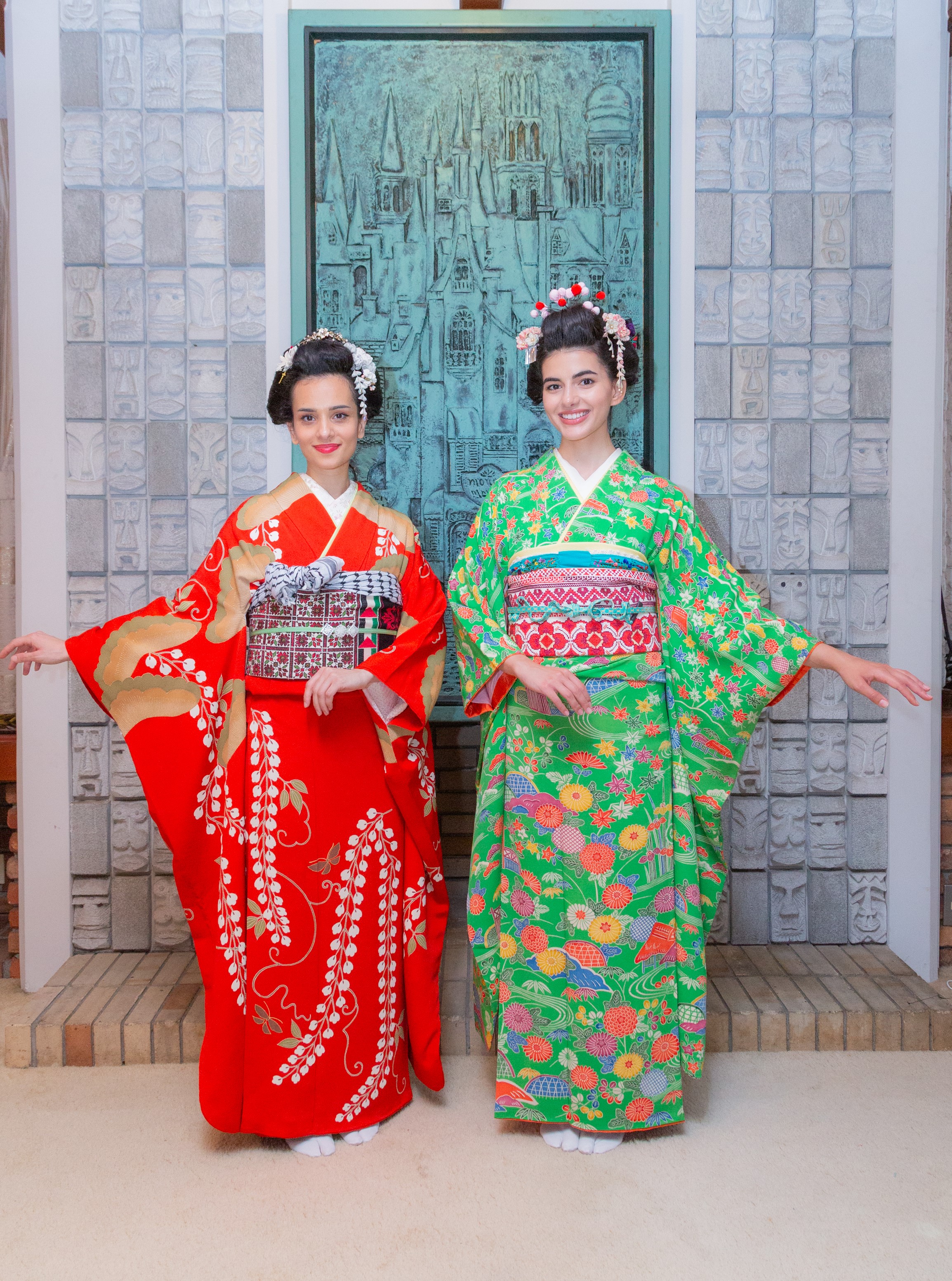
And when I visited the Palestine 10 years ago, I just want to do something for Palestine, and that time I hit the idea that mixing that the tapris to Japanese kimono belt obi. Because that Japanese kimono, when we think and go back to the history, Japanese kimono is not just Japanese culture. It's mixed by Chinese culture or the Persian or something through the Silk Road. So it's kimono itself is something that the blend of the many cultures. So for me, it's very something that natural to pair Patrice to Japanese kimono.
So I, I say that this my project is something like a modern Silk Road. I love that. I love that. That's So beautifully said. And we talked about this a little bit before we recorded, but I do love this blend that you have.
You know, we talk a lot in, in America about sensitivities around cultural appropriation and what's appropriate and what's not. And I think what you have done so beautifully— and again, we'll talk a lot more about this project— but what you've done so beautifully is perfectly blended and honored two cultures together. And as you're saying, even like, you know, komono history is already a blend of other cultures. And I think this is, this is the perfect example of how people can celebrate and participate in other cultures while still respecting the origins and the history and the heritage of it. And it just— everything I see that you do just blows my mind.
But I'm going to not fangirl too much because we got to ask you questions. So, and Haneen, you also What's your story with your tatreez journey? Because obviously being Palestinian, tatreez was always a part of your life and your mom was a part of Maki's tatreez journey. But how did you yourself start practicing and start viewing tatreez as something bigger than this is just something that Palestinians have and wear? Yeah, no, that's a really good question.
I would definitely say, yeah, as a Palestinian, as Palestinians, we're kind of born into tatreez, whether we practice it ourselves ourselves or not, but it's kind of around us, especially if we're born in Palestine. And my tata, her thobe collection is incredible, honestly. She really loved tatris, really appreciated its storytelling more than anything as well. The way that we could tell our stories, the way women in different villages were able to tell their stories and what happened during the Nakba and so on. And that That always stuck with me since I was a kid and I learned about what was happening in Gaza and around us in Palestine.
And even more so after actually I left Gaza and I was so far away from my home, but I saw my mom wearing tatris all the time, loud and proud to as many events. And it really stood out on her. It looked so good. And it always inspired me to be proud about our culture and our beauty. And just because people are not they're not wearing their traditional clothes at this event doesn't mean that you should be shy to not wear it.
And you can just be loud and proud about it. And who knows who you might inspire to also wear whatever they want and be happy with it. So that's kind of like the background growing up subconsciously. It's not things I even really thought about, but it's things I observed and saw with my mom. And she used to also always bring work from Atfaluna, which is, In Gaza, they're based in Gaza now, you know, who knows what the status of their work and the women even who are doing the tatris, but she used to always support their work, bring it here to Japan, sell it at charity bazaars, and then donate it back to them to support their work, especially because in Gaza it wasn't so easy to kind of amplify the beautiful art and craft that we do have.
So as people who had that privilege to take things with us when we visited and bring them here, we were able to do that. That. And yeah, I always knew just how important tatreez was and how it's really the most crucial thing in terms of preserving our identity and regionally too, people from Gaza or Hebron or Jaffa or Bethlehem or whatever. It's something that's so crucial to have these pieces. They're so sacred to us.
But I really wanted to learn it. I just thought I wasn't crafty enough or I didn't have the skills to learn tatris or the patience, but I, my sister used to always, and she still does a lot of stitch. Um, I asked her when she came to visit recently, I was like, I need to finally learn how to do tatris. I've always wanted to, and I realized I actually learned how to knit and sew and do all of these things in school. So maybe I got it and I did it and started learning how to do a bookmark and I'm working on it now.
Now. So it's been really awesome to actually get to know how to do it and realize just how much work goes into it, even though I know it and I've seen it. But to see it, like, um, to do the work step by step. So yeah, that's kind of been the journey, and hopefully there's a lot more to it too. Oh yeah, we talk about this all the time.
It's very different to appreciate the trees and then appreciate fathris after practicing fathris. Very, very different. So I kind of want to talk about the Palestinian Embroidery OB project. And, you know, Haneen, your grandmother's collection, Amani, I saw it in Japan. You would have drooled.
I can't. I can't. Over those dresses. They're absolutely gorgeous. Absolutely gorgeous.
And they play a really big role in how, Maki, you do your events and how you showcase about Palestinian fathris, even if it's not on the actual thobe, but on the OB. Like, they influence each each other. So I really want you to share a little bit more because, you know, I learned about the Intifada obi. Just wait till you hear about that, Amani. But yeah, maybe, maybe let's talk about the embroidery, the Palestinian embroidery obi project.
How did it— I know you said that you got inspired when you went to Palestine and started talking to Haneen's mom about it, but curious more about, you know, where did it start and how has it evolved? Because Maki, you've been working on this for over like a decade, I think, right? It's been many years. Yeah, it's been many years, so I'm sure it's evolved as well. Would love to hear the whole story, if you will.
So 10 years ago, I just make the obi for myself, for my— that because I often wear kimono, so I just make the tatris obi for myself. But whenever I wear and go for many reception parties or the gathering, they say that they have never seen something like this, the tapris, obi. So they ask me, how you get this? So I talked to the people that I visited Palestine, and this was stitched by the Palestinian woman, and this is very, very traditional Palestinian culture. And people say that, that it's amazing.
So I thought that this is not just for myself. I should make it and sell it so that if I can sell many obbies, I can pay more to Palestinian artisans. That's how I started this project. Who are your customers? Like, who are the people who are typically, um, purchasing these tatris, obbies?
So main customers are the Japanese who wear kimonos, for example, who do the tea ceremony, Japanese traditional tea ceremony, or the kimono lovers. But recently, not only Japanese but also Palestinian women bought this obi. For example, this April I did the exhibition, and the one Palestinian lady living in Dubai came and she bought 3 obi. Actually, she is the teacher of the Japanese ikebana. Ikebana is a Japanese flower arrangement.
So beautiful. For example, so nowadays some that the Palestinian people living in United States or European countries visiting Japan and they bought obi. Oh, I didn't know that. That was a good question, Amani. I didn't ask that because I'm getting ideas.
Yeah, I love it. I need one, obviously. Yeah, well, so Maki, you mentioned doing an exhibition in April, and I know you tend to do these like semi-frequently. Can you tell us more about kind of what is the exhibition? I know you do like fashion show types of situations, like what does that look like?
What kinds of, um, pieces are you showing? And then, um, yeah, I, I'd learn— love to learn more about that. And then also, oh, I really want you to talk about the different obis that you have because you have specific obis that represent different things. So I do exhibition because of course I need to sell the obbies, but I also want to share the culture of Palestine. So every time I do the exhibition, I borrow the very beautiful top from Hanin's mother and show it on the mannequin, the Palestinian old dress and also that the obby stitched by the Palestinian ladies so that the people can see, not without the word, just see, and they think, they feel that how the beauty of Palestine is.
So I do my exhibition as something the cultural thing to show just the beauty of Palestine and how it survived many— the Palestinian people, the many wars, but they preserved this top trees. So I want to share these things to Japanese people and not only Japanese, international people visiting the Pom Pom exhibition.
Introducing the drop that nobody asked for, Resolute RGL, the sneaker that takes centuries of Palestinian resistance and sells it back to you in leather. Co-founder Yossi Levin calls it empowerment. We call it exploitation. Same guy who once erased Palestinians from his projects in Haifa Now stitching Tathreez into a shoe to build his quote-unquote "multimillion-dollar brand." They say it's bridging local and global. Translation: Palestinian women stitch, Europe profits, Israel wins.
Limited edition, unlimited hypocrisy. Don't buy the hype, boycott Resolute RGL. This anti-ad was produced by Tathreez Talk. We stitch, we talk, we boycott.
Yeah. And Hani is one of your models, right, Hani? Yes. Tell us more, Hani. Yeah.
How did you— tell us more about how you got involved with this project. No, no, don't so much. So I'm happy that before Hani settled in Japan, Honey's mother always be my model, the Tatris Obby model. So then Honey came, oh please, I told mother that please Honey could be the model for the Tatris Obby. And Honey, yes, now she's the symbol of the Tatris Obby.
Oh gosh, I don't know about symbol, thank you Lucky, I don't know about symbol but I feel like it's almost an honor to wear the obis that have, you know, so much work gone into it.
So how could I say no, almost, even though I'm not a model, nor do I, you know, do that for a living or enjoy it. But how can I not want to wear the obi, and especially the Intifada obi, which I've seen for so many years. So when Maki-san asked, like, you know, do you want to wear it? I was like, Yes, of course I'll wear it. And then once I wore it, I didn't want to take it off, honestly.
Yeah, I can only imagine. Yeah. But it's been cool to do these exhibitions together to kind of highlight both, you know, the beauty in both these cultures and the connection between Palestine and Japan, especially from, again, a place that kind of feels super far away from Palestine. And to use these thobes that my grandmother had and actually put them on display for people to see instead of it collecting dust in the closet, in the sacred closet that nobody can touch or open. So it's like, what's the point?
You know, we should be putting these out for the world to see, all these beautiful pieces. So, um, yeah, it's, it's been amazing that we've been able to exhibit them with, um, all of Maki's obis, and hopefully we can do it in more places and just keep spreading this, um, you know, spreading our culture and the beauty and the storytelling, which is I think the most important aspect. So, and I think the reaction from Japanese people has truly been amazing. We— Maki-san did a, a fashion show at the Expo in Osaka, um, and it was for Palestine Day on June 1st, um, this year, and it was massive, the people that turned up to see, you know, the events for Palestine and they saw this fashion show, they saw people wearing all these different thobes from different regions in Palestine. And Maki explained it so beautifully.
She talked about each region and each thobe and the motifs on each dress and the colors. And people were just stunned by how beautiful it was and how rich the culture was. I think people might think that Palestinian thobes or dresses are, there's one type of dress or one traditional look, right? But they don't know that every area Every area has its own unique look and style and colors and everything. And I think it was so beautiful for me as a Palestinian to see their reaction because I was on stage facing them.
So I could see everybody's gasped faces when they see all these thobes and the obis. And yeah, it just kind of gives me some hope as well in our future and in liberation too. So yeah, I really respect what Maki has done and I hope we can continue to support her project and every other Tatreef's project.
Project, really. Yeah, no, I— it's so beautiful, and it's really amazing to hear from you too, as a Palestinian living in, um, in Japan. And remind me, how long have you been living in Japan? Because you grew up there partially, right? Yeah, so I moved here when I was 7, and then I left when I was 17, and then came back after October 2023.
So, but my parents have known Maki-san for over 20 years. Yeah, so I'm curious then for you, Haneen, as a Palestinian who has spent so much time growing up in Japan, like, what does it mean to you to see tatris carried into Japanese culture through the Obi? It's honestly, it's one of the most beautiful projects I've seen, and I'm not saying that just to, you know, boost Maki's work or anything. Genuinely, to see the dedication that has gone into it. I think Maki herself would be too humble to even speak about it, but Maki went and saw the reality, came back, decided to full career shift and change her whole, probably never imagined this path, and dedicate to supporting Palestinian artisans in Palestine and also raising awareness about our culture and our beauty.
So it was really, really just super heartwarming to see such effort. Um, she didn't have to, but to see her go this far and the way she persevered all these years, you know, she's been doing this for 10 years. She maybe just got like a lot more attention in the last few years, but before, you know, she was posting, doing things, exhibitions, and still continued even if people weren't really buying or paying attention. And now, um, honestly, she really deserves all the attention and, um, everything that so as far as the Palestinian embroidery project has received, and I hope there's only more and more support. But yeah, just to see this bridge between the cultures, especially Japan being so far away, it's really like, it's dialogue, it's a beautiful conversation that's now endless.
People see the obis everywhere or see the thobes, and it's an endless conversation, endless conversations that are happening. So it's really, really beautiful, and I hope we can, yeah, just keep it up, continue to support, and most importantly, also supporting the Palestinian craftswomen in Palestine. So I wanted to ask about that as well. Can you talk a little bit, maybe Maki, about the process of making the obi? I know in the last couple of years it's definitely probably been different, but how does that process typically go for you to make the actual obi?
So before COVID I visited Palestine, West Bank, 2 or 3 times in a year, and I visit the artisans to first order the obi, and then after 3 months or 6 months, I visit again and see the progress of the stitch. And after the embroidery finish, I pick up— pick them up and bring back to Japan. So I We continued something like this for 5 years, 5 or 6 years, and after the COVID I couldn't visit Palestine, so I start to order by the Facebook Messenger with the directly with the artisans. So I visited Palestine about 20 times, so I made the friendship and face-to-face communication. I think that's why I can now make the OB online.
Yeah, yeah. So do you primarily work with Atfaluna or a different organization? The different organization that in Gaza, Sulafa, but now temporary stopped, and in West Bank, the Society of Inash al-Lusra. And the group in Amari refugee camp and also from the Balata refugee camp. Okay, got it.
And do you tell them what you want, or like, how do you do the design of the OBs? So design, I want to keep the very, very authentic Palestine. So I see the art pieces of the producers or I find it in the tapestry book. There are many patterns, so I pick some of the tapestry patterns and then I design it for the obi because something to wear as obi, it should be designed to fit as obi. So I made it, the design, I made the pattern on the laptop and then decide the color because we have the DMC color book, so it's the same color in Japan and Palestine.
So I bought all the threads of DMC and put on the fabric and imagine the color and then make it on the laptop. That first, the, the application of the Tetris piece, and then print it and send it. So I'm curious, like, as far as, like, collaborating with the artisans, um, because some of these, some of them you've been working with for a while, I'm assuming, um, what has that process been like, especially now, um, kind of like, I guess, post-COVID and during all these, like, new restrictions given the genocide? So during the COVID all the producers in Gaza or the West Bank, their production decreased. But after that, October 2023, in Japan, the people's attention, the Japanese people want to support Palestine.
So the embroidery production the increased, but it depends on the location of the producers. For example, Amari Refugee Camp that I make obi now, they are very close to the center of the Ramallah city, so they can go to the fabric shop or the thread shop to buy thread or the materials, the buy on foot But for example, the village women surrounded by the Israeli settlements, they cannot go to the city to receive the order. So they, the village women, now very difficult to produce. So it depends on the area they live, but under this war, some of the ladies keep keep producing. Also in Gaza, Gaza women also producing the trees under this war.
I've heard that and seen that, and it's pretty amazing that they have the energy or the bandwidth, the emotional bandwidth to do that. But I know there is so much solace sometimes in Intatris. But it's also just insane to just hear about the difficulty of just something as simple as trying to get clothing fabric out of a country or going from a village to go pick up fabric or thread. But that's definitely the reality that Palestinian women face and have faced for many years. And you're obviously very experienced in it through your relationship with them.
How has this shaped kind of how you look at activism? Because I think a lot of what you are doing, especially working with the Palestinian, East Palestinian women, is a form of activism. So I'm curious how you have seen that. And then Haneen, I'm curious as well from your perspective too. Yeah, Maki, if you want to answer first.
Okay. So Basically, I try not to talk about political things, just to show the culture. But when we do something that the charity with Hanyin or the to support awareness of Palestine, I talk something the reality. But usually the I just work on the cultural thing. But for example, the Intifada Obby, I want to tell that the story of Tatris, that Intifada Obby was inspired by the Intifada dress named by Madame Widat Kawan.
So the During the first Intifada, the Palestinian women banned to hold the flag, so they start stitching on their own clothes. So this I want to share that these history through Intifada Obby. So I mainly don't talk about political things, but Intifada Obby shows many, many backgrounds. So when they ask more detail, I talk about the history of the Tatris. But the people, Japanese people who do not know well about Palestine and they who do not know the flag of Palestine, they say that Intifada will be so pretty.
So it's like a fashion. But I want to tell many things through the Intifada will be. Yeah, yeah. Maybe to add to that a little bit, I feel like when Satriiz becomes an Obi, it's not just fashion, it really is dialogue. It's memory meeting memory.
It's really like, it shows just how two cultures that seem so far apart can find a lot of common ground in craft and in beauty and in, you know, a practice that's passed down through generations because it's the same in Japan with the arts that they practice. It's passed down through generations too. So It is in itself, although it looks like fashion, it always sparks a conversation that will lead to learning about Palestine and our history and our story and our struggle. And that's where I really see the activism, silent activism, let's say, in Tatreez. And Maki always talks about also the history and the storytelling.
There's a lot of that too. There's an event that my mom and Maki do that's called Stitch for Palestine. So people can come and learn how to Stitch the Palestinian Way. And Maki always starts with a presentation about what is tatreez, what's the history of tatreez, what's been happening in Palestine, what's the situation today. And a lot of different people come and show up, and I think they come for the art, maybe because they're curious about tatreez or how to do it, how to stitch, but they always leave knowing so much more than they ever expected.
And I think that's really the beauty in these types of workshops and events, and that's where the activism is. So we're turning them slowly, slowly, one stitch at a time. Thank you. It's silent activism. Thank you, Haneen.
Yeah, totally. But also, Haneen, you're doing some loud activism as well. Oh yeah, for sure. Do you want to share more about the other— Do you want to share more about those types of activities? And I'm curious also, like, how the work with Maki's project influences maybe some of the other activist work that you do in Japan as well?
Like what's the— I don't know, how do you think about them together working in conjunction with each other?
This season's hottest look: genocide. From the brand that brought you fast fashion comes fast-track complicity. Zara just opened its largest ever store in Israel, 45 square meters of settler sheepskin while Gaza buries its dead. Their Israeli franchisee hosted far-right minister Itamar Ben-Gvir, who calls for shooting civilians and expelling Palestinians. His review: "Beautiful clothes, beautiful Israelis." Our review: ugly politics.
And yes, the jacket ad—mannequins shrouded like Palestinian bodies next to rubble? Zara called it a "misunderstanding" and kept cashing apartheid checks. Boycott Zara and all Inditex brands. Bershka, Massimo Dutti, Pull&Bear, Stradivarius, Oysho, Zara Home. Because genocide is never in season.
This anti-ad was produced by Tatreez Talk. We stitch, we talk, we boycott.
Yeah, so actually I've known Maki for a long time, but I definitely grew a lot closer since the genocide escalated in Gaza, right? Since the continued genocide. And I would talk about Stitch for Palestine that my mom and Maki had organized. And I also saw it as an opportunity for us to fundraise more for people in Gaza right now. And I have a team called Kifu for Palestine.
We're a fundraising team. We try to fundraise and do fundraising events for mutual aid campaigns, also for family campaigns to support individuals directly. We try to do both. And that's something People need material support more than ever right now in Gaza, and that's something that we can easily do. That's some action that we can take to help.
And yeah, so we kind of use these classes and exhibitions and events as opportunities to fundraise even more and send it back to Gaza. So that's the fundraising side of the work that I do. And then there's also the kind of louder in the street activism, which I think is really very necessary because we need to show the rage that we all feel. I think as much as we can talk about things and sit and have conferences, we really need to take action and show our leaders that we're not okay with what's happening. We're not going to sit back and just accept this genocide.
So we also have a team, Palestinians of Japan, that includes Palestinians, Japanese, and other foreigners living in Japan, that are just trying their best to protest and push for BDS and direct action against the settler colony of Israel. And we're trying our best. We are small but mighty community growing every day. And I think Tathreez has played a huge role also in helping people learn about Palestine in, let's say, easier way or a more welcoming way, let's say. It's less intimidating.
Exactly, exactly, 100%. And there's been a lot of people that have met through these classes and then happened to see later at a protest because they really realized through the presentation that Maki did that just how dire the situation is, and they really have to be louder about it. So a lot of people sometimes they say the cultural things, there's a bit of a debate, like how important is this cultural stuff while our people are being killed in front of our eyes every day? And it's extra sensitive for me because I'm from Gaza and I have family and friends there too. And it feels almost like, is this the right thing to be doing, sitting there stitching and talking and everything?
But this is what we need to preserve our identity. We need to preserve our culture and our beauty while it's being erased and showcase that. And at the same time, if you can also fundraise and get material support out of it that goes back to helping them directly, then why not? So this is some of the work we've been doing. And yeah, I hope to do more.
And I want to thank Maki as well because we've done some markets for Palestine to fundraise and Maki always donates work from her collection to help us fundraise even more. A lot of times not even covering the costs and stuff. So really, really appreciate the support. And yeah, hopefully we can just continue to collaborate and grow the movement for Palestine here. And I just want to kind of just comment on what you were talking about in regards to culture and does it feel right to kind of focus on this at this point?
And I always say, The occupation wants to take so much more than just our lives. They want to take our land, our culture, our history, and everything from us. And little things like— things that seem like they are little in the grand scheme of things while there is a genocide going on, obviously stuff like, oh, hummus or tatreez or dabke might not not seem as important, but at the same time, we need to preserve all aspects of who we are in our identity. And being Palestinian is not only heartache, it's also art and beauty and joy and laughs and good times and all of that. And so I do do think that obviously it can't be the only thing you're doing, um, but I do think it's important to continue to preserve all of that.
And so, um, you know, honestly, like, thank both of you, um, for the work that you guys are doing on that front, because it's just— it's amazing to kind of see. I always love seeing how Tetris continues to evolve and the story of Tetris continues to change as well. Yeah, no, it's, it's so true. Um, I want to know, what are the big dreams for the Palestinian Embroidery OB project? Like, both Maki and Haneen, like, where do you hope it is in, you know, 5 years, let's say?
Like, what are, what are the big, big goals? So for me, the big goal is the revival of the silk embroidery You know that now is the all the tatris is done by the cotton thread, but before Nakuba, the many dresses was stitched by the silk thread. So I want to make the silk tatris for the obi. This is my big goal, but I, I tried it to do it bringing that Uzbekistan, they produce silk threads, and I bring it to Palestine, and the artisans tried, but it's very difficult stitching by the silk thread. Yeah, but I want to do— I want to make the improve and then make the silk embroidery.
This is my big goal. That'd be really cool. Okay, I'm gonna keep an eye out for that. I, I really need to see this. I've tried stitching with, um, with silk thread before, and it is very difficult, but it is so beautiful.
Yes, the shiny, the shiny of the silk is very beautiful, so I want to make it. Yeah. Hanim, what about you? Yeah, uh, I think I really want to support Maki to have as many people know about the Fastened in Embroidery obi project. And I know that a lot of people have seen it, but don't necessarily have the chance to be able to come and see it for themselves because obviously, you know, they have to find a way to come to Japan, which is not always easy.
Um, so I want to try to find ways where we can get the obi to people somehow. Amani, Amani, I know your brain is like— Yes. My brain is working. Okay. Okay.
And this is something Lina even brought up when we all had met up, you know, and I was like, I'm ready to support that. Of course, if that's something that Maki is happy with and would want to do, I would be happy to support and yeah, get the OB to people. Yes. Maki, I'll help too. Thank you.
Because I want, I want like, oh, I, yeah. Yeah. Oh, this is exciting. Okay. I know.
We're just doing like a global exhibition. Yeah, the possibilities are endless. I, you guys, I have so many ideas already. Okay, I'm going to not get too excited. I know we can continue talking for hours and hours, but we want to be respectful of everyone's time.
So what is next on your Thetanys journey? So I know what we want to see in the future, But what are you guys working on right now? What projects are in— can people expect to see soon? So for me, before, I made the obby by the Syrian fabric available in Ramallah. But now I started to make the— bring the silk obby fabric weaved in Japan to Palestine.
Time. Yeah, but it needs the support by many people. For example, because we cannot ship the things to refugee camp directly because they do not have address, so I need to bring it, deliver to the somebody, and then he or she bring to the refugee camp. So now I got find the one that the supporter living Japanese, she's Japanese, that the diplomat and working at the Japanese MOFA, and she lives in Jerusalem. So now I ship the silk obi fabric to Jerusalem and she bring the obi fabric to the refugee camp.
So I just started to the this project, this is a new project, and in 1 or 1 week or 2 weeks, they will finish and arrive Japan. Because one of my, the big goal is making the silk embroidery obi. So it should be the obi fabric itself should be the silk. So this is the one that the progress to complete my, the big Yeah, yeah, sounds beautiful, but also is just also crazy to hear about what needs to be done again. Like, I know we talked about it earlier, but what needs to be done to get this stuff there and out is so much, so much.
Um, Haneen, can you share with us what you're working on, what projects people can expect from you? Yeah, well, in terms of Tatreez, I'm still on on my bookmark. Hopefully I can finish my first piece and be proud, uh, how, how far I've come. And then hopefully, yeah, do more, practice more. It's just from the little time I've done it, I've really realized how calming it can be, um, especially in these times where, you know, emotions are very turbulent and everything is just insane back home.
So yeah, I really found like a sense of just like, okay, I can breathe and process my emotions in a way. Um, so that was really nice to, to feel for the first time recently. Um, and I want to keep that up, so hopefully continue to practice the threes. Of course, I always wear it, um, and I want to continue to wear it more and more, whether it's a formal event or not, and encourage others to as And of course, support the Palestinian Border OB Project in whatever ways it needs. So yeah, hopefully, inshallah.
And I know you're doing a physical space too, right? Yeah. So we've always wanted to have a more physical space for Palestine. Palestine has In the last 2 years, people have learned about it through protests or events that have just popped up around the city, around all over Japan, really. It's not just Tokyo.
But we didn't have a place where we could just guide people to go if they wanted to meet Palestinians or wanted to learn about Palestine or wanted to purchase something in support. It was always pop-up markets and stuff. So yeah, we We, you know, recently found the space and everything and working on that to kind of also build the community, to build political education, which is something that I feel like needs a bit more work here as well. And yeah, also do Tatris classes and do more things like this where we can just share our culture and beauty with people, Debka and stuff. So yeah, I'm really excited for that and Hopefully we can support people back home in those efforts.
And before we say goodbye to both of you, we always like to ask, is there a major life lesson that you have gained from Tetris? Maki, do you want to go first? Mm-hmm. Tetris is the living proof of Palestinian people. Because since October 10th, October 2023, at the beginning I thought that the Gazan women cannot continue stitching.
But after, recently we knew that the Gazan women under the threat of bombing, they still continue stitching until the cushion cover stitched during this war arrived to Japan. And I show that this is— that this cushion cover was stitched by the Gazan women during the war. So tatris is not just the fashion, that the living proof. And it— I believe that the tatris in encourage people, not only Palestinian people, but the people around the world. Beautifully said.
Hanine? Yeah, that was beautiful. And just to add, actually, just a little bit to the cushion cover story, Maki shows the cushion covers and tells the story about how they were done in this genocide, and then they were brought out by by a doctor, right? Or the doctor who brought it back out of Gaza, smuggled the cushion cover out of Gaza just to bring it to Japan to Maki. And every time she shows it and explains that, you just hear like a, "Oh," in the room, like a really full gasp.
People can't believe it. Even a cushion cover, Tareeq's cushion cover had to be smuggled and it's so difficult to get around. So yeah, Everything is a danger to Israel in terms of Palestine. And that just shows how important it is for us to keep practicing that art and to keep spreading it as much as possible because they don't want us to spread it. But here we are doing it from Japan as well.
And for me, I would say the biggest lesson is Patrice really taught me that identity lives in our hands. And I don't mean this in like a cliché, you know, extra emotional way, but truly every stitch that we do is— could be a memory that we have, it could be a story that we have, could be, um, a person that we remember, or, you know. And it's just, it's so beautiful to know that. And, and I think in a world that pushes so much westernization, um, traditions like Tatreez really help us to remember who we are and to hold on to who we are. And I think that's really the beautiful part and why we need to preserve it and continue to practice it, whether it's in Gaza or in Japan or in the US.
It's really vital, and it's vital for people to support, um, Tatreez projects, like all of the projects that all of you you, uh, beautiful ladies are working on. So yeah, I hope everyone continues to support all, all your efforts. Ah, you both are amazing. I loved hearing these stories. Even though we spoke before, it was such a beautiful experience to hear, um, just the journeys that you both have been on and how you've been connected.
And I'm so happy that we made the time to, to do this because I think it's such a beautiful conversation that will only help amplify all the work that you guys are both doing in Japan, but also to the broader world, and maybe open up other opportunities, um, as well. Thank you both so much for taking the time. I like— seriously, it's been such a pleasure to talk to you again, um, and inshallah, many, many more conversations to come, like, now that we're connected even more and more. Yeah, uh, thank you guys, really. Thank you.
No, thank you guys so much for, for this opportunity and We really need a global Patris convention for Palestine or something. I know, a chance for all of us to meet in person, share all the different Patris styles and arts that everyone's been doing. And I mean, don't think I haven't said this before. Don't think I haven't thought about this. I'm ready, I'm ready to help you make that happen.
I have time, so let's get planning.
I love it. We'll talk. We'll talk. Perfect. Thank you.
Thank you, ladies. We'll talk to you soon.
I'm so glad that we finally were able to have Henny and Maki on. We've talked about it for a while, so glad we were able to coordinate, um, and it was just a great conversation. And I think everyone knows I'll be the first one to call people out.
And again, I mentioned it while we recorded, the conversation around cultural appropriation is pretty consistent, right? And everyone has different opinions on it. It is what it is. But what I will say is that the work that Maki and Henin are doing through, um, the Palestinian Embroidery OB project is just such a beautiful representation of what cultural appreciation and cultural blending truly can be. Um, both cultures are being represented and respected and uplifted through through this fashion, through this work.
And I just think it's really freaking cool. Yeah, no, it's truly incredible. And I mean, the conversations probably would never have moved as far as they have in Japan if it wasn't for Maki, like starting this a decade ago. Like that's a very big deal that she's been, you know, and you can hear it in her, in the way that she discusses and talks about the project. Like she is very much in touch with the reality of Palestinians in Palestine and about their day-to-day struggles.
And, you know, and she's like going above and beyond to continue this project even when these women are under genocide. Like, it's, it's really— she's gotten tear gassed herself. I know, I know. It's, it's, it's wild. It's wild.
I will say, like, as I, I visited Japan for the first time earlier this year, and one of the biggest impressions that I had from, like, just from the get-go really is just the appreciation that Japanese people have for handmade And so it actually doesn't surprise me too much that like, there's such a, like such an easy collaboration here because you have these two communities that have these beautiful handmade traditions that are like Haineen said, also are passed down generationally. And so it's just like such an obvious, like when you, when you talk to them and you, and like the people of Japan and the way that Maki talks about her work, Like, it just makes so much sense because they have that, not even just the appreciation versus appropriation, but like the actual appreciation for something handmade, for something that takes time and is slow. And, um, so I'm, I, yeah, I'm just so excited to see where this goes because the Japanese people also have their own beautiful tradition, textile tradition, and it'll be really beautiful to see kind of that exchange continue to grow and, um, I'm so happy. I knew when I met them in Japan, like, we had to have them on the podcast because the stories that they told me were just so beautiful, and the relationship that they have with each other is so beautiful to see. And, you know, it's like they were getting ready for, um, for one of their exhibitions when I was there, so they had all the thobes like laid out, and they were planning like what's the fashion show lineup and who are the different people gonna wear and model the different thobes.
And you start to like hear, like see people who are like half Japanese, half Palestinian, and it's, it's so lovely to see that. Um, yeah, I love it. I love it so much. Um, well, dear listener, thank you so much for listening to another episode of Talk. We want to hear about your Talk journeys, so please share your stories with us at talk@gmail.com, and we just might have you on an upcoming episode.
Don't forget to subscribe to the podcast on your favorite listening platform and be sure to leave a 5-star review. You can follow me at @LinaStob, @Amani@MinAmani, and of course the pod at Talk Talk. We will talk to you soon.
About this episode
MAKI IS THE FOUNDER OF THE PALESTINIAN OBI PROJECT (@palestinian_embroidery_obi), BLENDING TATREEZ WITH THE JAPANESE KIMONO AFTER EXPERIENCING PALESTINIAN LIFE AND HOSPITALITY. HANIN IS A MUSLIM-PALESTINIAN AND COMMUNITY ORGANIZER BASED IN TOKYO (@hanin.gaza.jp).
In this episode, we explore how Maki’s visits to Palestine over the last decade led to a cultural exchange project that bridges Japanese and Palestinian craft traditions. Working with Palestinian women artisans, the obi belts have become both art and quiet activism—sparking conversations about history, identity, and occupation.
Hanin shares how tatreez remains a grounding practice and a form of cultural preservation in times of war, while her organizing connects fundraising, political education, and community storytelling. Together, they show how tatreez continues to live, adapt, and resist.
Connect via Instagram to buy an obi, stay updated on events, and get involved with Hanin’s work.
You’ll hear about:
>> 1:07: Hanin & Maki-San’s connections to Palestine
>> 5:24: Maki’s introduction to tatreez and the inspiration to blend with the Japanese kimono
>> 8:06: Hanin’s tatreez journey
>> 12:10: The Palestinian Obi Project, their customers, and exhibitions
>> 18:15: How Hanin got involved with the Palestinian Obi Project
>> 24:43: The people and the process behind the embroidered obis
>> 27:44: Impact of the genocide (and COVID) on the production process
>> 30:31: Tatreez shaping activism in Japan, both silent and loud
>> 41:41: Goals for the Palestinian Obi Project and what’s next
>> 49:30: Major life lesson from tatreez
Rate, Review, & Follow on Your Favorite Podcast Platform
“I love Palestinian embroidery and Tatreez Talk.” <– If that sounds like you, please consider rating and reviewing our show! This helps us elevate the vibrant narratives of Palestinian embroiderers and support more tatreez-ers — just like you — in learning more about tatreez and connecting with each other. You can find us on Spotify, Apple Podcast, and others -- just scroll to the bottom, tap to rate with five stars, and select “Write a Review.” Then be sure to let us know what you loved most about the episode!
Also, if you haven’t done so already, follow the podcast. We’re adding a bunch of bonus episodes to the feed and, if you’re not following, there’s a good chance you’ll miss out. Follow now!
Links Mentioned (Palestinian Tatreez Cooperatives)
>> [Gaza] Atfaluna
>> [Gaza] Sulafa
>> [West Bank] Society of Inaash AlUsra
Boycott Resolute RGL. Click here for more information.
Boycott ZARA and all Inditex brands—Bershka, Massimo Dutti, Pull & Bear, Stradivarius, Oysho, ZARA Home. Click here for more information.
Follow us @tatreeztalk
Follow Amanne @minamanne & Lina @linasthobe
Links mentioned