Transcriptsyncs with video
Hi stitchers, welcome to Talk, where we share conversations about Palestinian embroidery. I'm Lina, here with my co-host Amani, chatting with talented embroiderers and artists, sharing their stories, inspirations, and the cultural significance behind their work. On today's episode, we are chatting with Hema, an owner and founder of Hema, a bespoke clothing design company using traditional embroidery designs Welcome to Tethri's Talk. We are so excited to have you here. Hello.
As-salamu alaykum. There you go. Early morning here. That's amazing. No, thank you so much for joining us.
We've had this episode in the works for some time now, but it's finally time to actually hit record and have the conversation, and we're very excited to do that. Hama, we always like to start off by learning more about our guest's connection to Palestine. Would you mind sharing? Of course. First of all, my name is Hama is taken— actually, my dad took 2 weeks to name me, like to give me this name, to honor me with this name.
First of all, because it means the height, like the summit, the highest point of the summit. So he wanted to make sure that I'm tall enough to earn that name. But it's basically taken from Mersil Khalifeh. Song, and it's written by Samih al-Qasem, "Mahrou'a al-Hamati Emchi." That's where it's taken from. So, and that's why I named the brand Hama, because Palestine is my cause, like my highest cause.
It's the summit. Yeah, it's not like randomly. So this is where it comes, like all the connection to Palestine. I think it was meant to happen. Yes, we're originally from Palestine.
Uh, my dad is from Nablus, my mom is from Hebron. And I was born and raised in Jordan, and it happened that, uh, alhamdulillah, I had— I'm the only one of my siblings that had the opportunity to go and visit Palestine. Oh wow. That was in 2010. Uh, we don't have the holy year, so we like, uh, we cannot go unless if we have a visa, and we were like, nope.
We were never going to get the visa stamped on our passport. There was a year that they opened up just like an outside visa. I don't know why or how. I was so lucky that I was introduced to that opportunity. So I applied and the visa, it was approved the last minute, literally like at 1:00 AM and we should be on the buses at 4:30 AM the same day.
Wow. And I made it. It was 5 days. But this is what really changed my whole life. This is how, you know, listen, in Jordan we are very educated when it comes to Palestine.
Yeah. Um, I think like 99% of the schools, like it was, uh, fi kana ishi isma takaf al-Palestiniyya. We used to study it as part of the curriculum. Okay. I think it's no longer there, as I, as I know, as far as I know.
I think it's based on the school now, if the schools want to teach it, but it's not a, like, a major part of the curriculum anymore. Yeah, so we're very educated, and in my household, like, our parents, they really taught us about Palestine and the history. So I grew up learning a lot, and I was like active with PCRF, BDS, and you know, all like the protesting when we go, you know, in the street. So I was active in that manner. But when I went to Palestine, so many things happened.
It's gonna be like another hour to talk about this, so I'm just gonna make it short. It's all, it's all over my website and in other interviews. It's a long story, but so many things happened, uh, in those 5 days that opened my eyes up to different reality. It's not different. Don't get me wrong.
It's just like reality, the real reality. I don't know how to verb it. Yeah. So it's different that when you, uh, for example, read the story of a woman who's struggling or you struggle. You know, it's just to feel that thing.
Yeah. And imagine, like, I've seen all this and I was a tourist, I was allowed to go to places and they were not allowed to treat us badly. And yet I felt it and I was very angry. I was like, so I decided to, and I've witnessed, like, for example, the major things, the major Maydash things. That when I visited Herbaawi factories in Hebron, and I was not still interested in any of what I do right now.
Yeah. Like fashion was not my thing. I was a medical business consultant. So nothing different. Yeah.
Like literally from an equation, I always use this example from equation of, you know, medicine is 1 1 2. It's very clear and obvious. But then in fashion, in every collection, in every piece, you have to create your own equation. And this is way harder than just learning the book. You have to create your own and you have to have your own signature away from the copiers.
I'm just talking about the real creators out there. So they were, I remember that year they were threatened to for their land that where their factories were on, they were threatened to just stole it. As simple as that. Like, you know, like it's just crazy to hear that story. Yeah.
But yeah, and we, I got back and we did campaign for them. I did not know the importance of Herbawi back then. It's just like, oh, another Palestinian struggling brand. And that's all I've known. Yeah.
And then I learned that, um, the Israeli flight attendants, they wear the Palestinian dope. Yeah, I remember that. Yep. That's dangerous. That's like as dangerous as stealing land, as stealing hummus.
Yeah. You know, that provoked me. Yep. And these are like the major things when it comes to fashion. So I came back, like 5 days just changed my life.
And the major, major, major point— I swear this is the last thing I'm gonna say. No, no, you're good. Yeah, um, there was like, we, we were allowed to visit the mosque every morning because we, we were not allowed as a single girls to leave, uh, Jerusalem. So we had to like, we can go anywhere with the group but like '70, like to the '48, '76, or anywhere, but we cannot but stay in Jerusalem. So the last day I went to pray Fajr in Al-Aqsa Mosque, there was a guy, there was an old man.
I was just like, you know, walking, just taking everything in before I leave. Because I wouldn't— I would never know when I'm gonna be back or if I'm ever gonna be able to go back. Um, and so he was just selling, you know, gums and just very simple stuff. And I was too ignorant to ask him, um, like, is it possible, Amo, that you are selling— like, you know, I opened the candy and I'm like It's made in Israel. And like, you know, you can hear the accent, like he's speaking Arabic and he's like a mix of Hebrew and Jerusalem man, you know, like how they mix, they are.
And he was like, looked at me with all the frustration and, you know, as an old man, like, what this idiot's talking about? And I was like, yeah, I'm more, uh, So I said like, uh, I'm Palestinian living in Jordan. He said something, I don't want to say it on the podcast, but anyway, I was like, oh, why are you saying that? Like, uh, we're, we're one nation, we're one people, we're, we're always Palestinians. It will never change.
We're just refugees, we're immigrants in different countries. And he was like, like, if you If you are a caring Palestinian, you would have known that we're not even allowed to put, this is made in Palestine. Palestine does not exist on the map anymore. And so many people sold it. And I don't know how you say, like, you just living outside, you're helping Palestinians.
I don't know how you're doing that. You do nothing for Palestine. And this is what really hit me. And I was like, no, I do to practice, and I do this and I do that. And I was like, okay.
He was like, just like, you know, he was done with me. So that was the last day, the last couple of minutes for me spending time in Jerusalem. And I just came back, I resigned, and literally in less than a week I remember it took me 3 days. It was very easy to open a company and I called it Yasmin at Nablus. And I, because like we're from Nablus and that's it.
I started my company and I started in machinery work because it was easier for me. And then I started, uh, um, some projects with the United Nations and European Union., to work with refugee women in Jordan, just like teaching them English, uh, social studies, just voluntary work. And this took me to different level. Like I did not know the importance of embroidery. And why did I go to fashion?
Because I was never good in expression and comprehension and writing. I mean, I had, I used to have a good voice. But I don't know, in our culture, like, uh, really, singer? Good luck with that. So yeah, so I like, we have to be like something in education and something related to that.
So fashion was acceptable. Um, and I found out that like when I went to my closet, why the flight attendants is wearing our fashion. Why we're not wearing them? Like, even Royal Jordanian, I reached out to them like, why you're not wearing Jordanian tobes on the plane? Like, why you're wearing the, the French atelier?
So, and now on the first class they do wear. So I, by the way, I know, I noticed that. I was gonna say, I, I, last time I took Royal Jordanian, they, they were wearing like tatris on their— yeah. So, good. Yeah, very cool.
Yeah, yeah. Okay, so you started, you started mentioning like your, like your interest in Tetris and your interest in embroidery kind of started working with, working with these refugee women. Can you tell us a little bit about before you met these women, what was your relationship to Tetris as a Palestinian?
That's it, like everybody else. Yeah. So, uh, when I was introduced, like, you know, when I saw those women and how they're making living out of it, yeah, uh, the details, uh, the long hours, uh, the, the wrong posture sitting doing all this work, um, and they were asking me like 'Do you want me to do— like, you look like a fine woman. Do you want— let me do some stuff for you.' And I was like, 'What do you mean? What are you gonna do for me?' Then we started— I started showing them the, you know, the very simple stuff that I used to do.
And the— 'Can you do this in the handmade embroidery? And how much time is gonna take you? How much— like, what is the cost?' And it just started for me. Then I started learning more and more. Then I started giving them— I started studying fashion, like online, parallel with this.
And I saw the impact on them. And when they started telling me the stories, you know, like I love sitting with older women and older people in general. Like the stories that they tell has so much wisdom, is way better than reading the best novel in the world. This is how we learn and this is how we interact. So from those projects, I started suggesting more projects, but I was specific in teaching them how to start doing fashion, creating fashion, and implementing their embroidery.
So some of them kicked off and some of them, they did not have enough sources. To, to, to like have a business. So I'm a PMP. So I started teaching them on the side as Hama, not as a consultant, how to start business from home, how to reach out. So this is how I started at the beginning to meet those women.
So they met me with another woman who take their embroidery and sell it. And this is how the whole thing started. Then I started like, okay, we're gonna start having like, this is Gaza camp, this is Cherish camp, this is Hafteen camp, this is Ba'a camp, you know, like it was different. And each one of them, how they can contribute. For example, my showroom in Jordan, it's not there anymore.
It was all made by women and men from Gaza town, everything. And it was all from olive tree branches. Everything was Palestinian symbols, but it was all made by them. So to make long story short, to the women that they were doing the embroidery and they could not last with that, the idea itself, because the men in their life, they did not— and when I say the men, it, it could be the son, the brother, the husband, the father, the cousin, the neighbor. Like, it's just crazy.
Like, you know, when you see it, when you hear, like, why the neighbor would, like, come and hit you and take your money? Like, why? What? And then what's right? You know, anyway, um, so when I met that woman and she was like, had a big eyeball, and she did not get me the, the work like it should have been done by that time.
And I was like, okay, do you want to tell me what's happening? So all the ladies were looking at her and just working, you know, those eyes. And I was like, I took her out and like, you need to tell me what happened. Then she started crying and I cannot tell you, he's gonna hit me, he's gonna kill the kids, he's da da da. And I was like, okay, I'm not gonna tell anyone, but I will help you.
So you do this secretly and you tell me what expenses you need to have to live on your own and away from him. So we studied the case, me and another two girls, we studied the case for her. And like between schools and clothing, food, all of this stuff on monthly basis. So I told the other woman I need to give her more work so she can make more money. And it's not like when I say more work, this is my work.
This is how I started. This is the work. So this is like, this can end in 2 days. It's not a lot of work. Okay.
This can take much longer time. This is like print and just a little bit of embroidery on top of it. So I just chose to give her the collection and the whole amount went back to her. Because it used to be like 20% of our profits, it used to go back to those women to help them to have their own projects. But now since October 2023, all the profits go to Gaza.
Like I told them, like, I know that you can stand up on your feet right now, the refugees in Jordan. Now all the help gotta go to Gaza. And they were like, nobody said a word. Like they were like, we support all the support to Gaza. So this is the connection to Embroidery, to how I started the whole thing.
They taught me embroidery, and I taught them fashion. And this is how Hama is built today. That's amazing. It's, it's such a journey. Like, I, I'm very impressed by how it all happened.
Seems like it all happened very organically too, which is really amazing. So when exactly did this start? Like, how long has this journey been for your brand?
Introducing the drop that nobody asked for. Resolute RGL, the sneaker that takes centuries of Palestinian resistance and sells it back to you in leather. Co-founder Yossi Levin calls it empowerment. We call it exploitation. Same guy who once erased Palestinians from his projects in Haifa, now stitching tatreez into a shoe to build his quote unquote multimillion dollar brand.
They say it's bridging local and global. Translation: Palestinian women stitch, Europe profits, Israel wins. Limited edition, unlimited hypocrisy. Don't buy the hype, boycott Resolute RGL. This anti-ad was produced by Tautriz Talk.
We stitch, we talk, we boycott.
2010, this was my visit on, uh, actually it was like the New Year's of 2010. 2010. So I started my company in 2011, and the first time I launched my collection, it was like in 2 months. It was, uh, it was Amr Hotel at that time in Jordan, and there was like a, a bazaar for Mother's Day on February 28th, and Princess Aisha She and her daughters bought from me immediately. Like the thing that I created, there's one thing, this is a very important thing to mention.
When I started this, the historians in Jordan and Palestine and the big names, they were so much against what I do. They lobbied against me and I didn't know it until later until somebody told me told me, like, you know that all these big names are against you and they're furious about what you do. And I was like, why are you saying that? Why are they furious? They're like, you're changing heritage.
I was like, how I'm changing heritage? Who does heritage? We people influenced by our environment. Like, this is what people do not know about the trees. Like, women used to document, it's documentary.
It's like encyclopedia about the era that they used to live, about her age, about if she's single or not, if she's happy or not, if she's widow, if she's rich or poor, if she is from a village or from the city, on what city she used to live in. Then when they merged after 1948, when they merged, the Emboudiri mix between Hebron and Jerusalem. And, you know, like, it's— if people know all this information, they will stop— like, now we're creating new motifs for what has been happening in Gaza for the past 2 years. It's not a crime. This is what the tattoos was created for, to document what was happening and who was wearing and You know, it's just, it's Miss Mirazi.
If people know these facts, then I decided to go and visit one of those big names. She's amazing. Like, if I tell you the name, everybody will know who she is because she's an icon. And I was like shocked. I was like, what?
Like, why? So I, I went at the same day and visited her. And we talked and I tell her, like, I told her my journey and why did I start this? Like, I was like, don't you feel happy that your 15-year-old grandkid can be wearing, whether a male or female, can wear it anywhere in the school? Like, why are you against it?
Now it's printed. Now it's like, you know, the symbols of hummus and falafel sandwich and tabbouleh and the things, the item, things that they were like, they are sewn in now. Like to talk about this stuff in a funny way, uh, like after 5 years, there were so many designers doing and actually copying or creating even better items than what I do today. Look at the amount of designers, like I cannot keep up. Yeah.
And I've been asked this question many times, like, like, uh, how do you feel about competition? I was like, bring it on. I want all these people to, you know, it just create more creativity and more, more ideas are out there for more people to have more options. Yeah, for like $10, for $1,000, everybody today can afford having— there are no excuses. And foreigners like Americans, British, all these people are like introduced to our beautiful culture and the meaning behind it.
What do we want? Like, this is, this is what we want— everybody to know about our culture, about heritage, and to know the meaning, the beauty behind it, right? So like, at the beginning, I was really at a war zone that I did not know of, and now, alhamdulillah, we're clear. And my work today is at museums, and I'm so happy. Like, from being their enemy, today we're collaborating together, which is awesome.
Beautiful. Beautiful. I love that because I agree. Like, I don't, I don't see all— I don't see it as competition. I see it as more options for people.
And I think that's really beautiful because everyone does have something different, right, to bring from a creativity standpoint. And to your point, like, people have different budgets. So maybe you can't afford a handmade piece and maybe what you can afford is a printed piece and that's okay. And there's an option for you. So I do really appreciate that.
Or machine-made work.
Yeah, exactly. Like, there's different options for different price points, different interests too. Like, it's, it's totally, um, it's totally out there. Um, and I really, really appreciate what you're saying about the fact that people do need to know the context, the history of Tetris, to really truly understand and appreciate that. We talk about that all the time on the podcast.
We talk about that amongst each other, um, especially this idea of being stuck in the past. We are not, yaani, as Palestiniyya, like we're not frozen in time. You know, we all have different stories. Like all of us have so many different stories now. There's Palestiniyya literally anywhere they'll give us a visa, we'll go, right?
So you can find Palestinians anywhere in the world. And yeah, our stories aren't stagnant at all. I'm curious how— I have a few things to comment on this. Like the more creators are there, it's not only fashion, like art is a universal language. Yeah.
Uh, like it's, it's poetry, it's books, it's, uh, artwork. It's, it's everything. Okay. The more voices out there to be heard. So imagine if we individually are heard, do you, do you see the impact of having all our voices united?
Yes. And that's the beauty, for example, about your podcast, like You enlighten more people to be just in the car and just, you know, to listen to all this stuff. And today, like, we— I was— I'm so happy that we finally— I was part of launching a new Tatreez session in Chicago. We finally started. Amazing.
Amazing. This is my dream come true. I've been here in Chicago for 3 years and a half. So it's just like Things are not super easy, and surprisingly, there are not many people who know embroidery in Chicago. This is where we have the most majority of Palestinian community in USA.
Mhm. Like, what? Why? How? Like, it's, it's very surprising and very frustrating, to be fair.
Uh, but now we started, alhamdulillah, and, uh, hopefully we're having more, uh, embroidery to be done.
Beautiful. And we're going to talk about this in the projects. Okay. You were asking. You could share.
You could share. Don't worry. You can share. I have two projects that I'm working on. One is I find it so hard.
It's just like creating a big long show of a collection of pieces from all over the world, uh, people that live in the different continents, different countries, that they hold even like a small piece of their soap, of their doll, of their blankets, of their anything that they have from when they were in Palestine and they kept it with them. And I'm trying to create a whole show to be in museums with every piece telling the story of that person and where they used to live, what does that mean, and where they live today. Uh, you know, it's all about documentation. This is what they're so good at. Like, there is a Holocaust museum in every city in USA, and this is what we need to do.
To document this stuff. The challenge here is that, you know, we carry soaps, we don't carry small pieces, unfortunately. Like, and if somebody have like a cushion, like, this means so much to them, it's so hard to give it away because it's not going to be back to them, it's going to be sued in a soap in museums. So now I'm doing parallel project we started doing is creating, documenting the eras of the trees from the Canaanites to today. So the soap, and I hope anyone who is listening to this, please do not steal the idea, come and work with me.
It's not a Hama brand, it's just Palestinian work. Yes. I beg you, stop stealing people ideas. Work aligned, work together. Yes, I beg you, like, respect the time and the thoughts and the energy that is put in here.
Um, so the idea is to start from the, the bottom with the what, how it started, then the, the gold threads that we can see in the Byzantine— did I say right? Byzantine? Yeah, Byzantine. Byzantine era, like the gold threads, it's so clear, especially in Ramallah, for example. And then to 1917, 1948, and after, in Tifada dress, all these symbols and how it's elevated to today with the new motifs of Gaza.
And this is a lot of work. And me being in the States and my girls are in Jordan and Palestine, that's tough. I'm not gonna lie. Like, this is very tough. It's gonna take around a year and a half so far.
I think it makes sense to 2 years. I told the museum, like, I might not be able to finish it. Yeah. So, uh, this is the new thing that is happening. I hope we can create more than one to be in much more than one museum.
But, uh, we are still working on the design itself. Okay, this is the, the hardest part and the storytelling. Yeah, so anyone who wants to volunteer, including you too, if anyone would like to be in this group and create a group of like, you know, artisans, thinkers, creators, I would love to have— like, it's not about Hama brand, It's about the piece itself. And yeah, I work on this. It's like encyclopedia.
Anyone who works on this, their names is going to be there. So everybody's welcome. This— okay, this is a really cool project. I want to talk to you about it a little bit after too. But I'm curious, so what's the process?
You're saying you still need to work on the design. So what is typically your process when you are creating these designs? And like, you know, we talk about the designs being such an important part of storytelling.
So every collection have a story. Uh, like once I had I'm Possible, like it's impossible, so I just put a handala between the I and an M and it became I'm Possible. That was 2 years ago when— not 2 years ago, in 2020. Okay, that's the, the Gaza, uh, the first war. 2021, I think it was directly after COVID.
2021. Yeah. Um, so I created that collection and it was all like all the funds, it just had a story in, in, um, the writing, in laser cuts, in embroidery, all of that. And there was another one, uh, the, the woman flower that, uh, um It was in embroidery, it was in painting, it was in poetry. With Zahra Wahbi, I collaborated on a collection to talk about the, you know, the injured people, the moms and the wives, the lovers who lost their lovers and how they expressed their feelings.
There was a whole collection and diwan about this, and we did Actually, 3 fashion shows with Zahi Wehbeh and Makadi Nakhaz. So I insisted at that fashion show that no music aligned, only Makadi Nakhaz's voice. Zahi Wehbeh, it was like a debate between them. Zahi Wehbeh poetry and my fashion, like on the runway. It was like, I would love to do it over and over and over again.
So what I'm trying to say is like now, oh my God, it's— sorry, it's in the closet. The black on black embroidery. Oh, I was just saying, I see that on your website. I'm obsessed. It's so, so beautiful.
Oh, thank you.
This season's hottest look, Genocide. From the brand that brought you fast fashion comes fast-track complicity. Zara just opened its largest-ever store in Israel. 45 square meters of settler chic. While Gaza buries its dead.
Their Israeli franchisee hosted far-right minister Itamar Ben-Gvir, who calls for shooting civilians and expelling Palestinians. His review: Beautiful clothes, beautiful Israelis. Our review: Ugly politics. And yes, the jacket ad—mannequins shrouded like Palestinian bodies next to rubble? Zara called it a "misunderstanding" and kept cashing apartheid checks.
Boycott Zara and all Inditex brands: Bershka, Massimo Dutti, Pull&Bear, Stradivarius, Oysho, Zara Home. Because genocide is never in season. This anti-ad was produced by Tatreez Talk. We stitch, we talk, we boycott.
Thank you. I mean, the idea came to me because of what's happening in Gaza. Like, you know, our embroidery is a lot of colors and life and fruits and flowers and gardens. And, you know, like, there's a garden. So, so, like, now looking at this, like, I don't know how I can celebrate anything.
And it just reflected, like, you know, Nafiti. It's just like how I felt, and it just came out black on black. It's like, you know, when we were like Inshallah, this— I don't want people to feel like, oh, we're going to Gaza when we're wearing this, but it's just like, just a reflection, you know. Again, embroidery speaks of our timing. Yeah.
And this is the timing we're living in, black on black. Like, I love the fact that so many designers are doing like colorful, uh, colors for brides, and I salute that. I just, I'm not feeling it right now. Like, I lost, I lost most of my embroideries in Gaza. This is a side of what's happening to so many people, like, you know, it's just like, I just don't feel it.
That's it. So that's how Black on Black was created. And like, most of my stuff is black and white. So this is like how, um, my embroidery is reflection of what's happening nowadays of a story of like, I heard one of my girls or a couple of my girls tell me, I'm a woman empowerment consultant. So I deal with those women on a daily basis, not only them, even other women.
And this is, I mean, this is away from Tatreez. When I came to the States, uh, which was not long time ago, me being, uh, born and raised in Jordan, you know, I'm pure Middle Eastern. Like in every single way you can think of. And when I came here as a woman empowerment consultant, I thought that, oh my God, I'm gonna see like the free woman in a free world and la la la la, this propaganda. And I can see Alina's smile, big smile.
I think she knows where this is going. And I was really surprised that I mean, they do not live much free life. And I mean, I think we are more liberal than they are in, in here, in the heads. Forget the way they dress. Like, yes, we do not dress like this, uh, we're not allowed to dress like this.
I totally get it, okay? We're not talking about the outside look. I'm talking about this And this is the major, the most important part of this body. It can take you to heaven or can take you to hell in real life.
And I noticed how Kurt, a very successful, very, very pretty woman, very like in like sharp shape, everything is perfect, and she has zero self-confidence.
And she's waiting for society acceptance. And she could spend millions on her outlook, the outlook, her house, her fashion, Prada, Chanel, all of these brands. Empty from the inside.
And this is what I started teaching women here. Imagine, I took the pride from my refugees. They taught me all this pride and resilience. Like, I'm coming from that house, don't get me wrong, but they, like, it just— they made it stronger. They made it built in, you know, like if it was built in and you don't know about it, like if you are a musician and you never— nobody found out that you're a great musician or you have a great voice, you will never know.
As simple as that, you will never know. So those women, like they said, like how much you taught them. I always say they taught me much more than I taught them because, you know, like sometimes we are in like Here I have had a lot of bad times, huge challenges. And, uh, you know, especially like not only me in my personal life, as a Palestinian brand, like my closest friends call me terrorist. And that's not easy for someone who does not have family.
Her friends are her family. And now my family is calling me terrorist because of my opinions and because of my views. Yeah, so like it was tough. Like, thank God I, I did not go through like hard depression. Um, so all of this— where was I?
Age. You're talking about the confidence that you gained from the Refugee Women's Movement. Age, age, start doing bakshebas now. So We were talking about like the women, how those women who, who lost so many stuff, but they did not lose resilience. They did not lose the power of resistance.
They teach me on daily basis, like, like yesterday I was helping a woman who lives in Gaza today. And she doesn't have anything. She lives in a tent. All she has is herself, her faith in Allah, and hoping that tomorrow is going to be better. She lost two of her girls.
She lost her husband. She lost— she has like— she's not sure if she lost her son. He's just like, it's not known where he is. Yeah. And One of her kids, literally, he was buried in front of her eyes alive by Israeli soldiers.
Like, it just— I can't. Yeah. And this woman, she's the same woman that she was like— I always like check on her whenever she has internet, she calls me. So I found, um, a grant opportunity, and I was telling her, I want to apply for this grant for you. It's not that sweet.
She used to be one of my embroiderers, but I want you to make a living from this grant because, listen, I'm not Mother Teresa. I'm not gonna pretend that I'm like, yeah, you know, coming from the Holy Land and I'm just giving everything away. I am not. I need to cover expenses here. So I told her, I want you to apply for this, and I want you to— it's recycling clothing and reselling it to other, uh, people around her who are in need.
So, and I want you to teach other women how to do this so you can make a living and other women can make a living. And even if kids, like, just move it around, okay? And then she was like, 'As-salamu alaykum, do you think I can have my house again? Do you think I can like bury my two girls properly after the war?' And I was like, and what I was complaining about, that it's getting cold today? Like, you know, it's just you feel embarrassed that someone— and this is what I was in a gathering with my girlfriends yesterday that, oh, I look— no, no, no, oh, Botox, oh, vitamins.
Oh, I was like, oh my God, come listen to this conversation. Yeah, it puts things into perspective. And this is the first world versus the third world. I need— we need to recategorize this because if you are really free, you start freeing this first. It's not by having 300 genders It's not by— and I know that many people are gonna be against me in what I'm saying right now, but be free in your soul first, and then, like, I don't need to be— I'm in fashion world, and, uh, can I afford having all these stuff?
I can. If I don't donate all my money, yes, I can. And do I need those labels? No. I don't need to stereotype anything or copycat anybody, and I have a personality and characteristic that I'm so proud of.
It doesn't have to be embroidery, it doesn't have to be all the time about Palestine. I have me, it's all in me, and I don't have to be Palestinian originally to talk about tatris or to do tatris, you know. It's— I love Mexican embroidery, I love Indian embroidery, I love art. Yes, you know, and it's the story behind this art, and this— I think this is what matters most, right? Yeah, yeah, wholeheartedly agree with that.
Um, so you were mentioning about a lot of these women that you work with, this one woman you're talking about, Nafazza. Um, and I know it's very important for you through your brand to ensure that the women you are working with are being taken care of financially and not being exploited. I know that's something that's very important to you for your brand. Can you talk a little bit about that and, you know, kind of what you do to ensure, to ensure that these women are being properly paid? And also, like, for people who are purchasing your, your, your pieces who aren't really familiar with the process so they can kind of understand as well, like how you are working with these women.
So the way it started that, you know, I was trying to help them to build their own identity so people can buy from them. Um, and I was like, like back then, I, I was not like into social media. I did not know the game. Et cetera. I was just like a very serious businesswoman, like a medical business consultant.
Like, I don't know what PP is. I do projects and numbers and other stuff. So when I got more into it and people started dealing with them directly, unfortunately, there are so many people without ethics. They think in homsatsrin. Lama, when they steal somebody else's work, money, or when they bargain a lot on a piece after they take it.
So they were like, like, I keep visiting them, like, you know, I've been in Jordan, so it's easier. It was easy, not that easy, but it was not that hard as, you know, going from USA to go visit them regularly. So they told me about those problems and I was like, okay, what, how we can do that? So I was like, okay, would you work for me? Like you tell me each piece, like, so they used to do the pieces and I used to sell them through a website.
Then, uh, just to guarantee that, um, the people are gonna pay in advance and they're gonna be paid for the materials and all the stuff before, ahead of time. And the shipping is gonna be under a company, it's not gonna be under them, because one of the things that is still happening till today, um, to get it from Palestine, it used to be like some of the pieces especially the bridal ones, it used to have like ink on it or a scratch on it. So I think it's just like on the customs they used to do bad stuff. So I talked to other designers, uh, that they said that they work with Palestinian women. They said that they did not have this problem.
So I don't know, it seems only me. I 100% agree that It's not my woman. So I stopped doing that part. If we have people that can carry it with them, we can get it out to Jordan and then from Jordan to outside. Anyway, so I started dealing with them as my, not employees, as my embroiderers.
So I send them the, like I designed this shirt, I send them the the shirt, they do the embroidery, and we get it back, clean it, ship it, and it's ready for the, the client. So today, between the abayas, the bespoke stuff— this is ready to wear, uh, so this is like available in stock. This is something bespoke. The bridal is bespoke. I cannot— I, I'm not machinery stuff.
Like, I do, but yeah, but I always give the option if you wanted machinery, if you wanted handmade. Okay. Um, so they can ask, like, everything is on the website and they can always reach out to me. And like, sometimes they say like, uh, I'm like, I'm hijabi girl, so I cannot have it sleeveless. Fine.
Like, we add the sleeves with a little bit of embroidery without addition. Unless if you ask like a whole sleeves embroidery, this is extra work on the girls. I cannot just ignore it. Um, I want it longer. I want it like my budget is like $500.
Can you work around it? Yes. So I tell the girls like remove some of these parts so we can work around, you know, like if you can work around your budget your needs, the colors, but at the same time, this is something that I need clients to understand. When you talk to me for an hour and we discuss ideas, you need to pay me. Because if I spend an hour with 10 clients a day, I will have no time to create anything, and you might not come back and you will take my idea to another cheaper tailor, just a tailor to create this.
You just wasted my time, which my time opens more than 200 family in Jordan and Palestine. And this is unfair. Not because, yeah, I'm better than Prada, believe it or not, because I benefit communities. Prada benefit their own pockets and their own lifestyle. So if you're willing to collaborate with us, because when people hear like, oh my God, $100 an hour, like, if you're serious, you're gonna book a— we're gonna deduct it from the dress or the item price.
But if you're gonna take an hour from me and order a shirt that is in my stock, this cannot work. You have to do your homework to go through the website. We have so many options. We have so many things out there that you can order. Winter, fall, even yoga items.
There's yoga. Yeah, we have marathon runners that wear like our stuff and run. We have everything for you. There's not to choose. Is it ready to go?
No, it's not ready. Not all of them are ready to go. We can change them for you 100%, extra cost. If it's handmade, yes. It's not gonna be used.
If it's machinery, no, we're not gonna ask you for that. Unless if you ask like, oh, I need extra 6 meters, uh, again, yeah, we're gonna charge you for that. You know, it's just simple. It's— we'll bespoke. So like this one, if you want it to be longer, it can.
If you want it to be in satin, it can. If you want it to be in raw silk, it can. You just need to say it. Do we have pictures for that? I cannot make samples of every single fabric.
This is handmade embroidery. This takes more than 45 days on daily basis to be done. Yeah. And the more colors you choose, the more, like, the more time she's gonna need to create this piece. So, like, listen, what I'm trying to say here, we're trying to not to only preserve heritage We're not trying only to tell a story.
We're trying to give financial stability to hundreds of women out there that really in need. And some of them, this is the only source of income. And some of them, they cannot do embroidery anymore. Can we give up on them because of her eye, because of her health, because she's like 70 years old? We cannot.
So if you really want to be supportive for the Palestinian cause, be really supportive, not only to follow the trend. Palestine is never a trend. Heritage is not a trend. Not because of what's only happening in Gaza, we need to speak about this. We need to speak about this all the time.
Just please don't use this to make money. Like, this is ethical fashion, and yeah, it's very, very, very sensitive topic. So don't use those women. And I know actually the woman— my woman told me that, uh, a couple of brands are using them with a very little money. For example, like, you know, it's handmade, they're not machines.
Like, some mistakes can have— like, little mistakes. I'm not talking about like Oh, different lines and you have to let it go. So they give them pennies. For example, they tell them like, we're gonna give you khamsasha dinara, tu be. They end up giving them 7.5, for example.
Oh, there was a mistake. And I think, I mean, everything that you're talking about is like why Filtriz matters so much is because there is this story and there's this human behind the work of it. I mean, just the two examples that you showed in those pieces is so powerful, but it's kind of similar back to what we start, how you started the conversation occupation, which was kind of having that conversation with the man in Jerusalem. And you're coming from outside of Palestine and you're asking him, but like, wait, why are you doing this? And he's like, do you not understand occupation?
And I have so many, I have my own experiences too. It's like, check yourself. But I think the thing that's really difficult is people see what you make and people see what, you know, Amati and I were talking about this earlier, what we make. And they're like, oh yeah, it's beautiful. Like, it's wonderful.
We love it. It's Palestinian. Like that, thank God. Kind of maintained, but there's still kind of that missing understanding of the story behind it. And people, if they don't know the story, they don't also tend to— like, they won't even think to ask about the story.
And that's when I think there's like a big miss— like, there's a gap, you know, that happens there. Um, but I, I think that's exactly why this podcast matters. That's why these conversations matter. So hopefully more and more people kind of understand, you know, through their own way of understanding it, that the stories are what is what makes Toprizh what it is and why it matters. And, um, I know that we could hear you talk about all these stories forever, and I would love to learn so much more about— you should do a series actually on the stories behind your designs, because I think that's really, really powerful.
We need people, we need volunteers. I know, I know. I'm working on my own. I'm one woman show. Because I need every single penny to just create and keep it going.
Yeah, the load is— I mean, I know that the load is nothing to the people there, but the load is just— no, it's tough. It's really hard. I mean, Amadi and I can both understand. Yeah, we get it. Um, so, so I just want to be respectful of your time though, and we mentioned this before, but we always love to end our episodes by asking, um, you if there is any major life lesson that you've learned from Safriyyah?
I mean, just from all of your stories, we've learned so many, but I'm curious, like, from your perspective, is there's— if there's one that really sticks out to you? Uh, 3 things: authenticity, resilience, and patience. I mean, this is like just talking, uh, to you for the past hour. It's just that this is what reminded me, like, what those women, uh, taught me throughout the years. It's just, uh, They're amazing, and I'm very forever thankful for that visit.
That changed my life. Truly, truly. It's so important to try to go back and, um, continue to try to go back because, yeah, it's connecting with that. Um, thank you so much for joining us. It's been such a pleasure hearing your stories.
We need you in Chicago. Yeah, um, I know. Yes, we should do something in Chicago. We should do something in Chicago. I haven't been to Chicago in years.
I love Chicago. It's such a great, like, city. It's too cold. I know, I know, I know. Yeah, okay, we're gonna— we'll have to talk.
I need the heat. Yes, I know, I know. I can't do snow in winter. That's why I live in California. Yeah.
Oh, I hear you. So thank you so much for being here. Thank you for sharing your story, and we are 100% gonna stay in touch. Let's do that project. Yes, yes, yes, yes.
Chicago. There we go. There we go. And just one last thing before we let you go. Where can everyone find you, get in touch if they're interested in learning more about your brand and all the activities you're doing?
Two major things. My Instagram is @hama_lifestyle and hamafashion.com. It's so easy. Like, it's just resonated with my name. Beautiful.
And we're always there, like 24/7 chat. So we're always there to answer. Thank you so much, Hamaoui. It's been such a pleasure. Thank you so much for everything you're doing.
Such a great conversation. And I always just love hearing the stories behind people's designs because it really, it really makes such a difference. I think we forget. It's like, because it's in our head and we know that there's stories and we understand that. And because we have our own stories that we tell, but people really don't know that.
Like, even for example, I'm, I'm, I'm supporting or like helping facilitate this global stitch-along. And even like the designs that came out of the stitch-along, like what we're actually stitching— I did a workshop the other day and, uh, you know, I— it was just a natural way for me to talk about the designs because like I'm introducing people to these designs. I'm like, yeah, like there was intention behind these designs. They have meanings and they're tied to the current situation. And they're tied to like what we're protesting and what we're calling for.
And people were mind-blown. They're like, oh wow, like there's so much meaning. And this was like a way for them to understand that Totris has always been like that. This isn't— we're not doing something innovative here. We're just following the same tradition.
And I just thought that we were able to tap into some of that behind her designs as well, because that's really what makes Totris so powerful. It's the people behind the designs. It's the people behind the work. It's not just a visually beautiful, beautiful thing. It's, it's telling you something about someone.
Yeah, no, definitely. And, you know, I, I appreciate, um, Gemma's, like, uh, insistence on the fact that people need to understand the stories and the designs and, like, all of that, because it, it does play a factor to so many things. Like, for example, like, I feel like when I teach classes, like, I have Obviously, like, non-Palestinians, you don't expect them to know anything. But I've taught a number of classes where I've had Palestinians in my class and they come up to me afterwards and they're like, oh my God, I'm so glad I took this because I didn't know any of this. And like, I've even had people who are like, I'm embarrassed that I didn't know any of this.
Like, please don't be embarrassed that you don't know any of this because like, it's not your fault. It's the occupation. Like, it's not your fault that you don't have this historical knowledge of your culture that has been ripped from you and is actively trying to be erased. So it's so important for those of us who do know or when we do learn to continue to like spread that message. And I think it just makes everything more powerful.
It makes the clothing more powerful. It makes like, you know, she's showing us like these bookmarks that she's working on and these 3D printed pins that she's working on that are not obviously not hand embroidered, but they take inspiration from these traditions and they are the quote unquote new innovative way of, you know, using these designs, but they still, because we know the history, because we know the context from before, it still carries the same, the same weight in a lot of ways. So it's just, it's, I love, I love seeing this. And like I said, I mentioned before we started recording, I mentioned during the recording, and I'll say it again, like, I know that personally for myself, I want much more everyday wearable tatris, even though I have way too many thobes and will continue to collect and buy way too many thobes. Like, I still, like, you know, the other day I was out and out and I just had like a Thetris top on and it was great.
And, you know, just being able to wear different Thetris pieces, it also starts conversations. Like people will be like, oh, that's so beautiful. What's that from? And then you can say, oh, this is Palestinian embroidery and yada, yada, yada. And then you tell the story.
So yeah, I could go on for, for way too long. But thank you all so much for listening to Thetris Talk. As always, we want to hear about your Thetris journey, so be sure to share your stories with us at thethetristalk@gmail.com and we might have you on an upcoming episode. Do not forget to subscribe to the podcast on your favorite listening platform and be sure to leave a 5-star review. You can follow me @minamani and Lina @linastaub.
And of course, you can follow the pod @tatristalk. We will talk to you soon.
About this episode
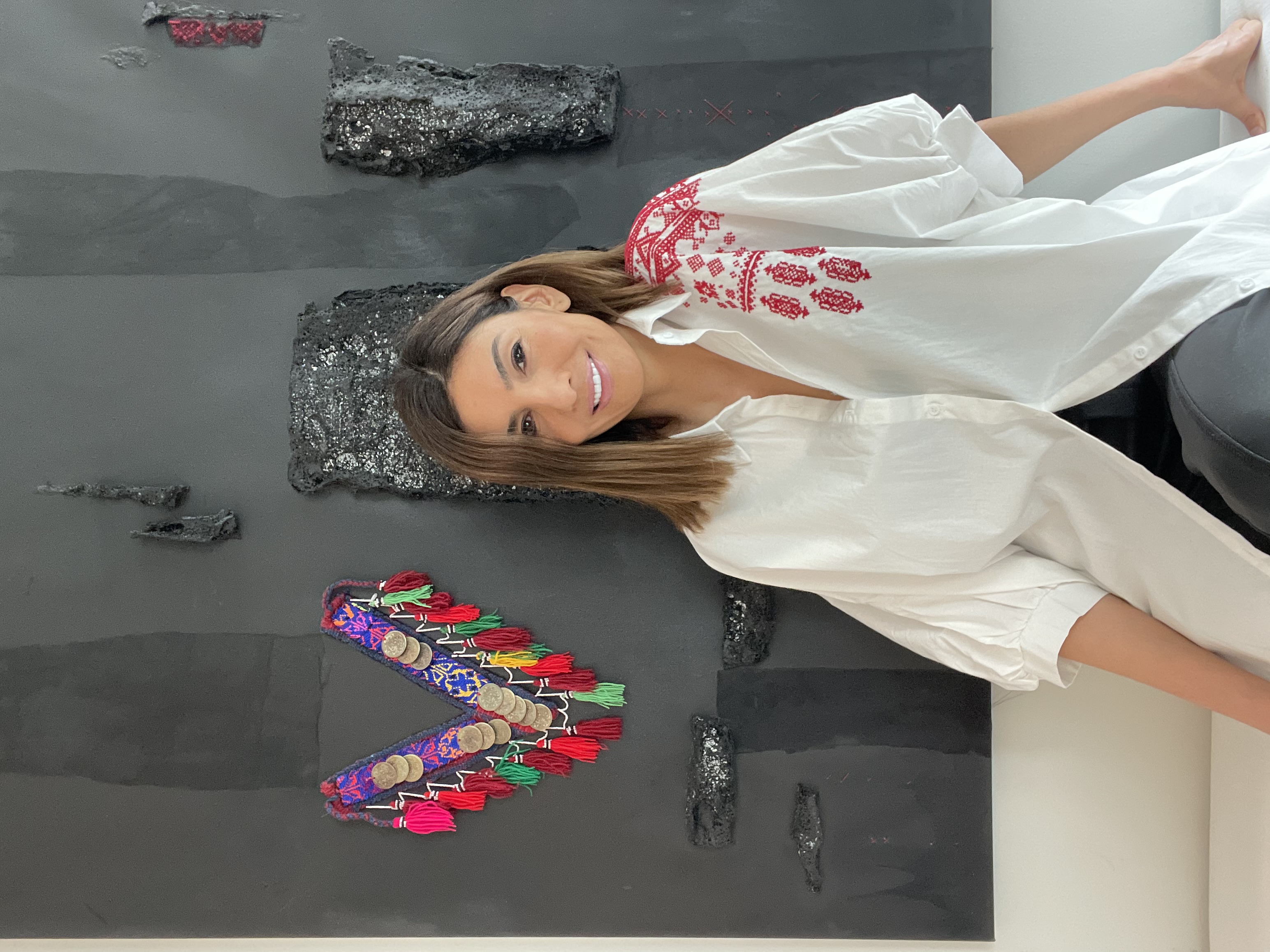
HAMA IS THE OWNER AND FOUNDER OF HAMA, A BRAND MAKING BESPOKE FASHION, CUSTOM TATREEZ ORDERS, READY TO WEAR, ART AND ACCESSORIES (@hama_lifestyle). She begins by sharing her personal connection to Palestine—her name, inspired by poetry, symbolizes the “summit,” and her visit to Palestine in 2010 profoundly shifted her life. Witnessing realities on the ground, from factory struggles to daily restrictions, deepened her connection to heritage.
Hama’s work began with refugee women in Jordan. She learned embroidery from them while teaching fashion and business skills, creating pathways for economic independence. After October 2023, her company redirected all profits to Gaza. For her, tatreez isn’t a static tradition but a living language of resistance and solidarity.
She also reveals new projects: a global thobe made from diaspora textile pieces and a historical timeline of motifs from Canaanite times to today. Her collections, like Black on Black, reflect the present moment—using embroidery to tell stories of resilience, loss, and collective memory.
You’ll hear about:
>> 00:57: The name Hama and her connection to Palestine
>> 06:57: The visit to Palestine that changed everything
>> 11:46: Hama’s relationship to tatreez & its evolution
>> 19:04: Hama Fashion launches
>> 26:44: Current tatreez initiatives
>> 30:59: Design & lessons through this work
>> 43:31: Equitable pay and working with refugees
>> 55:05: Life lessons from tatreez
Rate, Review, & Follow on Your Favorite Podcast Platform
“I love Palestinian embroidery and Tatreez Talk.” <– If that sounds like you, please consider rating and reviewing our show! This helps us elevate the vibrant narratives of Palestinian embroiderers and support more tatreez-ers — just like you — in learning more about tatreez and connecting with each other. You can find us on Spotify, Apple Podcast, and others -- just scroll to the bottom, tap to rate with five stars, and select “Write a Review.” Then be sure to let us know what you loved most about the episode!
Also, if you haven’t done so already, follow the podcast. We’re adding a bunch of bonus episodes to the feed and, if you’re not following, there’s a good chance you’ll miss out. Follow now!
Links Mentioned
>> Hama Fashion Website
Boycott Resolute RGL. Click here for more information.
Boycott ZARA and all Inditex brands—Bershka, Massimo Dutti, Pull & Bear, Stradivarius, Oysho, ZARA Home. Click here for more information.
Follow us @tatreeztalk
Follow Amanne @minamanne & Lina @linasthobe
Links mentioned