Transcriptsyncs with video
Hi stitchers, welcome to Tatreez Talk, where we share conversations about Palestinian embroidery. I'm Lina, here with my co-host Amani, chatting with talented embroiderers and artists, sharing their stories, inspirations, and the cultural significance behind their work. On today's episode, we are chatting with Samar Hosseini, a fine artist who has incorporated tatreez into her beautiful work. Welcome to Tatreez Talk, Samar. Hi, thanks for having me.
Oh, it's such a pleasure. Yeah, Samar, we, um, for our listeners, we got on a call about like a couple months ago maybe, and, um, I knew like from that phone call, I was like, oh my God, we should have you on Daltrees Talk. So I'm so happy we were able to, to make it happen. Um, we always like to kick off, Samar, by asking our guests a little bit about you and your family's connection to Palestine. Would you mind sharing?
Sure, absolutely. Um, so my family is from the Husseini family, and we are in Jerusalem. So it's a pretty well-known family. I used to travel there every summer when I was young, so I have a very strong connection. I used to visit my grandmother and grandfather.
My— they actually were forced to flee in 1948. They were living in West Jerusalem, and my grandfather Dr. Isaac, uh, Hussaini. He actually was a scholar and he had a huge library of books, and he fled because of the war, and he— they were forced to Syria, then to Lebanon, and then they finally ended up in Egypt, and the children were unable to return And that's my father, Dr. Hatem Husseini. And so he pretty much, he grew up outside of Jerusalem. He was 8 years old when they fled.
And, but my grandparents were able to finally return in 1970 because they, my grandfather being a scholar, he was appreciated within the university arena. And he actually started the, uh, a university in, uh, in Jerusalem. It's called— he worked with Hind al-Hassani, who is also a relative of ours. I don't know if you're familiar with Hind. She's— she was actually, um, she started— she founded the Darat Tifl Orphanage and School, uh, in her home in Jerusalem in 1948, right after the massacre of Dar Yassin.
So she opened her home up, and eventually she turned that into Darat Tifl Orphanage. And my grandfather worked with her to start— to found, actually, the Women's Art College at Al-Quds University, which, um, which is pretty awesome. And then that's amazing. Yeah. And then my, um, so my father was involved in politics pretty much all his life.
He was here in the States, and my mother, she grew up in the West Bank in Jerusalem, um, and she, she came here, uh, they were married, and she came here to the States because my father was teaching at, in Northampton, uh, at Smith College up there. That's where I was born. And so, um, he ended up moving. They moved to Washington, D.C., where he started the first PLO office. He worked with the Arab League.
He was a very well-respected political activist and academic, and he really advocated for Palestinian self-determination. And he wrote in the New York Times. He wrote op-eds in the New York Times, the Washington Post. He was on— I don't know if you guys remember the MacNeil-Lehrer Hour.
That was my generation.
But he was on— you can still find videos from him speaking about what was happening with Palestinians. And so a lot of his words really still, unfortunately, they resonate now with everything that's happening. But he finally was able to return to Palestine and he became the president of the Jerusalem University there, but ended up passing away in 1994. So he, he is buried there along with my grandfather and my grandmother. Yeah, so, and my mother, she's here with— she's actually— her story is really wonderful.
You talk about women and, you know, their role in Making us stronger. And she was one of, she actually, in relation to Auntie Hind Husseini, she was my mother's great aunt. And she used to visit her in the school. And she used to tell me stories of how they would sit and listen to classical music and drink tea and really talk about the history of Palestinians and how important education is for Palestinians. And she ended up staying here with my father, and she, she became a private banker for Citibank.
And so she really advocated for, you know, education and promoting cultural exchange. And she did a lot of fundraising as well. She established the Union of Arab Women in the '70s. So she was also very active. But I think I get a lot of You know, from both parents we get so much strength and culture and heritage that it's just really amazing to see the resilience and the strength of our people.
Yeah, you definitely— your family definitely has a beautiful history and foundation that you were able to spring from. I'm curious, for your grandfather, when he fled, and then when he returned, was he ever able to recover any of his books? You mentioned he had a huge library. No, he wasn't. And actually, my grandmother— thanks for asking— my grandmother actually used to tell us that, um, the books are actually in, um, the university, uh, there, um, the, the Israeli university.
So it's very interesting to see how, you know, they, they talk about that The houses were taken, mafrousha, everything inside, books, culture, heritage, photos, everything ready. And, you know, and then to go back and find out that even we're unable to get these remnants, these things that relate to our families. You can see them, they're there. We can touch them, but we can't retrieve them. It's heartbreaking.
Yeah, no, I, uh, I wholeheartedly agree. I, I've heard so many stories of people who've, you know, like you said, they take everything. They've taken their tulps, they've taken their books, they've taken their family pictures. Um, so it's just, uh, I don't know, it's, it's heartbreaking every time you hear, you hear about it. Um, but I, I just, I love the fact that this is your family's history and you have kind of like taken it and we'll talk about how you've taken that into your artwork.
But before we jump into that, let's also talk about your tatreez journey. Obviously, you clearly grew up in an extremely Palestinian family. So tatreez, I'm assuming, has always been a part of your life in some capacity. But when did you really start paying attention to tatreez and gain like your own personal interest in tatreez? So, um, my family here, and, you know, living here in the United States, we were more about politics.
And you talk about, like, always the news was on, on television, the news was on, on the radio. Everywhere I went with my dad, we would have the, you know, the news on the radio in the car. And it wasn't really, um, Takhteriz wasn't really a part of my growing up here in the States. Only when I went, used to visit my grandmother in Jerusalem, she shared a little bit of knowledge of how to tatriz with me. And I, it's funny because I was going through some of my things in my mother's home, you know, that I had packed up, and I found all of this tatriz from when I did, when I, you know, unfinished because I was little, that I was like, oh my gosh, I, you know, I remember doing this.
I remember my teta who who taught me a little bit. But, you know, my grandmother and my mother, they grew up in the city, and it was a little bit different in terms of creating the tatris that we have. Most of our tatris came from the support of women and purchasing the tatris from them that was then passed on from my grandmother to my mother to me. And a lot of the pieces that I have, actually, the toobs, were created for my mother from Dara Tafel, and they, you know, Hind, she would create, she created these pieces when my mother was married, and that was in the '70s. So they are, they're traditional in the Tetris style of them, but they're very non-traditional, uh, in terms, they're more modern, right?
Yes. Sleeves, they're much Yeah, fitting. You know, I love the '70s style. Yeah, I have one from— I have a 1970s, like, obsessed. They're so good.
They are. And, you know, and it's funny though, because now, you know, I'm older, I have two kids, I'm like a little bit more voluptuous, right? There is no way I could fit into those. But my daughter, who's 15, she wears them and she wears them so proudly and she's just so happy to be able to show off her Palestinian heritage and culture. So, um, yeah, so I mean, that's really where I, you know, found my love of, of the tatreez.
And then it wasn't until, you know, several years ago, maybe like probably 10 years ago, that I really started, um, looking back into tatreez and what it means and the symbolism of, you know, where women are from, what their narrative of their story is in these dresses, even pillowcases, scarves, all of this. And I just, I loved it so much. And when I came across all of these pieces, the toobs, the pillows, even pieces that I inherited from my grandmother, it just, it was so dear to me. And so So that's where I started thinking, oh, maybe I can try to start incorporating that into my art, try to start reinterpreting those designs, what they mean, really diving deep into the background of the motifs, which is— and the colors, you know, all of that represents, you know, it all represents where they come from. So it's really quite lovely, that narrative.
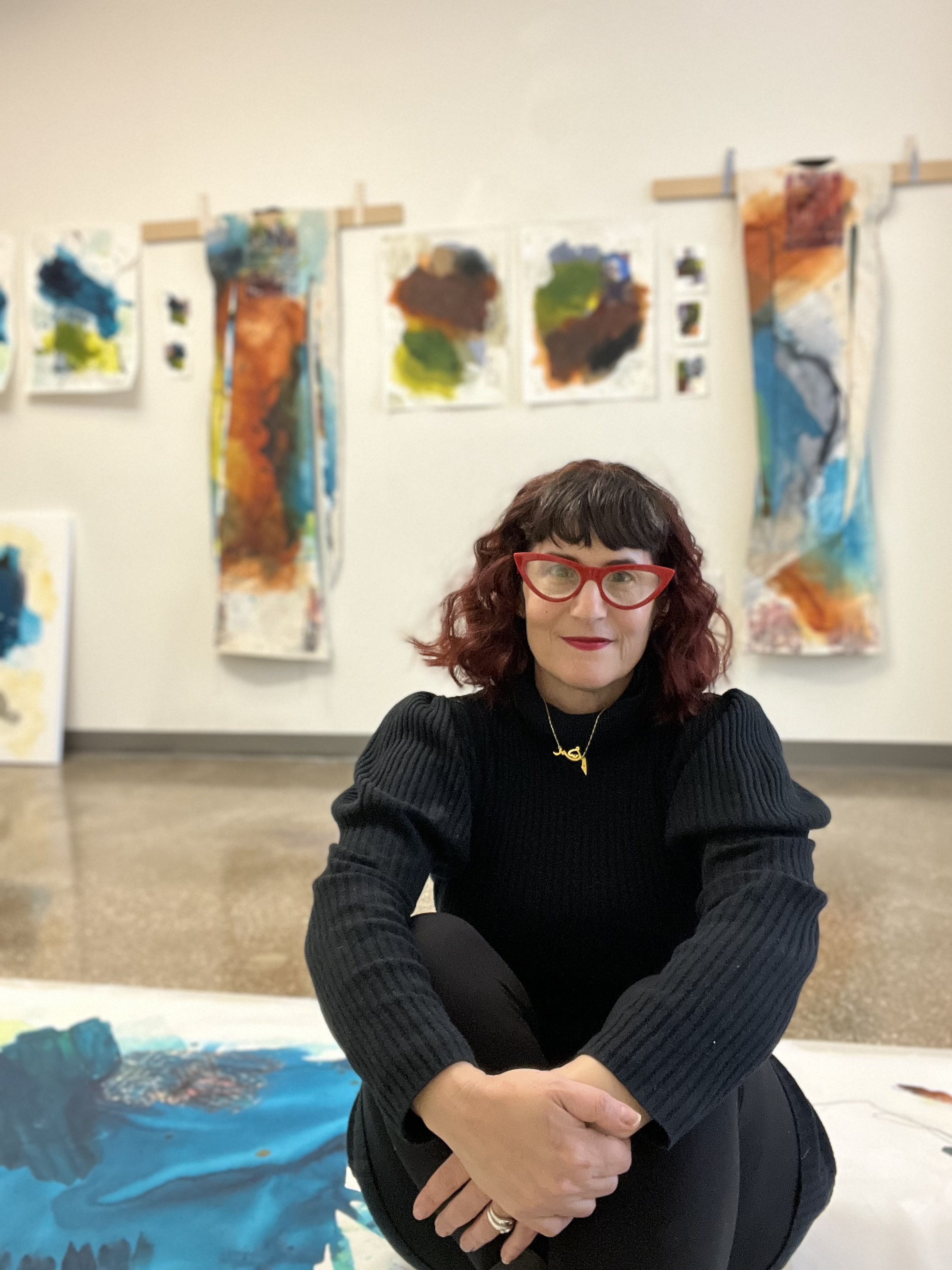
That's beautiful. And I, I, I'm seeing some of your pieces behind you, Amani. They're quite incredible as well. Yeah, I can tell. So I'm curious, you mentioned that you got into it or incorporating it into your art, you know, several years ago.
Do you remember kind of the first piece that you did that had tapris incorporated into it? Well, the very first piece I did. I actually have it right now. It's an abstract piece, and that piece I started incorporating the— always I incorporate motifs that I've inherited, right? So pieces, usually what I do is I take a photograph and then I do a transfer image so that it almost looks as though it's a remnant of the culture, of my history and narrative.
And I also incorporate a lot of of the writing that my father did when he was doing the op-eds for the New York Times and the Washington Post. So that's probably about 10 years ago when I really started incorporating the idea and what it really meant to me about being a part not just of my history but of all of our history and being so proud of sharing it. And I create these sculptural toobs that are all made out of a painting, and then I cut the canvas, and then I create actual 3-dimensional, so you can walk around these sculptural pieces. And they're filled inside with a special wire mesh to make them look as though there's someone inside of them, these toobs. And it's really, they're really meant to honor all of our ancestors and all all of these amazing, beautiful Palestinian women who, who have come before us, who are there with us, who are all of our sisters, who lift us up.
Introducing the drop that nobody asked for, Resolute RGL, the sneaker that takes centuries of Palestinian resistance and sells it back to you in leather. Co-founder Yossi Levin calls it empowerment. We call it exploitation. Same guy who once erased Palestinians from his projects in Haifa, now stitching Tatreez into a shoe to build his quote-unquote multimillion-dollar brand. They say it's bridging local and global.
Translation: Palestinian women stitch, Europe profits, Israel wins. Limited edition, unlimited hypocrisy. Don't buy the hype, boycott Resolute RGL. This anti-ad was produced by Tatreez Talk. We stitch, we talk, we boycott.
Wow. And so those are the pieces you're describing, the quilts that you have behind you, correct? Yes. Okay. We're going to have to share images on social media to show people because those are really cool.
I love the concept. I, I love the way that's painted, correct? Yes. Yeah, it's, it's just, it's really beautiful. I guess, you know, you kind of, you touched on it a little bit, but somebody who is viewing these pieces, like, what is the takeaway?
What's the story you want them to walk away with from these? From the Tog pieces? Yeah. Yeah. You know, I mean, really, it really is for me about the positiveness of the Palestinian culture and heritage.
And I want people to see these pieces as— a lot of people don't even know about our heritage and culture, and they're only just now learning about Tatreez, and people are getting interested. So these dresses were really meant to be about showing the positiveness of the culture and the heritage and And also reflecting on the idea that they're a dress, but they're without a body. And what does that mean, right? What does it mean for us as Palestinians, for people on the outside who are seeing our culture and our heritage being annihilated, right? And so I really the idea of preserving these pieces, not just the original ones, but also for myself as a Palestinian living in the diaspora, unable to really return and live in Palestine.
I want to show through my painting and through these dresses, this idea of what it means to be Palestinian living outside of Palestine. And so that's why they're A lot of the dresses are, the colors are for me reminders of the land, visiting my grandmother and traveling. My mother's family is from Ansiniya, which is right outside of Ramallah. Going and seeing the olive trees that were part of, that's part of their land. Even the toots, picking the toots from the trees there.
The hills, the stones, the mountains.
People, when I tell them how rich and beautiful the land is, they're like, "What? We thought it was just a desert," you know? And I'm like, "No, we have such beauty there. It's such a rich, beautiful environment." So a lot of the dresses are painted that way with these colors to reflect that environment. And then, as I said, then I when I finish the painting, then I cut them and I hand— I'll either hand stitch them or sew them with my sewing machine.
And then I add all of the embroidery that I have that was given to me to the pieces as well. It takes quite a little bit of time, but to create the pieces, there are several steps to it. But, but it's really— I think it's I think it's, for me, it's really wonderful because it's lethargic, you know, it's like getting it out. And the most beautiful thing is to see when people come and see these pieces and they're so, you know, blown away by them and what it, depending on where they come even from the world, if they're Palestinian, they have a different reaction. If they're Irish, they have a different reaction.
Reaction. If they're American, they're, you know, and I, I really love that. And I love that then people will ask me questions. Where is it from? I've had people say to me, what?
Oh wow, that's so cool. Is that Japanese? Right? And, you know, and I, because they think it's the shape is so similar to the Japanese dresses, right? Lena and I have talked about this before and And, you know, there's that connection, right, that, you know, what we wear connects us all throughout the whole world.
But, you know, having to say, no, this is actually Palestinian and this has gone back centuries. And actually tatreez, like, is even centuries further back and how it spread to all over the world. Some people are like, oh, I'm from Eastern Europe and I, my great-grandmother used to do that type of, you know, yeah, of course they did. Went on pilgrimages to Jerusalem. It makes sense that then they, you know, saw the beauty in these pieces, saw how much it meant to them from these pilgrimages, and then they took it back and they started creating it.
Ah, yeah, that is so powerful. And I love that. I love how you frame it as like the purpose of the thobes is to showcase that there is a body missing. And like, to me, the way I interpret that as someone who practices al-triz is like, I see a lot of Even like in the Palestinian community, a lot of organizations that are doing fundraisers and they'll be doing like a raffle for a thobe. And it's like, yeah, but it's a beautiful piece.
But like, who is the person who made it? Like, who's— what Palestinian story are we missing because they're not present with that dress, even though the dress does hold a big part of their story? And so I think that's a really powerful way to kind of have those conversations of like, do you think about who could have worn this or the type of people who made this beauty and what their day-to-day looked like? And also love the reference to the land. And because people really don't know, they have— they've never experienced it.
And so they have no idea that there's so much beauty in Palestine. I'm curious about— and you kind of touched a little bit on it, but I'm curious if there are any like interactions that you had with people that really stood out to you. I know that the kimono comment came up, but perhaps like, I don't know if there was anything else and, and maybe also from like what is the experience like when someone goes to an exhibit of yours? Like, do you do it in specific spaces? Is there like a forum where you can talk about your art and how you incorporate and like where that concept came from?
I'm curious about just that entire experience. I mean, it is an interesting challenge to be Palestinian and presenting my work. It's always been And it does, you know, you asked a question earlier, you know, what the pieces represent. And I remember being a young child and talking to my mother about being Palestinian. And I said to her, you know, Mom, I, you know, I think I was like 6 or 7.
And I said, Oh, I see on TV these Palestinians, they're all terrorists, you know. And she was, she was so shocked. And she said, what are you talking about? No, habibti, like we are, Palestinians are not terrorists. And my father actually wrote an op-ed about it, you know, speaking about the humanity of Palestinians.
There was something, there's always something missing that you know, Palestinians are terrorists, Palestinians are— and so for me, when I create these pieces of work, I approach it as like this feeling of we are human, and I want it to go against the narrative of what is out there in the media, right? And I want people to approach me and to talk to me about what they believe, and hopefully I will change their perspective. A lot of people— I have my exhibits usually in galleries, and a lot of people have come up to me and said things like, "I've never met a Palestinian before. Wow," right? I've had one woman came to my exhibit and she said to me, "Oh, I'm, you know, a liberal Zionist." And after speaking to her, her coming back several times, several times, she said to me, you know, I've never met a Palestinian, and I, I've started to realize that we're taught certain things.
And she was so happy to be able to meet me and to be able to talk and, and to be able to understand the, the other side, the perspective. And, and she, she was like, I want want, you know, more people to know about this because we do— they don't, they have no idea. They don't allow themselves that understanding. They don't, they don't want that, right? Because then it will, you know, get them not to think about what they're actually doing, which is really sad to me.
But, you know, I, I hope that my art can do that. That's for me what I What I love, people come up, they see the work, the idea is to get closer. What is that? Oh, you know, is it like what Lena said? Is it a Japanese dress?
Is, you know, oh, it's an abstract piece. Wait a second, what's that? Getting a little bit closer. What is that? Is that embroidery?
Oh my gosh, there's actual real embroidery and, you know, images of embroidery in there. What does that mean? Tell me more about it. And then as soon as I start talking about it, you know, for the most part, people are very open to the discussion and trying to understand, you know, about Palestinians, which to me is, again, it's sort of the— my whole family has been about activism and positiveness of of being Palestinian. And I feel like that is my way of doing that.
I'm not the best writer. I do it through my art. I create my art and I hope that it draws people in.
This season's hottest look, genocide. From the brand that brought you fast fashion comes fast-track complicity. Zara just opened its largest-ever store in Israel. 45 square meters of settler chic. While Gaza buries its dead.
Their Israeli franchisee hosted far-right minister Itamar Ben-Gvir, who calls for shooting civilians and expelling Palestinians. His review: Beautiful clothes, beautiful Israelis. Our review: Ugly politics. And yes, the jacket ad—mannequins shrouded like Palestinian bodies next to rubble? Zara called it a "misunderstanding" and kept cashing apartheid checks.
Boycott Zara and all Intedex brands: Bershka, Massimo Dutti, Pull&Bear, Stradivarius, Oysho, Zara Home. Because genocide is never in season. This anti-ad was produced by Tatris Talk. We stitch, we talk, we boycott.
Yeah, how— like, in that kind of same, same vein, like, how do you see your art playing, like what role do you see your art in Palestinian liberation? I mean, it's, it's, I see it as a way of people thinking differently about Palestinians, right? That, especially the idea of culture and our heritage and going, you know, the narrative that is out there that there was no Palestine, there was no, there are no Palestinians. And I, I I see it as a way of really making people understand that it goes, our culture and our history go back generations and generations. And through the embroidery, through the writing, through the history, I hope that people can see that in the work and come away with a really positive feeling of of the beauty of it all.
I hope that answered your question. Yeah, I know, that's, that's so powerful. I hopefully I can experience one of your exhibits one of these days, especially because we had talked about this before we started recording, we're not too far from each other. So there is a possibility potentially. Um, I guess what's next for your Taltrīz journey?
Um, do you have any other projects that you're working on right now? Do you have any exhibits coming up? Uh, we'd love to hear So my practice is always evolving, right? So I started painting. I started with painting.
I'm an abstract painter. The idea of layers, layering my culture and my heritage. And then I started going into these sculptural dresses and really exploring how to create these pieces. And now I've started working on freehand machine embroidery, which is— It's sewing with a sewing machine onto water-soluble fabric. And then once the fabric dissolves, you're just left with the stitching.
So the, but the, the idea behind it was that I wanted to take Tetris embroidery that I inherited, and I wanted to be able to create my own version of it as someone here in the United States, Palestinian growing up, and what that meant to me. And so I discovered this freehand machine embroidery. And so I started creating these pieces and I took the design of the, the embroidery and I translate it into my own narrative through this style of design. And then what I've been doing also is working on the art, tearing it apart, and then having the embroidery, this type of freehand machine embroidery, stitch the pieces back together again. So it's, it's on multi-levels.
It's showing how our embroidery lifts us up, how it also can be transformed into something bigger, and it's also because I float the pieces on, um, on the— in the frames, the shadow that it casts from these, these designs really for me represent our ancestors lifting us up and always being behind us. Yeah, that's beautiful. I love that. Okay, definitely need to see some visuals of that. Um, it's really cool.
I feel like I've seen what you're talking about, this like the freehand embroidery with the water-soluble fabric. And it's very interesting. How did you— how do you typically like stumble upon these new mediums and these new kind of like experiments, I guess, that you're doing with your art? Well, I think it's just I'm constantly trying to learn new things and new techniques for my art, just really trying to push myself. Into, you know, creating work that, that's also meaningful for me and but also is new and innovative.
So when someone sees it, they're like, wow, like, you know, that's, that's really great. And what is the meaning behind it? And so I, I stumbled on the freehand sewing. There's an artist in Australia who her name is Meredith Woollo, and she does does these beautiful, um, sewing. Is she the one that does like, it's like corals?
Yes, she does. Yeah, they're beautiful. So I stumbled upon her and she, she's actually my teacher, so I took several courses with her. And then from that, then I started exploring my own way of creating the designs, and it's really like if you get really close to it, you'll see that there's, it's not just the design of the Tetris, it's also there's, there's layers in between it as well. So, um, I'll share that with you guys.
Yes, really, it's very fun. It's a fun process. It's, it takes quite a while, but, um, it's very meditative. Which is the same as tapestries, is a very meditative process of like just really sitting, thinking, mathematical, like with the sewing machine, the freehand sewing machine, everything has to be connected. Everything has to be touching because once the fabric dissolves, uh, the stitching, you know, if it's not connected, will fall apart.
And, you know, we know that with tatris, right, the stitching on the front has to be as clean as the stitching on the back. You have to have certain space, you know, it's like it's all related to each other, which, which is really fun to see. Yeah, I love that. And this— I'm just like imagining also just on a, on a human level, like we are all connected, like all of our stories, we don't just like like poof come out of nowhere, you know, all of us are connected to each other. And that is, that is a really powerful image, um, that I'm having in my head.
So thank you. Thank you for sharing that. I'm curious also, um, because you're doing a lot of like machine embroidery and then you, you take photos of existing pieces and then you also mentioned, I think, embroidery on the actual sculptures. Do you, do you do the embroidery as well or Or it's mostly just transfer? It's mostly transfer because it— because the, um, it's not fabric, it's actual canvas.
Um, so, and there's paint on top of the canvas, so I paint in layers, so it's much harder. But I do try to add a few stitches in there, which are, you know, the cross stitch, a few little designs. Uh, but it is very difficult to do. So, um, but it's, it is mostly image transfer on the dresses. Yes.
But you will find some, some of my pieces, the ones that are not as layered, um, that I have started actually embroidering on, on the work. And sometimes the nice thing about it is because my work is so, um, so layered and there's, uh, that that you don't even notice the actual embroidery part of it. You see the embroidery, but you think that it's part of the painting. And then again, it's not until you get close up that you start to realize that it's, it's actually, it's actually thread on there. And, and to me, that's like, that is really what it is to be human, right?
Is, is this idea that we see something from far away. We think it's interesting and we get a little closer. And that to me is what I think— I feel sometimes we need to reinforce with humanity, right? Is that we need to be getting a little bit closer. We need to be seeing things and understanding things from a closer vantage point rather than far away.
Yeah, definitely. Especially today, especially in today's world, especially I think for Palestinians with everything that's going on, us witnessing genocide from all over the world. So yeah, I wholeheartedly agree. So Samar, we have to ask you, are there any major life lessons that you've gained from Tetris? I have.
I'm so excited to share this with you. Yes, I have been like waiting for this question. Yes, there is. And, um, so when I, when I was, uh, talking to my daughter, you know, she's 15, and I was telling her about Tetris, and I said, you know what, we should, we should, I should start you learning how to do Tetris. And she was like, I think at the time she was like 12, she was like, meh, I don't Really?
Okay, I think so. It looks kind of cool. So I took her, I taught her myself. I took her to some classes and she loved it. And she started, you know, 12, 13, 14, 15.
She started doing these pieces, giving them to her grandmother on my husband's side, you know, my mother, making them for the holidays, giving them to friends. And I— it filled my heart so much to see her doing this. Number one, because passing on that tradition, that Palestinian tradition, but more so because— so she, as a teenager, as most people know, teenagers tend to have little patience. And I was I was like shocked to see that she actually gained more patience and more understanding of, um, by doing the Tetris. She would make a mistake at the beginning, she would get frustrated and angry and throw it across the room.
And I'd say to her, you know, take a moment, take a breath. 'Look at your piece. Yes, you made a mistake, but that's okay. Mistakes are part of the process.' And slowly over time, it, it gave her this beautiful calmness that she started having taking over her by, by doing this embroidery, realizing that mistakes are okay, by going through. She doesn't have to be perfect.
And I saw it then go into her life, right? How she was with her friends, how she is now with her, the work that she does. She's not as hard on herself. She and I, I just, that to me was like the biggest, most wonderful life lesson of, of being able to pass on that Tetris because it, it's, it really truly is a learning experience, right? And it gives us not only understanding of where we come from, understanding of how it's passed on, but also it gives us this calmness of, of, of how to work, of how to create.
And yeah, so that's— I love it. Oh my goodness. Pro mom tip for any angsty teenagers. I love it. More reason to teach your daughters, Tatriz.
Oh, that's so beautiful, Summer. Thank you for sharing. I loved— I love that life lesson. That's powerful. Before, before we let you go, where can everyone find you?
Follow along your work and maybe, uh, know about the next exhibit that you might have? Yes. So, um, we— I have a website. It's www.summerdesigns.com. And then my Instagram, you can follow me on Instagram.
That's where I mainly post all of my process or where I'm having my shows, exhibits, and that's Summer Designs and Art, uh, which I'm sure you guys will be able to post as well. Yes. Um, yeah. But I have a lot of things going on right now. I have— I'm working with Rutgers University.
I'm working with local galleries, local museums. There might be something in the works in Michigan. So there's a lot of stuff that's happening in the next 2 years, which I'm really excited about. Amazing. You're keeping busy.
Yeah. Can't wait to see it. We need more Palestinian art in the world. So excited to see everything that you have coming coming along. But thank you so much for being here, Samad.
Um, we were really excited to be able to have this conversation. It was beautiful, and we really appreciate your time and your art. Thank you. I am so grateful for the two of you. I have been following you for a while, and I just want to say thank you both for doing this.
It's— I know it's a lot of work, and it's so important, especially right now, and, um, to, to be able to show Palestinians in a positive light. And I'm really grateful to the both of you as well for doing this. Thank you. Thanks for having me. Thank you.
Thank you.
I was so happy to have Samah on the podcast. I just, I knew when we met that I wanted to have her join us and share her story. And I love, it's so interesting, Amani, because like when I talk to people individually, like I have a conversation We don't necessarily go through the script that we go through, but like the guide. And then so it's so interesting to hear their family story in connection to Palestine in this format, because I didn't hear it from her when we chatted. And it is so crazy how you really get to know someone through these interviews and document their story in a way.
So I'm really happy. It's also the second Harsaney this season. Oh yeah, which is so funny. We're getting a lot of Hassani love on Talk. Um, there you go.
I love it. Yeah, no, um, it's really— it was really great chatting with her. I, um, one, her sharing her family's history, it was beautiful to hear. And, um, you just— you kind of see, I think, the importance of this, like, cultural preservation and, like, how it's been passed down through generations, like she was talking, and we talked a little bit more after we recorded about her daughter and her daughter's own tatvri's journey that she was able to pass on to her, which is just, I don't know, it's just so beautiful. And it's like what we always talk about is like so important.
It's the combination of preserving the culture and continuing the culture, you know? It's twofold. And we definitely could have continued talking forever, but really excited to see her work. She also told us she's gonna send us like some videos that we'll share on social with people so you can actually see the process of her work. And I mean, just the way she described it is really cool.
And I think this should also encourage people yet again, if you're Palestinian, this is your art, this is your culture. So play with tatris, explore tatris, make it your own, and then show us what you do. All right. Well, of course, thank you all for listening to Tatris Talk. As always, we want to hear about your tatris journey.
So share your stories with us at tatristalk@gmail.com and we might have you on an upcoming episode. Do not forget to subscribe to the podcast on your favorite listening platform and be sure to give us a 5-star review. You can follow me @minamani and Lina @linasthob and follow the pod @thethreestalk. We'll talk to you soon.
About this episode
SAMAR HUSSAINI IS A FINE ARTIST WHO HAS INCORPORATED TATREEZ INTO HER BEAUTIFUL WORK (@samardesignsandart). Samar shares her powerful family history rooted in Jerusalem, tracing her grandparents’ forced displacement in 1948, her grandfather’s scholarly work, and her parents’ lifelong political activism. Growing up between the U.S. and her Palestinian heritage, she reflects on the deep influence of her family—particularly the women—who preserved culture, education, and resilience across generations.
She describes how tatreez re-emerged in her life through inherited pieces, memories of her grandmother teaching her, and eventually through her work as a fine artist. Samar now creates sculptural thobes and layered paintings incorporating image transfers of tatreez, remnants of family embroidery, and even fragments of her father’s political writings. Her work centers on absence, memory, land, and the emotional experience of Palestinians in the diaspora.
Samar emphasizes how art allows her to humanize Palestinians and shift narratives in gallery spaces, often serving as her form of activism. She shares emotional stories of viewers who had never met a Palestinian before, and how her work creates openings for connection, empathy, and dialogue. She also discusses passing tatreez to her daughter and the life lessons—patience, calmness, embracing mistakes—that stitching helped instill.
You’ll hear about:
>> 00:52: Samar’s connection to Palestine
>> 08:11: Connection with tatreez
>> 12:28: Incorporating tatreez into Samar’s fine art
>> 15:56: What Samar hopes people takeaway from her art
>> 21:44: Interacting with visitors viewing her art
>> 27:25: The role of art in Palestinian liberation
>> 28:46: What’s next for Samar
>> 36:36: Samar’s major life lesson from tatreez
Rate, Review, & Follow on Your Favorite Podcast Platform
“I love Palestinian embroidery and Tatreez Talk.” <– If that sounds like you, please consider rating and reviewing our show! This helps us elevate the vibrant narratives of Palestinian embroiderers and support more tatreez-ers — just like you — in learning more about tatreez and connecting with each other. You can find us on Spotify, Apple Podcast, and others -- just scroll to the bottom, tap to rate with five stars, and select “Write a Review.” Then be sure to let us know what you loved most about the episode!
Also, if you haven’t done so already, follow the podcast. We’re adding a bunch of bonus episodes to the feed and, if you’re not following, there’s a good chance you’ll miss out. Follow now!
Links Mentioned
>> Samar Designs Website
>> Meredith Woolnough on Instagram (water soluble embroidery technique)
Boycott Resolute RGL. Click here for more information.
Boycott ZARA and all Inditex brands—Bershka, Massimo Dutti, Pull & Bear, Stradivarius, Oysho, ZARA Home. Click here for more information.
Follow us @tatreeztalk
Follow Amanne @minamanne & Lina @linasthobe
Links mentioned