Transcriptsyncs with video
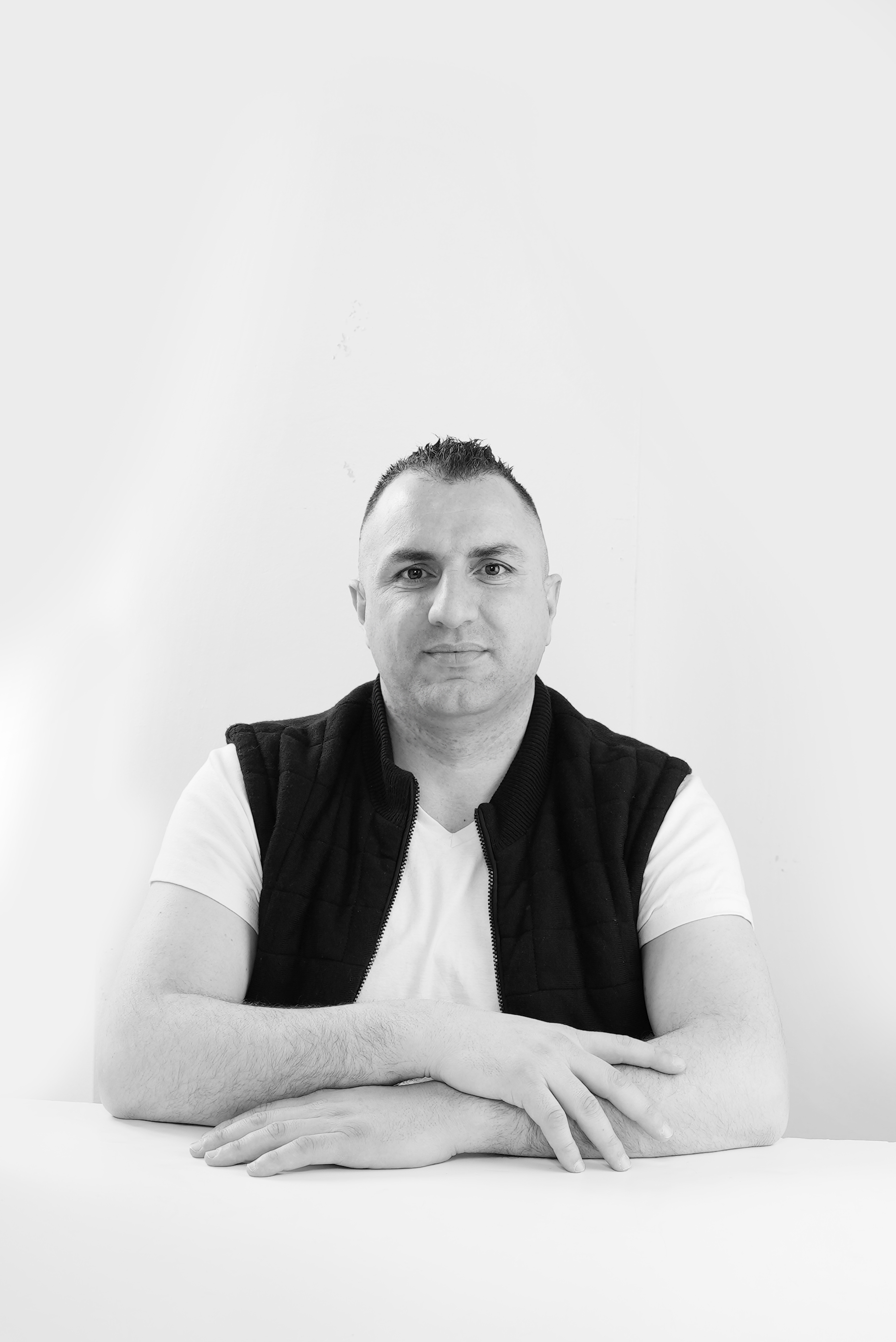
Hi stitchers, welcome to Tatreez Talk, where we share conversations about Palestinian embroidery. I'm Lina, here with my co-host Amani, chatting with talented embroiderers and artists, sharing their stories, inspirations, and the cultural significance behind their work. On today's episode, we are chatting with Bilal Herbawi— sorry, I screwed up your last name already— a lecturer and graphic designer focusing on integrating traditional tatreez motifs and patterns into modern design practices and trying to bridge the gap between heritage and contemporary aesthetics, preserving the cultural significance of tatris while adapting it for contemporary applications. Welcome to Tatris Talk, Bilal. Thank you.
Thank you for having me here also. I'm sure it will be a nice conversation here. Yes, please. About tatris and about digitizing. Yes, I'm so excited to talk to you about that.
It's— I know, I know a lot of people who listen are also very interested in the world of digitizing and how so many different artists are bringing tatris into new technology and into like this new world that we live in. So we'll talk all about that. Yeah. And I remember, I remember Amani shared your profile with me when we were looking for guests to join us on the podcast. And I remember like just being so blown away by the colors that you use, like super bright, like very, I don't know, enjoyable colors to experience.
So I'm excited for our listeners to also get introduced to your work because I think it'll be really, really wonderful to see that, seeing more applications of tatreez. But before we get into all of your work with tatreez, Bilal, we always like to ask, you know, what is your connection to Palestine? I know you are joining us from Palestine, but we'd love to hear about your family and your connection to Palestine. Yes, actually, um, the main connection may be, and it's related from the beginning of my life, from my childhood, I'm working with my father in textiles. So I'm related somehow in textiles factory, and until 23 years old, I'm still working with yarn and the threads and everything.
And the main important thing that actually my family owned the last keffiyeh factory, the Herbawi brand, which is internationally now famous, especially for the people who solidarity with Palestine. I'm a Palestinian. So it's, this is the main connection. It's direct related to Palestine and Palestinian culture and resistance, actually. And you grew up in Bilqalid, right?
Yes, I'm in Hebron. Yes, yes. And right now, um, you are— I know you're in Palestine right now, um, but you're, you're living in Portugal, is that correct? I was spending around, uh, it's a few months, you know, it's a few 3 months, 3 months, like this. It's different periods, it's not connected.
Yeah, but yes, I was there more for 8 months, around 8 months, and I'm starting my PhD there, a PhD in design actually. And, um, you know, I select the subject, the research subject related to Palestinian traditional motifs, actually, because, you know, when you see these kind of motifs and these kind of patterns and you imagine that it's created before many decades. While I'm researching, I saw a thobe with 150 years old. So it's just— Yeah. And how Arula Ruman can create something with this perfection, you know.
So because of that, I think why not to integrate these beautiful and fabulous patterns, these compositions actually. Why we cannot integrate it into graphic design, into design as we will later talk about that. But I'm focusing on what I'm working on as a graphic designer. Yeah, so why we cannot focusing or use it as a design element in the modern graphic design? Some— someone said, may said that it already exists.
Yes, but, but the main idea of my project is to encourage designers, is disseminate, disseminate the idea of using these motifs and to make it, um, not, not a habit, but it's to make it more familiar. Yeah, designer, and they can use it, and also more familiar with the public. Yeah, I love that. Okay, we're definitely going to talk a lot about this. Before we dive into that too, I'm, you know, going back to kind of your childhood and growing up, um, and working with textiles with your family, and your family continuing to work with textiles.
Um, how did Tetris Obviously being Palestinian, tatreez is always a part of just everyday life, but how did tatreez become something that you personally were interested in beyond just, okay, this is what is something that Palestinians do? It's something come with nature. I don't know. But when I designed my home here in Hebron, I included tatreez everywhere. In the cushions, in the roof, in the decoration, even in the wood itself, there is some kind of motifs.
And that's before I started the journey of the trees and the journey of digitizing of motifs. But I think it's something for Palestine, it's come by natural, by nature, okay.
And let's say in Arabic, I think all Palestinians in love with this kind of crafts, let's say, and of tatris. Yeah. And did you manage to practice it yourself? Have you tried doing tatris before? Do you have family members who do tatris?
Yes, actually the main idea of this, that's when I start the project, I need to involve, to be involved in the tattooist community. So I'm researching the subject and the topic from their view. So I'm start to learn stitching and tattoos, and I have all the materials here also. I brought all the books related to tattoos. And I'm not very good, actually.
It needs time, actually. And it needs to be patient and spending a lot of time. And that's actually— I don't have. So yes, but I'm learning. I joined maybe more than 5 workshops related to the 3D.
Yes, I will tell you exactly about each one. And each one is different, different kind of interest of Tathagata. It's not just learning Tathagata. Something, one of the workshops is Tathagata as a reflective action. Oh, okay.
Kind of meditation and you're spending the music also. Yes. And you You trace, you embroider randomly without any shape in your mind. Just do it, and then you realize that you are creating some kind of shapes and some kinds of composition randomly. And, and this is really surprised.
That's really cool. Where did you take this workshop? Oh, Bethlehem. Okay, I'll see. Lena, we need to, uh, we need to take an educational trip to Palestine, a research trip ASAP.
Oh, we've been thinking about it for so long, for sure. Wow. Okay, so can you tell us about the other workshops that you've taken? The other Japanese workshops? Um, another— yes, another workshop is in the Palestinian Museum.
Uh, it's about Mr. Vish, um, you know, the fabrics. And also it's have— you, they learned you— actually, it's 6 hours, I think. They learned you how to, uh, thermim, uh, Disturbation, I think it's like this, thermim. So, and this was maybe more than 40 participants. Oh wow.
Okay. Each one have his own bees and there's 3 tutors who learn you how to, um, to do the process. And it's a very long process actually. And it's a very sensitive process. Yani, when you have, um, damaged fabrics, damaged dress, the top, and you need to fix it and to make it like come back again to life.
Yeah. The process. Another workshop, actually, that's how I was helped actually, and it's maybe you see in my profile Threads of Creativity. Yes, Threads of Creativity. Actually, it's two versions, two editions of Threads of Creativity.
The first one, actually, it was here also in Palestine. I gathering, or it's combined, three or four any graphic designer with interior designer with fashion designer. I bring all these designers together and with artisans, with the 3 artisans. Okay. And the main idea that you need to create just a poster.
You need to create the poster with the motif. So they have the motifs like stamps. I do it manually. I kept it manually, maybe around 50 motifs with different size, and you need to make a composition. Okay.
So, um, your own composition, just do it. So the, the motifs, uh, sorry, I moved my hand. No, you're fine.
So the motifs around the tables, there is also stickers, motifs, branded motifs, and there is the threads. The threads, that's the part which the artisans will do. 3 or 4 designers, you know, the tattooist, the embroiderer doing their part, the interior designer doing their part, the graphic designer doing their part, and we all together discuss everything. Let's do this, let's do this. So the outputs, maybe I must give a lecture about the output of this workshop because it's very interesting to see how people interact with this kind.
And it's a new process, you know. Never— no one do it in Palestine to use printing techniques with the graphic symbols, with the embroiders and the threads and yarn. So this is a new— and the participant very impressive of the process itself rather than the result. So the other part is also in the thread for creativity, the Threads of Creativity 1, let's say 1, the first edition is 2 parts: lectures, one part is lectures from different also countries, researchers and artisans from different places, and the other part is the practical that we generate our posters. Threads of Creativity 2, actually, which I'm still working on, is the international design challenge that I'm invited.
Maybe more than 200 graphic design— it's just a graphic design. So I'm invited 200 graphic designers from all over the world. Yani, there is from Taiwan, there is from China. Turkey, from, uh, there is a lot of people from the Arab world actually, from USA also there is some graphic designers, Spain, Germany, and a lot, a lot of countries. So the main idea of this project, and I give them, if, and you, you might, you, you sure you know about that, that TerraZane website online archive.
I make it as a reference for the motifs, and it's a huge archive actually. So this is the main resources for the motifs they use, and the idea just generate a pattern using these motifs. And the exhibition will held soon, but the result is insane, you know. It's kind of international perspective to the trees. And you give these designers open source of motifs and they combine it in very nice way, actually.
Actually, some designers don't understand the main objective of the challenge, but the result is, for me, is was very satisfying. That's the main idea. But the exhibition will held here in Hebron also, and there is another version it will held online, actually online exhibition, uh, in 15 days I will announce about it also. Okay, that's very exciting. I was going to ask how people can see it if they're not there.
So I know people are going to be really— that's, that's a very cool concept, I, uh, getting all these different interpretations of Tetris and Tetris design. Yeah, for me personally, I always, um, I always find that interesting to see people's interpretation. I'm, you know, in that world too of that. Has that, as you've gone through the process, has that opened up anything for you personally with your designs?
Introducing the drop that nobody asked for. Resolute RGL, the sneaker that takes centuries of Palestinian resistance and sells it back to you in leather. Co-founder Yossi Levin calls it empowerment.
We call it exploitation. Same guy who once erased Palestinians from his projects in Haifa, now stitching Tatreez into a shoe to build his quote-unquote "multimillion-dollar brand." They say it's bridging local and global. Translation: Palestinian women stitch, Europe profits, Israel wins. Limited edition, unlimited hypocrisy. Don't buy the hype, boycott Resolute RGL.
This anti-ad was produced by Tatreez Talk. We stitch, we talk, we boycott.
Uh, that's a very big question, a very important question, Yanni. You know, the VHD journey, actually my VHD journey is a very big journey actually, and the project is bigger than what I, I think, you know. So I'm working now, and that's That I think will change how graphic designers, especially graphic designers, deals with traditional patterns and motifs. That's because I am now designing a manual, a guide, how you can use these motifs, kind of repetition. And you know, there is many kind of repetition, many kinds that you can generate patterns, you know.
I put rules, some rules.
The first of my journey, I start learning about Islamic geometric shape rules, you know. I'm trying to apply Islamic geometric shape and Palestinian traditional motifs. Yeah, it's a mathematical process. Kind of process for me. So that's the idea.
I think if I success, and inshallah I will, it's here, I'm start designing that. I think it will change the way we're looking for the traditional motifs itself. So this is one of the big challenges and achievements, I think. Also, there's another big challenge while I'm designing and digitizing, but I think I success in this challenge, you know. And as, as Lina said, um, the colorful and something like that.
When I meet the artisans in different workshops, I visit many workshops and Tatreez hubs here in Palestine The main idea they focus on, it's about the color. They focus about the color and the shape. And that's the main challenge. Even I held, I participated in 4 conferences, international conferences about this subject also. And every time they asked me this question, how you will save the originality of the motifs.
And this is a big challenge. But when I share it on social media and get the feedbacks, get the feedback from artisans and tweezers already, actually they like it very much. And they, yes, it's very nice. It's a new way of thinking, something like that.
But one of the funny stories I have when I have connected with Artisans, she saw the image I create and she said, oh my God, how much stitches in this design. There's, that's a thousand of stitches. So how, oh my God, I didn't think about the stitches. I never, when I design and make this composition, I never think about the stitches. But that's like, you know, a hint.
If you want your work to apply in different format, in fashion, in graphic, and you need to take that, Yanni, in your mind. Okay. So yes, I start to think about, yes, if you want to do it manually, it will take one year with you. Okay. So that's the idea.
Yes. I think I learned a lot from the tutorials.
From the Tatreez journey, I'm still learning, actually. Yeah, I mean, Amani and I can both— we both understand that sentiment, and we've heard it also. Like, I've gotten, like, comments about the colors that I use versus, you know, what's the traditional colors, and everyone wants to make sure that they're honoring, you know, the legacy of Tatreez, which is 100%, you know, that's very true. We have to preserve kind of the original way of practicing, but at the same time, it's okay to play and innovate and, you know, try different colors. Um, so I'm so happy to see that you're also kind of tapping into that because I think there's a lot there.
And, um, you know, to your point about graphic design or exploring tapestries through graphic design is really interesting because you don't have to think about the number of stitches. Like, you can like put many things and see what happens. If they don't like it, you can change it very quickly. It doesn't take you like hours and hours to undo. Um, so I think that's also a very interesting way of exploring more.
I'm curious, now that you've introduced Tatreez to other people who are not Palestinian and who maybe don't really know much about the history, I'm curious, you know, what has that kind of opened up in terms of, I don't know, like thinking about how you talk about Tatreez or just innovating and thinking about, I know you mentioned in your form, the open source, like having this accessible to people who maybe don't have the books or don't have the thulbs or don't have the pieces with them. I'm curious curious about just that, that exchange of ideas as you were working with those designers.
Yes, um, let's, um, say that after the war started, actually, that the trees, we can all recognize that it's become more familiar internationally, globally. So because of that, I think it's make easier for me and for other artisans and designers who use tattoos in different kinds as a modern fashion pieces or different kinds of modernization process. This is the first one. So I think people now familiar with Palestinian tattoos. Okay, but there is another point of the other side, because I have it question many time, but I didn't answer that actually.
How you recognize the Palestinian tattoos, you know, how you can— I don't know how the word in English.
Because they have the same roots, maybe, or something like that, you know. So the main idea of the project, again, that the manual— let's talk about the manual— the manual will have historical information, and that's part also of the project. Okay, it will not be like a book, a history book about the trees. It will have some information and some stories, you know. It's a language, Yani.
These motifs, it's a kind of language created by Palestinian women. So you must save the originality of the story itself. Okay, you can, as you said, play with the colors, some, some changes and innovation, but you need to reflect the original story about the motifs itself and the battle. I think people start recognize the Palestinian tattoos and there is no way that you can, they can separate it from the Palestinian culture, you know. Now it's kind of fixed item.
No one can destroy this connection between Palestine and the tattoos, you know. So the open source also, the open source of the motifs and the patterns I think it's kind of an easy process. It will make easier for the designer to use these motifs. It's easy to add also. It will be kind of, uh, transparent, I think.
It's something like that. So they can add, they can download, they can update also. So every designer, or every designer Palestinian, or who interested in Palestinian culture, who can use these motifs in their own ways. But there is multiple options or variations actually from each motifs. Okay, I will not do it for 2,000 motifs or 1,000 motifs.
But in the start, it will be around 50 motifs, 30 to 50 motifs with variations. So the projects gain an international or gain interest actually, and people really start to use it. So I'm sure it's a kind of the purpose of doing your PhD is to cooperate with people and make it practical, not just a theoretical, um, thesis and theoretical science and just, just to get to gain the degree. So I, I think, I'm sure I will make it practical and people will use this manual and use this online source, open source, effectively. In Palestine specifically, you kind of touched on talking to different, uh, tattoo users and artisans in Palestine.
How are people reacting, I guess, the more work that you're doing in this space? How are people, I think especially people who, as we talked about, I think Palestinians, we're very hard on ourselves, and we really, really want to preserve as much as possible. So how are these people reacting now as keep seeing your work unfold? That I must answer in Arabic, it's easier, but I will answer in English. I think there is two part of this.
The first part, two part of answering this question. The first part, people here very interesting about the first result of the project. And you know, I didn't show the project itself. It's just, it's need more time, maybe few months Wanted, but the, the, the posted, the, the design I post on social media, actually, they, I have a very good feedback from here, from Palestinian people. Um, but the main idea, the main idea of the project also, uh, to integrate this in, yeah, when you go to shop in the mall or something like that, you, I, I, I, I make a search There is nothing having any traditional motifs on it.
Maybe just one product, two products just. So why we don't have it in Palestine? That's the main idea, to encourage designers to use this in their design and packaging, in branding. I search for Palestinian companies use motifs in their logos. There is no one, maybe just one.
I think I don't need to mention the name. But that's the idea. So we have kind of taksir, let's say, okay, we need to do more preserving, activating, actually activating these motifs during the daily life and daily life, I mean, of Palestinian daily life in advertising, in branding, in, okay, it's already exists. In fashion design, but we need to extract from the fabric to other applications. And the main idea that it's acceptable, these changes.
I tried in interior design, the result was fabulous. I tried in the flower pots. I will show in the result of the exhibition. Some of designers do it, the flower pots, and using the flower pots motifs, it's called the flower. Oh yeah, yeah, yeah.
And he used it as a flower pot and he printed the 3D. That's fabulous. Yeah. So the traditional Palestinian motifs actually accept that changes without, as again, I said, without you losing the authenticity of the sustainability. Of the motif, the originality of the motifs itself.
So I think, yes, what we need to do more as designers and also, Yanni, for me as a normal Palestinian person, before I started this journey, I never thought about the name of the motifs, you know. When I started the journey, now I can recognize that's from Bethlehem, this is from Jericho, this is from Gaza, this is from— when I was visiting some workshops here, I asked the artisans, but this is motifs from Gaza, why you mix it with Ramallah motifs? I don't know.
So I start now to recognize all these kind of stuff. I know the thoughts of all the regions. Yeah. But it's, you know, it's It needs more time, it needs more efforts. I cannot do it alone.
So I encourage designers actually, and now it's the turn of graphic designer. Now maybe around 10 designers will help me to, after the manual is ready, to use it and to generate also a new perspective and of the motifs. And let's back to the Threads of Creativity too. Actually, this is the first international graphic posters related to Palestinian tattoos, international, you know. This is the first time.
I'm sure no one do it before. So this is— and one of the main objective of the project is to disseminate the culture, the Palestinian culture. And I got several feedback that it's an honor, such an honor to us from the designers to be a part of this project.
And that's it, Yanni. I think we need— there is a lot to do actually as Palestinians and as designers. You know, a lot of what you said, I'm sitting here and I'm shaking my head, yes, yes, yes, because I agree. I think it's very exciting to see tatris in different forms. I, even as you're talking, when you first started talking, when we started the episode and you're talking about your home and how you decorate tatris in different ways, I think about that and I'm like, oh, I want to decorate my home with all these different things because it is, I think, even as you talked about Islamic art and Islamic geographical art, I love that art too, because similar to Tetris, it is very geographic, very mathematical.
Yes. And there's beauty in that. And so it's very cool to see that come in different forms. So, I mean, I support it, obviously. Thank you very much.
I very much support it. But I also, I am curious to how for you, I know you don't stitch a lot, but you do know how to stitch. How has it changed like yours, like the specific work that you're doing, like your artwork?
This season's hottest look, genocide. From the brand that brought you fast fashion comes fast-track complicity. Zara just opened its largest-ever store in Israel. 45 square meters of settler chic. While Gaza buries its dead.
Their Israeli franchisee hosted far-right minister Itamar Ben-Gvir, who calls for shooting civilians and expelling Palestinians. His review: "Beautiful clothes, beautiful Israelis." Our review: ugly politics. And yes, the jacket ad—mannequins shrouded like Palestinian bodies next to rubble? Zara called it a "misunderstanding" and kept cashing apartheid checks. Boycott Zara and all Intedex brands: Bershka, Massimo Dutti, Pull&Bear, Stradivarius, Oysho, Zara Home.
Because genocide is never in season. This anti-ad was produced by Tatriz Talk. We stitch, we talk, we boycott.
Do you mean the Tatriz? Mm-hmm. But there is something actually very interesting in the tatreez process, and they use it manually, and they use it in the digital— who use digital applications. There is two kind of artisans, you know, or tatreezers or embroiderers. Some who use just manual process with the etamine and, you know, everything by hand.
Yeah, hand. And there is another kind of tatreezers who draw using the different kind of applications. So, and you know, the X-stitch is the main stitch or the most famous, you know. So when I start digitizing and I study all the techniques they use it, I found the squares techniques is very fabulous, you know. They use the square techniques and the square paper is sometimes also Even the application use a square paper and you stitch and start to fill.
So these techniques I involved in my designing process, normal designing process I mean, not just rooted trees, but this technique, the squares techniques, and even I use it manually in the stitch paper. I start to draw shapes on, it's kind of, you know, it's kind of easy way to draw. And okay, the, the, the straight shapes, but this process, I think one of the objectives to learn the trees and to learn the techniques around behind the trees, you know. And that's one of the— that affect me very much. I'm use it a lot now, in many times I'm use it.
Yesterday I use to generate different kinds of repetition. So I think this is also will be main part of my manual, you know, because I study many of manuals, graphic manuals, and they use it, the graph paper, you know, the graph paper. Yeah, yeah. A lot in this kind of repetitions. Exactly.
And geometric shapes, Islamic geometric shapes, it's a kind of peace for the geometry shapes and patterns. So what, for you, what's next on like this journey, this PhD journey, as well as your Tetris journey, which are combined, obviously? Yes, I think, yeah, now I'm in the final stage of my PhD journey. I think the next journey, the next step after I finish my PhD is to continuing, continue add to the open source. Also, one of the most important research topic I must focus, I guess I will continue is combine and compare, sorry, compare with other cultures, you know.
And there is a lot of cultures, or not a lot, many cultures start to modernize their motifs and their symbols, traditional symbols, and use it in— it's kind of, I don't need to say trend, But it's kind of very important now, rules, because of the changing world we have. Okay. Yeah. Yeah. Culture and countries start to save their culture, their main culture, which is related to their beliefs, related to their existence, actually.
So now they started to to save it, to safeguard it in many ways. One of the ways, I have a very good example in China. Actually, China put a lot of efforts, and there is many researchers I read about, and I saw about this subject about the integrating in the modern design process, you know, creating heritage, actually cultural heritage in the modern design process. That's taking a very big, big part in the Chinese culture now. So, and there is many also cultures started to, and here in Palestine, I think we need more projects related to encouraging designers and any kind of preservation Piani, and I always imagine that just when you go to the supermarket, hypermarket, just to see money in borders, packaging, and printed packages with traditional motifs.
And that's one of the main idea I have about the tattoos, and I will continue somehow to encourage people and disseminate and Let's say I do good job. I don't need to say very good job, but I need— I'm start, I'm started, and I hope I continue in the same steps and very good steps. Oh, I love it. Now you're doing awesome, and I think there's so much, there's so much opportunity now opening it up to an entire different population that doesn't necessarily embroider themselves but can appreciate, you know, this beautiful culture. And I think that goes across not just Falasleen, but, you know, the entire world.
There's so many different cultures that have, like you're mentioning, you know, their own libraries of motifs and designs that represent them and make them feel at home. And there's so much there, I think, that, that we can tap into, I think, which is awesome. We always like to ask our guests before they leave if there is one major life lesson that you've learned from Tatreez. What is the one thing that Tatreez has taught you?
Oh, that's a tough question. Yeah, we know. Sorry to be redundant. The main, I think the main lesson I learned from the trees is to be patient. You know, you need to be patient and to focus on doing things.
And that's That's the reason I think Palestinian woman do it perfectly, you know, because she spent time, she spent time, she focusing on what she doing. Okay, she have already time, that's the when she started with this process, but I think yes, it's to be patient and to focus and make it perfect what you are doing, to make it perfect and give it the time it deserves. This is the main lesson I think I learned from the trees. I love that. That resonates.
We, we definitely hear that. Um, thank you so much, Bilal, for being here. We really enjoyed this conversation. Um, one last thing, where can people on social media— where could people find you? What's your social media handle?
And we'll tag everything. Yes, you, you can find me on Bilal Herber. On Instagram, uh, Bilal Harbawi. And I will mention the links. You already have it.
Yeah, perfect. We'll link everything. Thank you so much, Bilal. We really enjoyed the conversation, and we will talk to you soon.
I love that we had Bilal, another male guest. We love to have more representation in our podcast. It's awesome. Yeah. Um, and I love hearing his perspective.
It's also so funny because the thing that stuck out to me from the conversation conversation was how, you know, he was showing his, his interpretations of Sutris in graphic design, and then the women who practice Sutris are like, absolutely not. Like, that's, that's so much— like, in order to actually make them happen in reality, like, actually stitch them out, those designs, forget it. It would take forever. Okay, I was dying when he said that because I was like, that is literally my design process. And when he was like, I was like, yes sir, that is why it takes me so long to stitch anything because I Love the complicated, the big, the full, you know, very embroidered.
Yep, yep, yep. I was like, ooh, resonates.
Oh, but they're so beautiful. Like, that's the thing, those big intricate pieces are gorgeous. Um, yeah, it's just no one has the time to— well, I think if you're making it for yourself, like for example for me, like I make these for myself, so I don't care. I don't ever have a deadline. Yeah, I, I'll take 9 months, I'll take a year to stitch something.
But I think one of the things that he's trying to do, which I really appreciate and respect because it seems like he's really trying to do this. And the focus being on like doing this for Palestinians is this idea of like making that these just more a part of everyday life. Yeah, really beyond. And I love that because we talk about that in so many different forms. And so like, yeah, I just, I love that idea and how how that comes to life, right?
And I think for, you know, going back to kind of like the, the women who were like, no, we're not stitching all that. I think obviously when you're trying to do Tetris where it's more for the people, uh, it's not for you, then yeah, there's gonna have some limitations. But if it's for you and you don't have a deadline, stitch that crazy, huge, complicated pattern. Endorse that, Dani. Oh, and I co-sign, I co-sign.
Oh man. But yeah, I'm really excited to I'm really glad that his exhibit, his exhibition is going to be digital as well. It's going to be online because I think a lot of us are going to want to see what that looks like. I wish we could go to Palestine to see it in person. You never know.
But excited to see that, excited to share it with everyone. Yeah, I just, I think he's doing some cool stuff. I think so many Palestinians are doing really cool things with tatreez beyond the traditional needle and thread and ittamin. So I just I hope that more people see these kind of projects and hear these kind of conversations are encouraged to do it themselves and explore. I think I've said this before and I'll say it again, if you're Palestinian, tatreez is our art, it's our tradition, it's our culture.
And so I think it makes a lot of sense for Palestinians to take tatreez and innovate it and make it their own. In 2025, in 2035, in 2045, and as we continue. So yeah, I just— I'm excited to see what everyone does. These conversations always get me pumped. And on that note, thank you, of course, for listening to The Threes Talk.
We want to hear about your Threes journey. Share your stories with us at thethreestalk@gmail.com and we might have you on an upcoming episode. Do not forget to subscribe to the podcast on your favorite listening platform and be sure to leave us a 5-star review. You can follow me @minamani and Lina @linastaub. And of course you could follow the pod @tatristalk.
We'll talk to you soon.
About this episode
BELAL HERBAWI IS A PALESTINIAN GRAPHIC DESIGNER AND PHD RESEARCHER WHOSE WORK FOCUSES ON DIGITIZING AND REINTRODUCING TRADITIONAL TATREEZ MOTIFS INTO CONTEMPORARY DESIGN (@belalherbawi). He grew up in Hebron in a family deeply rooted in textile production—his family owns Hirbawi, the last keffiyeh factory—which shaped his early connection to Palestinian cultural identity and craft.
Over time, Belal began learning to stitch himself and immersed in workshops that explored tatreez as meditation, restoration, and creativity. Through his PhD project, he works to digitize motifs and develop a designer’s manual that helps graphic designers use tatreez patterns respectfully while keeping their cultural context intact. He also created Threads of Creativity, a collaborative initiative bringing together artisans and designers—locally and internationally—to reinterpret motifs and generate new compositions for posters, interiors, objects, and digital design.
Belal emphasizes that tatreez must remain rooted in its origins and stories, even as colors, formats, and applications evolve. For him, the goal is to make tatreez a living part of everyday Palestinian visual life—not only in fashion, but in branding, interiors, public design, and global creative dialogue. Throughout his journey, the practice has taught him patience, intentionality, and the value of giving time and care to one’s craft—the same values embodied by Palestinian women who carried this tradition forward for generations.
You’ll hear about:
>> 1:49: Belal’s connection to Palestine and Palestinian textiles
>> 5:42: Why and how Belal focuses on tatreez
>> 9:04: Tatreez (design) workshops in Palestine
>> 16:33: Belal’s tatreez design journey
>> 21:30: Innovating tatreez and making tatreez accessible, to non-Palestinians too
>> 26:40: The bigger vision of Belal’s project
>> 34:23: Evolution of Belal’s art after tatreez
>> 37:00: What’s next for Belal
>> 40:38: Major life lesson from tatreez
Rate, Review, & Follow on Your Favorite Podcast Platform
“I love Palestinian embroidery and Tatreez Talk.” <– If that sounds like you, please consider rating and reviewing our show! This helps us elevate the vibrant narratives of Palestinian embroiderers and support more tatreez-ers — just like you — in learning more about tatreez and connecting with each other. You can find us on Spotify, Apple Podcast, and others -- just scroll to the bottom, tap to rate with five stars, and select “Write a Review.” Then be sure to let us know what you loved most about the episode!
Also, if you haven’t done so already, follow the podcast. We’re adding a bunch of bonus episodes to the feed and, if you’re not following, there’s a good chance you’ll miss out. Follow now!
Boycott Resolute RGL. Click here for more information.
Boycott ZARA and all Inditex brands—Bershka, Massimo Dutti, Pull & Bear, Stradivarius, Oysho, ZARA Home. Click here for more information.
Follow us @tatreeztalk
Follow Amanne @minamanne & Lina @linasthobe
Links mentioned