Transcriptsyncs with video
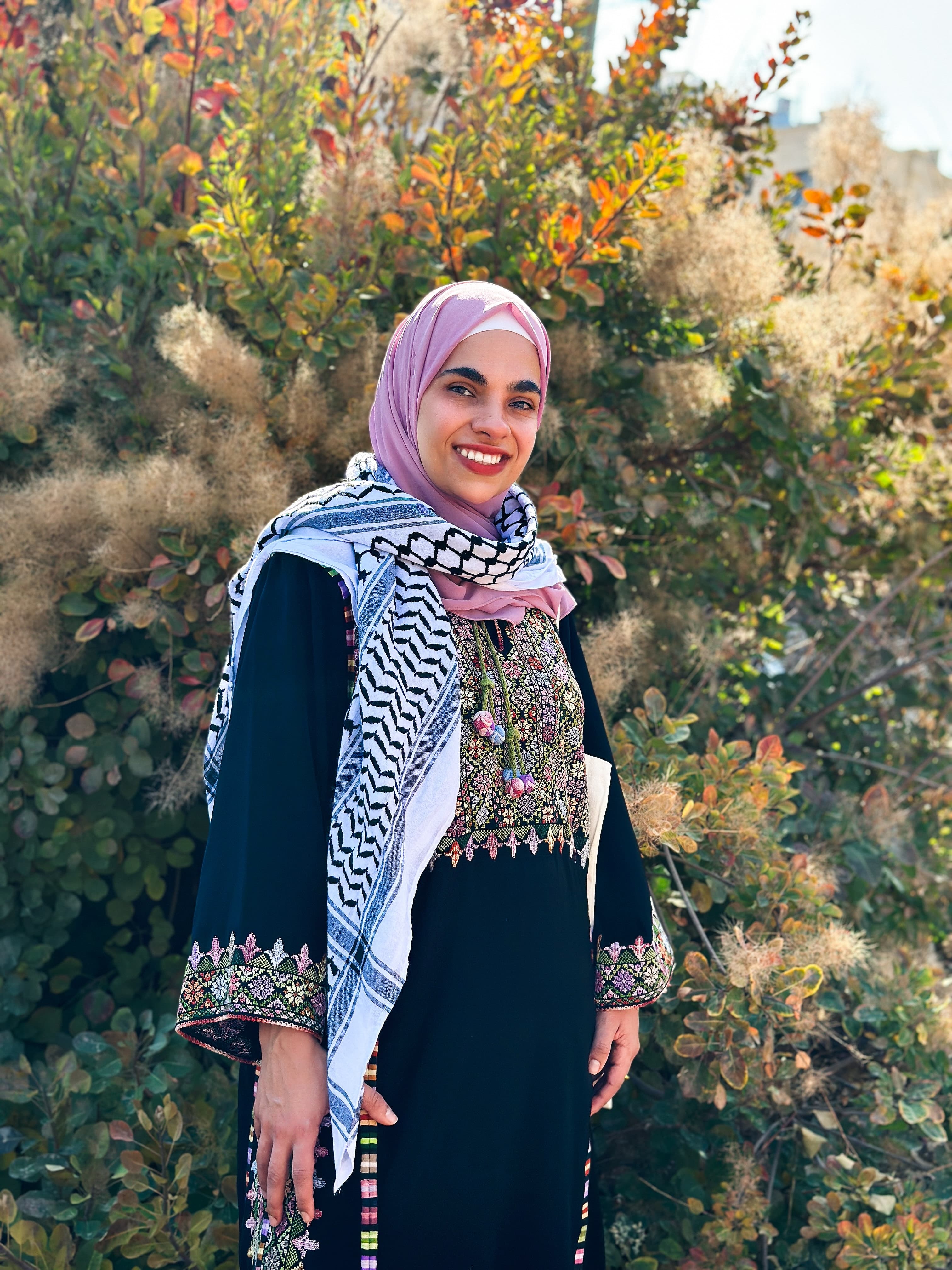
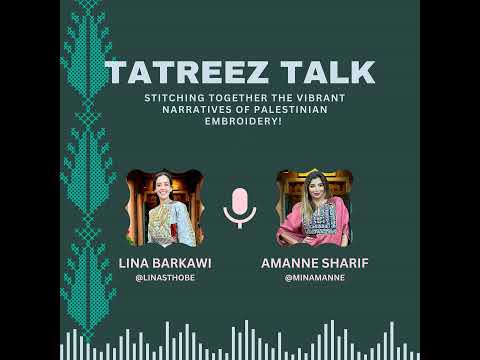
Hi stitchers, welcome to Tatreez Talk where we share conversations about Palestinian embroidery. I'm Lina here with my co-host Amani chatting with talented embroiderers and artists sharing their stories, inspirations, and the cultural significance behind their work. On today's episode, we are chatting with Tasneem, a Tatreez artist, chess panel fanatic, and digitizer. Oh, I, I already screwed that up. But welcome, welcome to Tatri's talk.
Tasneem, welcome. We're excited to have you. Hi everyone. I am excited too. We were just— I have to give people context.
You were just talking before we started recording on the proper way to pronounce digitizing versus digitalizing, and I messed it up already, but it's okay. We're just gonna go with it.
Oh, this is gonna be a long episode of Mani. Let's just avoid— we'll just avoid— I'll say the word digitalize. It's a tongue twister for me. I don't know why it is. It's a hard one.
It's a hard one. Well, Tasneem, it's such a pleasure to have you on the show because we have been seeing the work that you've been doing online and in digitalizing especially chess panels specifically. So super excited to get into that. But before we get into all of those details, would love to hear from you about you and your family's connection to Palestine. Uh, so both of my parents are from Jenin.
My mom from a village called, uh, And my dad from village called Kufrajah. So both of my parents, like, I'm from there, but we both of them born in Amman, Jordan, and I am the second generation and I live in Jordan. Have you had the opportunity to, you know, go to Palestine at all, or do you not have a Palestinian Hawiyah? So sadly, no, I don't have Palestinian Hawiyah. I only have the Jordanian passport.
And even though that I am so close to my homeland. It is so difficult to go there. So inshallah, one day we will all be able to go there freely. Inshallah. You know, I know we've talked to other people, other Palestinians who've grown up, um, in the diaspora in Jordan, but I would love to hear from you, um, a little bit about your experience.
Obviously, as most Palestinians know, Jordan is full of Palestinians, um, but what was your experience? Because you still live there as now. Well, What was your experience growing up as a Palestinian in Jordan, and how did that shape your Palestinian identity? So as you mentioned, like mostly I live in Amman, and 70% of people in Amman are Palestinian. So it is a normal conversation.
The first thing when you get to know someone, you ask, "Where are you from?" And like accordingly, you will say, "Oh, I am from that village. I am from Khalil. I am from there." And if it is an old lady, like she will immediately, oh, I know your aunt, I know someone that know you. And they— this is the way that how we get to know each other. And funny thing that now, uh, because of Tatreez, I am starting to ask someone, where are you from?
And according to that, I'll tell them, oh, you have Tatreez, you don't have Tatreez, you have this, you have that. So this is— yes, this is how I became to know people now. I ask them which village you are from and do you have tatrees and show me the photo of your, uh, like mom or grandmother. I absolutely love that. That's my new favorite thing.
I think, I mean, Lina, I'm going to implement that now. I love it, I love it. Well, I mean, speaking of tatrees, Tasneem, how did you get into tatrees? Where did that journey begin? So I always like hope that I will get to know tatris.
But because I am from Jenin, usually people— we as from Jenin, we don't have tatris. Like, we are not famous with it. We are from the few villages that do not have tatris. So it started, I watch a video, I think from Tatris Circle, and about a lady who went to Amman and her husband's grandmother gifted her this piece of tatreez. And I remember I watched this over and over and I started to cry.
It was a middle of the night because I was remembering my past grandmother and I was being so nostalgic about something I will never have. Like both of my grandmother do not know tatreez and this kind of feeling I will never have a piece of tatreez with me. And then I think like I need to be hopeful about this. What about me creating this piece of tatreez? What about me creating this piece of pottery and give it back to my future grandsons and daughters.
And so the next day I called one of my friends and she is from Gaza and her mom used to do a lot of pottery. We went to downtown Amman and I grabbed these tools and I went. It was the next day, it was a Friday, and I spent whole Friday like learning pottery. Usually at that time, it was around December, it was the peak of what went on with Gaza genocide. I used to go to protest each Friday.
It was the first Friday that I did not go there. I wanted to learn Patrice and I was watching YouTube video and trying to learn it. I remember the conversation between me and my friend. I say, "Oh my God, this is so difficult. This is 'This is so complicated.
This is so slow.' And I remember my friend like cheer me up, like, 'Continue, continue.' And because what's going on with the current genocide, I continue to do the tatris until it become an obsession. So this is overall the whole story behind it. I love that. And so, okay, you said you started by watching YouTube videos, right? That's also how I started learning before I jumped into classes.
Did your friend's mom, or did anyone kind of in your circle jump in and start teaching you in person? Or how did you kind of develop your tatreez journey?
So I think when I started the first 2 months of tatreez, I did not have anyone surrounding me doing tatreez. But my mom tried to go to her friend And now, like, the thing with tatris, it's built my connection not only with people all over the world, but also with my mom and other cousins. Now my WhatsApp conversation with my mom full of photo of tatris. Anytime she will go to visit anyone, she will photograph all of these kind of things. So she will tell me, oh, see this piece, see this piece.
And she has a Syrian friend who learned how to do tatris. She take me there so I can learn more about tatris. And also my auntie, like, she has also a lady that lives in Al-Baqaa camp, and I went there and she taught me a lot because I want to make a dress that represents, like, like has a chest panel and has tatris. So it was so amazing that even though that he will spend so much time learning potteries through YouTube videos, there are other levels of skills and experience that come from interacting with people who done potteries for so many years. Like for a simple kind of thing, you know, when you use the canva, a wasted canva, and there are a lot of thread, usually I will throw them.
But that lady from the Baqa'a, she told me, we don't throw them, we use them to fashion, the new fashion, like Wasted Canvas. So they do not throw anything, they use the thing within and available. So it was so interesting that before I thought that I will not have that strong connection with people who are like the elder generation, but now I have this kind of strong connection. And now because of Potteryeze on Instagram, a lot of, like, my people, a lot of people I interact with are above 40 years old, and they are proud of what I do. And this is the new kind of thing.
And when I started Potteryeze, I thought a lot of people from other generation are doing Potteryeze. What could I add? What new thing I could add? And because now of digitalizing I have now my kind of print, you know.
The thing is, there is a poem from Imam Ali. In Arabic, it says, 'Wa tashabu annaka jurman sagheer, o fikha qawala alam al-akbar.' You think, like, you think you are a small entity, but within you an entire universe. And this is stuck within me. Because, you know, with the Gazan genocide, when it started, we did not think that it will be so long. So what we did, we started to go, we protest, we boycott, we prayed.
And because it is still going, you ask yourself every day, what should I do more? What should I do more? And because of all of this, Like digitalizing came up, you know, and I think I will never will have this kind of a chance to do digitalizing. Like if I did not have that drive that come from the current genocide, because I wanted to do something for Palestine. I wanted to leave an imprint.
I'm happy that I was able to do something and my hope to do more, inshallah.
Introducing the drop that nobody asked for. Resolute RGL, the sneaker that takes centuries of Palestinian resistance and sells it back to you in leather. Co-founder Yossi Levin calls it empowerment. We call it exploitation. Same guy who once erased Palestinians from his projects in Haifa, now stitching tatreez into a shoe to build his quote unquote multimillion dollar brand.
They say it's bridging local and global. Translation: Palestinian women stitch, Europe profits, Israel wins. Limited edition, unlimited hypocrisy. Don't buy the hype, boycott Resolute RGL. This anti-ad was produced by Tatreez Talk.
We stitch, we talk, we boycott.
Oh, that is so beautiful, Tasnim. You're so inspiring. You're making me excited about— I mean, I'm already excited about Tatreez, but like, you're taking me to the next, like, level or two of excitement.
I think it's time to talk about digitalizing. So maybe define what that means, and, uh, would love to hear kind of what you're doing with that and, and the types of things that you're, you're digitalizing. So with digitalizing, uh, I think I came up with a definition for it because, uh, I think when we started our conversation, we've been debating, is it digitalizing or another, uh, word? Yeah, so it is interesting that Sometimes you come up with a word that Kizuwali did not exist pre-that. So as all of you know, like I did 3 courses of digitalizing, and because of that I felt like it is important to have a definition.
So what is digitalizing? Digitalizing of Tatreez work is the process of creating a digital pattern by converting each Tatreez stitch into its equivalent square cell within the grid, digital grid. So the result is an accurate digital representation of the original embroidery, serving as a valuable tool, as a valuable tool for replicating authentic Patrice, uh, design while preserving their intricate details. So the idea with that, that you create a digital pattern that give it, that you can give it to anyone, and it is a tool to replicate the embroidery that are already present. So this is Ansambal.
Can you tell us more about how, where did you get the idea to do this, and maybe what was the first thing that you digitalized? I'll tell you the first thing that led me to this. So I used to hear your talk, Tris, talk. And yeah, like a lot of eureka moments came to me because of your talk. Like I remember that the first 3, 4 episodes I was doing a chess panel by my hand and I was hearing a lot of like a word and definition that I was not interested in before.
And I remember that Amani said about that tatreez is like the cross stitch of the European, and because of that thing I went and started to like search more about it, and it led me to people talking about their cross stitch pattern. Then I've been introduced to Traditional Tatreez. I think it is an Instagram account, and they mention a website called Freezy Artwork, and The whole digitalizing came from the idea. I opened a book by Bidad Qanwar called The Palestinian Falahi Tutorials. It contains a lot of images of old thob from the chest panel to like the old component of the thob.
And I remember when I opened it, I saw one of the chest panel from Persebet. Bert Schabach, and I was so mesmerized by it. Like, I started to, like, just look at it for more than half an hour. And at that point, it was 2 months since I started the whole series, and it seemed like a big, big kind of puzzle. And I did more hobbies before, and my mom was not that supportive of the other hobby.
I did photography, collage art. So I took that book, I show my mom, and, uh, it was some kind of— I want her to challenge me on that. And I told her, Mom, see, this is a big chess panel. What do you think about it? And she told me, oh, this is amazing.
Oh yeah, you can do it. Let me help you. So we, like, we were cutting the fabric and she was helping me with that. And because what she said to me, like, I felt now it is a responsibility for me to do this. It's just a panel.
Because usually she was not supportive of other people's because it is the trees, it is a linkage to Palestine. She was helping me to that. And because that the image was too, like, it was so old and sometimes it have been difficult for me to tell how the stitches. And I was thinking, I was dreaming about, okay, what if there is a better pattern? What if there will be an easy way to tell this and that?
And I did a lot of research and I did not find this as a pattern. And there was an existing pattern of similar, of other purchase panel, but I wanted the stitches panel. And so I started to learn like dot by dot how to do it. The first idea in my mind was, this is an insanity. Like, why would I do that?
This is— yeah, this is— this is— I said, no, this is an insanity. I shouldn't do that. This is a lot of time spent on this. You know what I mean? And now— but I said, like, let me start with just the corner of the chest panel.
And let me see what will happen. So when I started with that, oh, I found it, oh, it is an easy thing if you do certain kind of tricks and tips. And because of that, uh, like, I think a lot of people who attended my digitalizing course, they told me after they started doing it, they understand how addictive it is. That, like, with digitalizing you go to similar process how you do Dotrees, but in a faster way. Also, it's a way where you prepare yourself for the technique itself.
You know, usually I remember when you— I heard this from you, Amani, when you were talking about Dotrees, like, as it is a technique, you have to figure out how you— when or where to start and this type of thing. And it was similar to me when I started to do digitalizing. You need to figure out that symmetry line, how you can replicate this and that. And from that point, because I'm so addicted to do chess panel and I wanted to do what is the next, what is the next. So I was thinking, okay, let me do more chess panel.
And then because it time consuming to do chess panel and I wanted other people to do also chess panel. So I made 3 chess panels and I put them on Perazine at that time, and I sent them to all people who do that because it is another level, uh, of doing the, uh, the chess panel. I know a lot of people told me like, there are when you start and you do small motif, and there is level when you do big chess panel and amount of proudness that come from doing that. And I think it is like, I think it is a whole journey. I remember when I started doing the first dress panel, I was thinking about the old Palestinian women, how creative they are, how like it, how creative they are, how interesting that they know about the color theory because two of my sister like, no, like came from art.
They are art student.
So they were— I was hearing about talking about the art color theory. They were talking about how making all of these small elements fit together. And it was so amazing for me that this culture of art, this culture of potteries was widespread. Like, imagine you are in a community full of artists. And a lot of people are competing between each other how to go to the next step with it.
And I think that feeling like was even more when I started doing the chest panel from Ramallah because it consists of only two color, a black and red. And I was thinking, oh my God, how amazing they are. So they only limited with two color and now they have to compete with the motif. How to level it up? So the motif, like, so I did the Shabbaa cheese bun.
It has multicolor. The motif were so simple compared when I went to the Ramallah cheese bun. The motif are next level because they are only limited with two color. And it was a different way of experiencing Palestine because Honestly, when I was in— like when I grow up, when I used to be in a school, I remember that the first 2 days of the school year, they will give us this kind of like assessment to fill. And all of this, they ask you, are you refugee or are you like an IDP?
Like, are your parents left Palestine in 1948? '48 or left it in Naxa, 1887. And I remember we question and asking our parents, what is the difference? What is Naxa? What is Nakba?
And this hold a lot of responsibility. And our definition of Palestine was the suffering, the leaving of the land. So now because of Tawfiq Rizq, I have new definition about all Palestine. It's not about Suffering is not about like feeling the heartburn, feeling the pain of leaving the land. There was an old Palestine that it is beautiful, that full of all of these artists of the color, of the beauty.
And this is like made me redefine my Palestine. It is not all suffering. There is a beautiful world. That I now am experimenting and revisiting, like, through the tatris. And this is what the big deal to me.
And I think a lot of people, they know me now, they told me like, I know you did photography for many years, you did collage art, you do this and that, but I know you will stick with this tatris because it holds a huge level within you. This is my identity, you know. Always we have this kind the Palestinian question, who I am. Yani, I am really Palestinian, but I never set foot there. I don't have any paper to prove that I'm Palestinian, uh, and I'm not a full Jordanian.
Who I am? And you know what I mean. So now, because of the trees, I can proudly say I'm Palestinian and this is my heritage, and I'm proud of my ancestor. And inshallah, one day we will go there and rebuild Palestine and make it beautiful again. Oh, that was so beautiful.
I'm going to like sit here and cry. That was really, really beautifully said. I absolutely 100 million percent resonate with everything you said completely wholeheartedly. And, you know, it also brings me to this point, you know, with the work you're doing, you know, it is very important because we don't have a lot of our history is oral history. A lot of our history has been lost.
Because of ethnic cleansing and genocide. So it is very important to have nowadays people who can record our history to pass it down. And I know specifically too, you are working on chest panels from depopulated 48 villages, right? So can you talk a little bit more about that? Because I think that goes hand in hand with everything you're just talking about, even with like this art being a part of your Palestinian identity.
This season's hottest look: genocide. From the brand that brought you fast fashion comes fast-track complicity. Zara just opened its largest-ever store in Israel, 45 square meters of settler chic, while Gaza buries its dead. Their Israeli franchisee hosted far-right minister Itamar Ben-Gvir, who calls for shooting civilians and expelling Palestinians. His review?
Beautiful clothes, beautiful Israelis. Our review? Ugly politics. And yes, the jacket ad? Mannequins shrouded like Palestinian bodies next to rubble?
Zara called it a "misunderstanding" and kept cashing apartheid checks. Boycott Zara and all Inditex brands: Bershka, Massimo Dutti, Pull&Bear, Stradivarius, Oysho, Zara Home. Because genocide is never in season. This anti-ad was produced by Tautriz Talk. We stitch, we talk, we boycott.
So it's a huge journey with the depopulated villages. It also made me, when I started, a little bit guilty for the fact that I didn't know the name of that village. I didn't know anything about that village because I thought I know Palestine because we read a lot of Al-Ani, books, we read a lot of history about Palestine, we have our parents telling us about Palestine, but there are parts that we did not know about, which is the depopulated villages.
I think it started from seeing a chess panel that is so beautiful, but I never seen before, and even the dimension of it, it's different. So all Palestinian chess panels are huge, are so bigger than the current one. Also, the second thing what I notice that the motif are not widespread. Like, it is not easy to go, for example, to Atarpok or to Razin to find them again.
And I remember doing the first one from the depopulated villages and that a lot of people from Instagram came to me and saying to me, oh, I am from that village. I wanted to access Lebanon from there. I didn't know that it exists. And this is the first kind of interaction that got me, that a lot of people who were from that village and they do not have even thobu from that village because during that war, a lot of women left everything that they have and left, like went out of there. Usually the process of doing the depopulated village is usually there are not a lot of, uh, photo or picture available.
So I'm very happy of the work of Fidad Qarwad because her book Thread of Identity holds some of these, uh, like chess panel. Sadly they are so small, so sometimes I have to use a magnifying lens to look at them bit by bit. But it is like so interesting when I'm doing this type of thing. Or the second thing, when I remember last month, someone from a village, also from the village, she told me that she has her grandma, she's coming from Jerusalem. There are a lot of villages in Jerusalem are depopulated and Honestly, it's a whole kind of journey when you look to the chest panel, try to analyze it, try to understand it, and bit by bit do the digitalizing.
Because usually when you actually doing the topography of chest panel, you have to define how to start. Is it from the middle, or I have to start from the cost, the arc? And also It honestly, I did one for Jerusalem and I was so mesmerized by the fact, like I will ask myself how they did that. This is so beautiful. This is so amazing.
So if I wanted to show you like one of the things that I did is even in the thing is also the linkage between the depopulated villages. With new thobes after Nakba with new villages. Because what I noticed, like especially for example Gaza, Khalil, a lot of people who left, women left there, went to, for example, Khalil and influenced the thobe after the Nakba. And because a lot of debate will happen when I like post it, they call me, oh, this is look like someone that in Hebron. And they say, oh, I thought it is from Hebron.
The origin is the Gaza one. Uh, and I think that the prize after doing the digitalizing is seeing someone doing it and doing the tapris themselves. Like, like, imagine the huge kind of connection then that I did this work, someone far away from UK, from the US have did it. Like someone who never visited, for example, Tora's center, and they were now able to do a chest panel from there. And a lot of people told me, now I'm making a dress for my daughter from like a raza chest panel.
I tried to do this more before, I couldn't. Now I'm able to do it because I have the pattern to it. After doing these courses of digitalizing, like, it was so amazing the fact that now new people are able to do that because they told me, and I want to preserve my, my grandma or my mom's thobe. So the idea with the digitalizing that even the, even the thobe will be burned, even the thobe will be disappear, we have a replica., on it, and people all around the world, Palestinian all around the world, now have the key to redo it again and preserve it. Uh, and I think this is the idea that make me more attached to digitalizing is the fact, uh, like, whatever will happen now, the, like, the future generation will be able to do that, like I'm so passionate about digitalizing and 3Ds that even people at my work started to dream about and talk about it and give me ideas.
I love that. So I took the book of Thread of Identity and they say, oh my God, this picture goes back 100 years. Imagine this, Niamh, that your work after 100 years from now, someone in the future will be able to do this kind and replicate it. So For me, this is a reward in itself. I want to be remembered.
I want Palestine to be remembered. I'd want all of these things to be preserved. So it's a huge reward for me to do digitalizing, even sometimes when you start with it, it's really time-consuming, but the reward, it's more. That is so powerful. Also, by the way, I know several people who are doing your qatris patterns, the chest pieces in the US.
So it has— it is happening, uh, like everywhere. Um, I have— I get update photo— update photos from a lot of people as well. It's so, so powerful, um, what you just shared. And you also said something that I, I thought was really interesting, that you learn about these depopulated villages when you wouldn't have otherwise, because you're only surrounded by, you know, your, your own family and what you learn. Um, and like, for example, like Amani, I learned about Ramleh from you, you know, through, through your— because it's not even necessarily just the takhtis, but it's the stories from these families of people who practice Sutris and that they share with you.
And that is, that is so powerful to be able to have that accessible for, for other people. Tasneem, such a— this is such a pleasure. I'm just so enjoying everything you're sharing. Your energy is super infectious. What is next for your Sutris journey?
What are you, what are you working on these days? So the next on— because I did so many chess panels My wish is that I'm starting to collecting information to do a chess panel design course. It is so interesting when you go and navigate and do many chess panels. You go to, for example, Khan Yoon's chess panel, and it is only like one unit square, and it is so small. You go to chess panel of Farasa, it is big.
You go to other villages is different kind of thing. So it is so interesting, uh, to differentiate between, uh, the design of each village and try to navigate that. And I, I will say also another thing. A lot of people will come to me when they will do my pattern saying, okay, can I change the color? And tell them, you are Palestinian, you have the ability to change.
This is your imprint on And I think this should be also when we think about designing a chest panel. A lot of people want their own stuff that reflect their own kind of identity. And I hope to do that with this course that I'm working on. The second thing is I hope to do other courses related to digitalizing. The third thing, I want to digitalize more patterns, especially from the depopulated villages.
And I will end it with a dream because the course, the digitalizing, was a dream. I was holding and dreaming about this coming true. What I wish to do, and it is like a huge kind of a dream that I hope to, I wish to have a fund where I will have other people who work also on digitalizing and we do digitalizing for a lot of thobes, and we put them online free, like as a free domain for people to access it all over the world. This is my wish, and this is, I think, how we can do more to preserve people at the past. The knowledge of Thaqris was free to them, and it was available to them.
So inshallah, this is what I hope to have a free platform that contains all of these patterns, and inshallah, maybe making an NGO that's really concerned about this and making all of this available to all people, so it can be easy for them to replicate and access to, to do Tatri's, to do their top and to replicate, because this is why it was my struggle when I started.
I didn't— when you start, you don't want to invest more, but when you, Khalas, committed, you invest more in money, etc. So I was thinking I wanted to make things free so people have more the courage to invest and learn. And I want to encourage more people and more Palestinians to do more chess panel. Yeah, I hear that. I love that.
And I know, okay, so we already said like it's extremely important to have the, the ability to digitize this and have our history recorded. Also, you do classes. We know if anyone's interested, they can join one of your classes. But also just curious if there are any tips and tricks that you could recommend for people who want to, you know, maybe they have one of their grandmother's thobes at home and they want to digitize. How would you recommend they get started?
So I always will tell them, when you want to start to do that, you start by it like I'll tell them a free way to do that. Go to Turazin and explore the motif from the villages of that thobe. And after you scan it, you go back to the thobe and try to match between these type of thing. Like I remember I had a documentary from I think Palestinian Museum saying that that some of these ladies that have huge experience with TOB, that she took the TOB from Beit Dajan and she spent half an hour just staring at it. And this is a huge skill.
So there you stare at these stitches panel and you try to recognize the motif from that village and you match between them. Then bit by bit And what I teach people in my courses is how to do the importing of this motif from Surazine in one step, and then bit by bit through learning the how to do the digitalizing, it will be easier for you to copy and paste. And because the Palestinian thobe or even the motif, it's built on symmetry So with my course, I give them easy tip to do the digitalizing and to save their, uh, like, time doing that. So I told them, when you look to the Thawb, don't be scared. You are not required to do each square.
You are required to find— I told them— the unique pattern, the unique motif and all the replicated motif. And by recognizing this motif, you will understand later on how to do the digitalizing. Amazing, amazing. This is so helpful, and I'm sure there's someone listening who is looking to do this. So I'm very excited to see all the different designs that become digitalized, you know, through this as well.
Um, Tasneem, you've already shared so much, but Is there one or a couple of major life lessons that you've learned from Tatreez? I will start with saying patience. I think a lot of close people within my family, they told me like never in a million times that I will think that you will do Tatreez because I am impatient. I don't have the vision to do that. And when we thought to do cross-stitch at school, I remember that I did not like, complete it.
So first, patience. Second thing is to appreciate, like, Palestine, to see the beauty in Palestine. The third thing, and most important, usually other people, like, Palestine have, like, because what happened to it has a dark side. And it has very beautiful sight. I would say with the trees, it's a big lesson in how to do something for Palestine without being burned out.
It's okay to enjoy the good parts of Palestine because usually they will tell you, like when in genocide habit, you have to only indulge on what is going on with the genocide, there is no space for you to feel the happiness. But I will say the big lesson with Patrice is have a point where you can support without being burned out with the process. That is beautiful. I love that. Thank you so much for, for being with us.
This has been such a pleasure. Thank you too. Before we let you go, can you let people know if they want to find you, if they want to take one of your classes, they want to grab one of your patterns, how can they, um, get in How can they find you? So they can find me, uh, with Tasnim Potries on Instagram, uh, and in it you can find the link to my Ko-fi, uh, shop. It has a lot of free patterns, there are some paid patterns, but they can go there and maybe if you want to start with your first chest panel, there are a lot of variety to choose from.
Amazing. Thank you. And we'll of course link everything. Um, stay tuned for more classes from Tasnim. Um, we're really excited to see what else you create.
And thank you so much for being here with us today on TechBeast Talk. We really appreciate it. Thank you too. Thank you too. I'm very happy to be with you today.
It's a big thing. I, I used to dream about it. Like, stop, you're so sweet. You're so sweet. Thank you so much.
Thank you. That was probably one of my favorite conversations. Tasneem is so freaking inspiring, so inspiring. And she actually said a line that I wrote down because it stuck with me, and she said, "Imagine being part of a community full of artists." I just, I I— that is such a solid, solid line. Yeah, it just— wow.
Yeah, I know. I, um, I, I was definitely holding back a lot of, uh, teary eyes because everything she said was just so beautifully put. And, you know, even, you know, we're all in diaspora in different ways. Obviously she's in diaspora in Jordan where she's so close, um, to Palestine, and, you know, can probably see it depending on where she is, right? And we are here in diaspora in the US, and doesn't matter, like, still completely resonates with every single thing that she says about being Palestinian in diaspora and, you know, sometimes not feeling Palestinian enough and how Tatreez is like this connection for her.
And like, oh yeah, I was— I had to be on mute because I was like snapping my fingers the whole time. I'm like, yes, yes, girl, yes. But everything was really beautifully said. And, you know, again, like we've talked about this before on the podcast with other people, but, you know, our history, unfortunately, a lot of it has been lost. And, you know, it is a very big deal that she is digitizing these traditional historic patterns.
You know, like you and I make patterns, but like we make patterns of like our own designs, you know, what inspires us. Whatever. And that's important too, to create new art and to create new tætris. But it is insanely, insanely, insanely, insanely important to, uh, preserve and pass down what came before. Because even, you know, even when we're talking to, to her, she's talking about like the fact that like as she's studying these like patterns from these depopulated villages, seeing how, you know, people migrated to this village and now it inspired this region's tætris, All of those things are so important.
You know, we even talk about, you know, post-1948 and what Tetris looks like post-1948 versus pre-1948. Like, all of these pieces of the puzzle really matter. So just, I mean, again, I know we said it to her, but like, bravo, bravo, bravo, bravo to the fact that she is digitizing and preserving this art. It is a lot of work. And, you know, as she said, most of this is free.
Obviously, it's like old traditional tomes, not her own designs, but it's still a lot of work. So whatever you could do to support her work, like you should definitely be supporting her work because we need more people to do this type of work. It's amazing. 100%. 100%.
I think one of the things that makes this very, very real is, is seeing what's happening in Gaza. And it's not just that you know, we are getting desensitized to hundreds of people being murdered each day. But it's, it's like, I, like, I remember the first time that they had talked about, you know, the first families that had been removed from the registry that had been killed, like, their entire family lines, those last names no longer exist. Like, that is what, that's what she means when we say depopulated villages. You know, some of these villages, we don't, we will never know now because their names are lost.
They haven't been passed down through generations. And so capturing these ebbes, these chest panels from these dresses, is one way of, like, remembering and continuing to remember. And I don't know, it's just, it's so real now more than ever. And I'm so happy that we were able to chat with her and hear her story. And like you said, just continue to support the work that she's doing because it really, really matters.
Same. Yeah, honestly, when she said she's gonna do a chest panel design class, I was like, I need my knee to sign up for that. Because honestly, yes, I design stuff, but there has to be a much more efficient way than what I'm doing because I'm a hot mess. But that's a whole other episode. Let's first make sure you can differentiate digitalize versus digitize.
That's good. Girl, no, it's not gonna happen. It's a tongue twister. I can't do it. It's fine.
I don't care. Anyways, uh, Of course. Thank you so much for listening to Tetris Talk. We want to hear about your Tetris journeys, so please share your stories with us at tetristalk@gmail.com and we might have you on an upcoming episode. Do not forget to subscribe to the podcast on your favorite listening platform and be sure to leave a 5-star review.
You can follow me @minandmani and Lena @lenastob and of course follow the podcast at Tetris Talk. We'll talk to you soon.
About this episode
S3E2. DIGITALIZING TATREEZ WITH TASNEEM
TASNEEM IS A TATREEZ ARTIST, CHEST PANEL FANATIC, AND DIGITALIZER (@tasneemtatreez). Tasneem shares her journey into Palestinian embroidery and how she balances tradition with modernity. From her early days of stitching to becoming a digital pattern creator, her story highlights the resilience and beauty of cultural preservation.
Learn about the art of digitalizing tatreez and the dedication it takes to maintain authenticity while bringing traditional motifs into the digital realm. Tasneem dives into the narratives behind her designs, explaining how each stitch connects to identity, history, and resistance. She also offers practical advice for newcomers who want to explore their own stories through embroidery.
With laughter and engaging moments, this episode captures the heart of storytelling through tatreez. Don’t miss a fun debate on pronunciation, favorite tools, and memorable tatreez mishaps. Tune in to celebrate the power of Palestinian embroidery and its ability to inspire across generations.
You’ll hear about:
>> 1:20: Tasneem’s connection to Palestine
>> 3:50: How Tasneem started tatreez
>> 8:50: Digitalizing, Tasneem’s unique spin to tatreez
>> 18:07: “Imagine you are in a community full of artists”
>> 22:30: Digitalizing chest panels from depopulated Palestinian villages
>> 30:48: What’s next for Tasneem’s tatreez journey
>> 34:40: Recommendations to get started digitalizing
>> 37:11: Biggest lesson from tatreez
Rate, Review, & Follow on Your Favorite Podcast Platform
“I love Palestinian embroidery and Tatreez Talk.” <– If that sounds like you, please consider rating and reviewing our show! This helps us elevate the vibrant narratives of Palestinian embroiderers and support more tatreez-ers — just like you — in learning more about tatreez and connecting with each other. You can find us on Spotify, Apple Podcast, and others -- just scroll to the bottom, tap to rate with five stars, and select “Write a Review.” Then be sure to let us know what you loved most about the episode!
Also, if you haven’t done so already, follow the podcast. We’re adding a bunch of bonus episodes to the feed and, if you’re not following, there’s a good chance you’ll miss out. Follow now!
Boycott Resolute RGL. Click here for more information.
Boycott ZARA and all Inditex brands—Bershka, Massimo Dutti, Pull & Bear, Stradivarius, Oysho, ZARA Home. Click here for more information.
Follow us @tatreeztalk
Follow Amanne @minamanne & Lina @linasthobe
Links mentioned