Transcriptsyncs with video
Hi stitchers, welcome to The Threes Talk where we share conversations about Palestinian embroidery. I'm Amani here with my co-host Lina chatting with talented embroiderers and artists sharing their stories, inspirations, and the cultural significance behind their work. On today's episode, we're chatting with Paige Austin, the artist, activist, and creator behind the Instagram account Khubze Ujubne, Welcome to Talk Page. We're thrilled to have you. And before we get into the conversation, could we just talk a little bit about your Instagram handle?
Because we literally just talked about that before going live because it is a little bit misleading in its spelling. Yes. Thank you for having me. First of all, I am so humbled to be here. It's insane.
My Instagram handle is @khobzeojibne. It's missing the K, so a lot of people have trouble pronouncing it, but I promise you it is Bread and cheese, khobze o jibneh. Only Arabs would be confused without the K, like what? Huh? Right.
I wanted to make the Instagram handle accessible for non-Arab speakers because I feel like, you know, when you spell it phonetically, it's better, but not for Arabs. Oh man. Well, okay, now we have set the record straight. @khobzeojibneh. That's the Instagram handle.
Follow her. We'll talk more about that. We'll link it also. All right. Well, Paige, as always, we like to kick off with our guests by asking about your connection to Palestine.
So can you share with us a little about, a little bit about you and your family's connection to Palestine? Yeah, definitely. So I am technically in my immediate family, am first generation here in the US. My mom was born in Eilat, or Jerusalem for those of you who don't know. And then so my, my Tetza's family is from originally from Eilat, and then after '48 from Be'er Sheva.
My Sido side is from Ramallah, always been from Ramallah, uh, Falahi girl here. Um, so my mom and my Tetza came over a year after my grandpa in the '60s, so I believe she came here when she was one— um, and I won't divulge the year because I think my mom would take offense to that. Um, but in the '60s they came over. And then I am half Palestinian, and then I'm— well, I'm a little bit more than half says DNA tests, but, um, the other side of me is Portuguese from Hong Kong. So— oh wait, hold on!
Let's talk about that. To be Portuguese obviously from Hong Kong. We— it's like, it's the colonizer of Hong Kong, so that's why it's not like something to be super proud of. Yeah, yeah, yeah. Same time, um, it's kind of cool because through generations and generations, um, we're more Asian, so we get all the great Chinese food.
Um, but yeah. Oh, okay, okay, okay. Wait, wait, how did your parents meet? Maybe this will help. Um, so I grew up in the Bay Area, actually.
Um, hey, they actually met working at a bank. Oh my God, I'm dying. Oh my goodness. Okay, so how— Portuguese from Hong Kong, is that like a thing? Is there like a big community there?
There is, yeah. Okay, or at least— I mean, I've never been there, but from what like my relatives have said Um, there's like a huge Portuguese— do they have Portuguese, uh, citizenship? Is that like why you identify as Portuguese and from Hong Kong? Or— I don't actually know the entire story. Um, my family doesn't necessarily talk about like our origins from that side.
Um, we have like— I have the lineage obviously that goes further back than my Palestinian side because we don't have like as much written record. Um, but I like can't go as far back to see when my like ancestors came from Portugal to Hong Kong. So, okay. Wow, that is so fascinating. Oh my goodness.
Okay. Yeah, I love this. Okay. Okay. Let's dive a little bit into your Tathagata practice.
Um, how did you get started with Tathagata? So I actually started this last October. Um, I had I actually never even realized that— well, I guess I realized, but I didn't quite connect that ordinary people could do tatreez, you know? It was always like a kind of a legend thing. I grew up around tatreez, like my tata always had the, you know, the cushions and embroidery, and she would always say like, "Tatreez, like this is tatreez, this is like famous for Palestinians," and like that's kind of what we're known for.
But she specifically, my tata, never did tatreez. She never like practiced or anything. I think it was lost prior to her mom's generation. And so after October, I actually found your channel, Alina, and I was like, oh my gosh, like she's doing tatris, like that's insane. I want to do that.
Yeah. So I really just like picked up a needle and thread. This is before like you— I knew that you had your 101 class and I was like, okay, we're just going to teach yourself here. I love it. Yeah, yeah, yeah.
I had like no idea about the back. Like I didn't know that the clean back was like a thing. And so I was like, oh, okay, I'll just put the thread through this hole and then back up through this hole. And then like I tried to continue with that. And let me tell you, my first piece, as most people who are self-taught, is like atrocious.
But same, same girl, same, same. Don't worry. That's what I tell people. It's always a mess in the beginning. It's fine.
Yeah. So funny. But, um, and then I enrolled in Lena's 101 class. Which was awesome. I really loved that because it really gives you like the all the basics that you need.
The only part that I like struggled with afterwards, like trying to get started, was I didn't realize that like where to put the thread, if that makes sense. I didn't know that you could start like cleanly, if that makes sense. Like I didn't know that you couldn't— you didn't have to tie your thread. So Then fast forward like maybe a month or so, and I connected with Dana from Tătriiști cu Danduna on Instagram, and she's actually from my area. So I had contacted her and was like, hey, do you know of any Tătriiști circles around here?
And she was like, no, there's none, but I want to start one. And so I was like, yeah, you should do it. I was like devil's advocate, you know, like, please do it. I want to know. And so she had— we had the first Pātari circle and she actually showed me how the correct way to start.
Um, and from there it was game over. I was obsessed. I love that. I love that. She's, she's a sweetheart and I love that, you know, you, you learn through community in so many different ways.
Like you learned virtually through Lena, who you didn't even know at the time. And then you got to like experience that in-person, um, learning with, um, with Dana. So that's, That's sweet. I love that. Yeah.
So good. So what was your first project then? How did you decide what to do? Um, so my first project was actually a sampler. Um, after I had started that initial, like, I was just messing around, like, trying to figure out things.
Um, I had seen on, I believe it was Tetsuri's Traditions on Instagram, um, they posted the sampler and I was like, oh, that's really cool. I want to do that. Um, and before even like understanding really about how to read patterns or anything like that. I was like, okay, I'm gonna, I'm gonna figure out how to put these patterns together. And I just kind of dove in not like knowing what to expect.
But it worked out pretty well. I mean, I just randomly picked different patterns from the first book that I obtained from my teta, which was a coincidence. Um, but I just like randomly threw together patterns and that's kind of how I started to learn how to do things. And then immediately after, I, I dove into my denim jacket. Um, oh my goodness, denim!
Um, let me just show you really quickly. So this is one of those denim jackets that's like zero stretch. There's no stretch. Yeah. And the first part that I tried to tetris, which I did successfully by the way, was a nightmare because it's the bottom of the jacket.
The thick part. Yeah. Oh my God. That's so cute though. Thank you.
It's like little watermelons. We'll have to post pictures. And that was the first thing that I had ever tatris on clothing using waste yarn. You're wild. You're wild.
Yeah. I love this. But see, I think this is a great example. Like you just started in October, so it hasn't even been a year yet of you tatirsing and like you've dove into the community, you have like stretched yourself out of the typical comfort zones that are already doing denim. I love that.
Okay. I know you're still new, so you're probably still developing like what your style is. But since you did dive in so quickly to just kind of exploring and experimenting, how would you describe your Tetris style? That's an interesting question. I think I'm like, as I'm discovering new techniques and things, I would say that my style is like fall colors.
I'm really into like muted, I guess, like greens, golds, browns, oranges, all that kind of stuff. And then I'm really drawn to like the Ramallah style bulbs. So I think the combination of those two together is kind of my style. So a Falahi girl through and through. Through and through.
That's so good. And I can, I can relate to the fall colors. Definitely something that I love as well. Um, you mentioned, uh, the, a book from your tata. Uh, can you talk more about like how, how, what is your relationship with your tata now that you've done Tatreez?
Do you guys talk about it at all? Do you get her ideas? I'm curious about if you're bringing potríz back to her even though she never practiced herself. Yeah, actually, so that's a good question. So the book that I got from her was actually a gift to her from my uncle, and he just bought it for her because, you know, as like culture keepers, we're obsessed with anything Palestinian, and he thought that that was like a really cool book to kind of give her a history and show— it's the traditional Palestinian costume book, so like the big one.
It's a beautiful book. It's so beautiful, yeah. And so she like used it as a coffee table book, like she would look at the pictures but didn't really like, you know, she didn't read it or anything. And so when I started, I was like, oh my gosh, Tessa, like you have this book, do you mind if I read it? And she was like, oh yeah, take it, like I'm not gonna read it, just go ahead and take it.
And so I was like, oh my gosh, thank you. So I dove in and read through that whole book, which was awesome. And then learning more about the Tzotzils, I would go— so my relationship with my teta is really good. She cooks, obviously, and I eat her food, which is really all you need to know about any teta, right? Duh.
But she really enjoys the fact that I'm taking initiative and learning about our culture. Through Tatreez, and I teach her things, you know, that I learn, like facts about Tatreez, and she, she loves it. Like, she'll genuinely sit down with me and like ask me questions about Tatreez and kind of like origin stuff that I learn about it, and I think she's just really impressed. And then I show her like all of you guys, all your work on Instagram. I introduced her like to Bisan from Thobna, and Bisan is like My teta always asks about Bisann.
It's so cute. Dead. That's so adorable. I love that. I love that.
I love that. Oh my gosh. But I think that even through me, she's getting more of a sense of community. And I think that's really special because my teta hasn't been back to Palestine since she left in the '60s. And I think there's just always that missing piece for her that she's not— she still has community.
She still talks to, you know, relatives and friends and stuff, but it's obviously not the same as having that community. So yeah. Is there anyone else in your family, like your mom, um, or any, anyone else in your family that you've brought into the world of Tetris since you've started learning? Um, not necessarily like in practice, but just kind of awareness of Tetris and like that people still actually do tatris and things like that. My mom is very artistic and that's kind of like where I get my creativity from.
But she hasn't done tatris and I don't think— I think the last time I asked her if she wanted to do it with me, she was like, I'm not going to be able to see the holes. Like, that's my mom. That's my mom. Yeah. And actually, so I have a couple of questions for you for listeners who may have not started.
So one, I guess, what is the biggest piece of advice you wish you got when you were first starting out? And two, what is the number one thing that you've learned that has kind of stuck with you that you think is really amazing about Telfariz?
Introducing the drop that nobody asked for, Resolute RGL, the sneaker that takes centuries of Palestinian resistance and sells it back to you in leather.
Cofounder Yossi Levin calls it empowerment. We call it exploitation. Same guy who once erased Palestinians from his projects in Haifa, now stitching tatrees into a shoe to build his quote-unquote multimillion-dollar brand. They say it's bridging local and global. Translation: Palestinian women stitch, Europe profits, Israel wins.
Limited edition, unlimited hypocrisy. Don't buy the hype. Boycott Resolute RGL. This anti-ad was produced by Tautris Talk. We stitch, we talk, we boycott.
So I think my advice to somebody that's just starting out or thinking about starting out would be don't worry about like the details like right away. You know, you always hear of like the folklore of, you know, clean backs, clean backs, right, Imani?
Like, don't worry about it. When you first start, you're gonna make mistakes. Um, and it's not a big deal because first of all, you can fix your mistakes. And second of all, there's always new things to learn. Um, so you're not gonna learn unless you try it.
100%. Like, I love that. Wholeheartedly agree. Everyone has a different, uh, everyone takes different roads to it, but yeah, you should not be afraid to mess up and try different things. I still do different things and mess up.
Yeah, Lena's seen me mess up and have a panic attack. Oh yeah, yeah, all the time, all the time. And I, I think one of the things that you like bring up such a good point is that like even if you do mess up, you can fix it. I think potpourri is such a forgiving craft, it's such a forgiving type of art that like you really— this is the best thing that you could do to make mistakes, you know what I mean? Because it's like always you can undo them, you can redo them, you can start anew, like it's totally not a big deal.
Yeah, even you saying that, Lena, like, kind of takes me to— so we were recently, um, in Jordan and we went to Tiraz Center and we were talking to, um, the women there about the dresses. And they were talking about how, um, when, you know, with their old thwab, when a woman became a widow, she would then stitch on at the bottom, she would stitch on some blue, and then if she remarried, she would kind of— she would take it out. And stitch in color. So it kind of like, it just reminded me like tatris is not stagnant, tatris is supposed to be constantly changing and moving. And I think by, by experimenting with things, um, that really like contributes to that.
Um, so don't be afraid to try things, y'all. Like pick up your needle and thread. Definitely. Um, and then the one thing I guess I would say that I've learned through tatris, um, is a sense of community.
So growing up, I wasn't really in touch with my Palestinian side. Really, I wasn't in touch with any of my heritage from either side. It wasn't like, when you grow up, it's not like you think about where you're from. And at least for me growing up in the US as a California kid, I was just trying to fit in. And I think that like even my mom, so like when she moved here, she still had like a little accent as like a 2 or 3-year-old.
And when she like first started going to school, she was made fun of because she was different. And so like for her whole life, she just wanted to fit in with, you know, the American kids so that she doesn't get made fun of. And so she— I think she lost a little bit of that for her, for like her Palestinian side. And she grew up just trying to like blend in, I guess, you know, and then transfer over to me. It kind of happened with me too, right?
So like, I'm Palestinian in the sense that, you know, I've always grown up with Palestinian food, Palestinian, like, sense of family. But really, that was kind of the extent. Like, it wasn't like I was like into learning about the history of Palestine or anything like that. And so I think tatreez really like connects me more with our roots because doing the craft that like my great-grandparents used to do, like my great-grandma was doing tatreez and now I'm doing tatreez. And so there's just that little connection, even though I never met her or any of my ancestors, it's you have the connection.
And I forget who said, I think some kid said it in one of Wafaa's classes, classes, right, that she said that, um, she said, "Mama, my hands know how to do this," or something like that. And the first time I picked up a needle and thread, I totally felt that, like, it was insane. Like, I was like, "I know how to do this, and I don't know why I know how to do this." Like, it's very weird. Um, and so I think that tatreeh is really, like, it brings full circle for me, um, is that community, the sense of community that it brought to me, is like, now I'm friends with, you know, Palestinian women And I, because I didn't grow up with that sort of community, now it's like so special because it's like that thing in my life that was missing. And it's that sense of community with, you know, our own people, with being around other women from Palestine, it's that have grown up in the diaspora.
We all have like kind of the same, you know, feelings towards it. And it's just like an amazing connection. I don't know how to explain it other than that. Yeah, I know we can all relate to that. Yeah, yeah, it's like something like being part of something bigger, you know, than, than just you.
And that, that can be really powerful. I mean, and I know, like, I mean, I've, I've spoken about it several times, and I'm sure Imani has similar sentiments, but like, when you grow up kind of disconnected from a place that is so clearly a part of you, it's, you have a crisis, you know, you go through this crisis, no matter how, like, no matter what the thing is. Like for me, it was, you know, I was never Arab enough for the Arabs and I was never Latin enough for the Latinos. Like that was never even, like, I never even considered it to be perfectly honest. But then like in the US, I'm never American enough either.
Like I didn't understand certain things about American culture that like impacted my, like, my people elsewhere. And so it's being— feeling like you're part of that bigger thing is, is really powerful. It makes you feel kind of secure and confident in your identity, and I think that's really important. Yeah, and that's actually a really good point, is like, I feel exactly what you just said. Like, growing up, um, so I played softball like my whole life, um, and I grew up in a town in Northern California that is predominantly white.
And so, like, I never really thought about it, you know what I mean? Like, growing up, it was just how I grew up. It's where I was from, technically. And I think that the— I, like, grew up, I always had friends and things around me, you know, playing sports, you just kind of have that sort of community. But it always felt like I was missing something, like something was not quite right.
And, like, retrospectively, I look back and that's what it was, is that I didn't have that community that I, that my body was like looking for. Um, like I, my soul knew something was missing, but my brain didn't know what it was. If that makes sense. Yeah. And I don't know if Arabs would be able to relate to softball.
Have you talked to— I'm like just thinking about that conversation. Um, and I was the only Arab softball player that I had ever met. So I believe that. Um, Okay, but also like diving into like, you know, I love how you talked about building this like community through Tethris, which I think a lot of us have a similar sentiment. Um, but can you also just share with us a little bit more on, um, how Tethris has really helped build your, um, confidence in your Palestinian identity?
Um, that's a good question. So I guess It would kind of go back to the building of the community. So, you know, when I started Tatreez, I found Lena and I was like, wow, like, I like watched all your videos and I was like, this girl sounds exactly what I am thinking. Like she's saying the things that my brain is telling me. And so when I met Dana, she was, she was just so sweet, you know?
And when we connected, it was like having a, like meeting a sister that I didn't know existed. And so like seeing someone who is aggressively Palestinian, you know, actually like accept me for who I am and like understand that growing up in the diaspora is hard and you don't necessarily like feel like you belong. She kind of like took me under her wing, you know, and was like, you know, this— I'm here for you, basically. And so through her, through that tipply circle, it just kind of gave me confidence because I did feel Palestinian enough, even though sometimes you don't if you're half or even just a portion of Palestinian, you're like, maybe I'm not, I don't have any say on what is Palestinian enough. And then when you have someone who is more Palestinian than you is accepting of you, that changes your whole perspective of everything, you know.
This season's hottest look: genocide. From the brand that brought you fast fashion comes fast-track complicity. Zara just opened its largest ever store in Israel, 45 square meters of settler chic, while Gaza buries its dead. Their Israeli franchisee hosted far-right minister Itamar Ben-Gvir, who calls for shooting civilians and expelling Palestinians. His review: "Beautiful clothes, beautiful Israelis." Our review: ugly politics.
And yes, the jacket ad, mannequins shrouded like Palestinian bodies next to rubble? Zara called it a "misunderstanding" and kept cashing apartheid checks. Boycott Zara and all Inditex brands: Bershka, Massimo Dutti, Pull&Bear, Stradivarius, Oysho, Zara Home. Because genocide is never in season. This anti-ad was produced by Tatreez Talk.
We stitch, we talk, we boycott.
That's really beautiful. I'm really glad that you were able to find that and that the Tatreez community has been open and welcoming to you. And I hope other people, other Palestinians feel that because it is, as Lina was saying earlier, as you said, it's hard. It's hard growing up in diaspora. We all have different levels of— yeah, I mean, we all have what we assume is different levels of being quote unquote Palestinian enough.
Um, and I think, I think even Wafaa might have said it too, like in her classes, like Palestinians tend to be the hardest on ourselves. And I think that goes for us in diaspora and like, you know, being comfortable enough with our identity and being comfortable enough being Palestinian enough. So I'm glad that you feel that because you are. Can we also— so Paige, kind of going from there, obviously, like, you have dove into the world of Tetris, you've dove into the community of Tetris. What is next for you?
Like, what projects are on the horizon, Tetris-related and Tetris-adjacent, if you will? Sure. So first, I guess I can go over— so my Two of my pieces that I had worked on were featured in an exhibition in New York, which was really cool. I was like, so honored that the curator picked my pieces to be in that show, and that was really cool. And then I actually just created an online shop.
It's, it's Etsy right now, but eventually, hopefully it'll be my own website. It's Wandering Camel Goods. Um, and that right now I am making, um, pendant necklaces that are made from broken pottery from Al Khalil, and they look like this. So cute! We'll post pictures.
Thanks. Um, but I am selling those, and I do like a drop like once a month so that, um, everyone has a chance to get some because they're, they're time-consuming to make. So for sure, the drops are like spread out a little bit because it takes a long time to make them. But then, yeah, so I plan on doing that on Wandering Camel Goods. And then there's also a book coming out that was created by some community members, and I don't have a list of everybody who was involved, but basically the book is called Passport of Witness.
And it features excerpts from people who are in the diaspora and their stories about Palestine and their connection to Palestine, and it's super amazing. And honestly, I have to tell you that— so my friend that I met through the community, through Fathlees, uh, Ren, she actually told me about the project and I submitted an excerpt for myself for the book. And that should actually be coming out, I think, like in the next couple of months. I don't have an exact date or anything, but you should check out that project because it's really cool. 100%.
Like, are you kidding me? That sounds— you let us know when it drops and we're on it. Like, okay, yeah, I can give you the link to the person that actually is like doing the publishing because she's an artist and she's like amazing. So, oh my God, yes, please share, um, and we'll share with the listeners. And I— okay, I want to ask really quickly, um, I feel like I have a million questions on the project you're working on, but, um, the first project you talked about, you have two pieces currently, um, at a show in New York.
That's amazing. I am a big proponent of this because I highly believe that the— these is art, and why shouldn't it be hanging in galleries and museums along with that boring-ass Fine art. Sorry, I cursed. I try not to. But can you tell us about that journey?
Like how this came to be? If this is something that you want to venture more into the future, tell us everything. Yeah. So I actually entered my pieces through an Instagram thing that I just randomly stumbled across and it was like calling all Tatreez or Palestinian artists, like, we want your stuff. And they accepted my work.
My first one, which was Flower Power, it's like the outline of a falicene with the flowers around it, and I had submitted that and it got accepted. And then I had finished the one with the key, which I call Spring of Return, and, and so I messaged the curator separately and was like, hey, I know I submitted this one, but would you also want this one so that it's like set and it's not just, you know, by itself. She was like, "Oh my gosh, yes, I would love it." And so I sent my stuff off to New York and that show, I believe it was a week long, it was called Tapestry Gallery and it featured basically a bunch of people of color or women of color and like all of their work. And so it was like really humbling to like actually be included in that and As far as like gallery work goes, I don't know if that's like my avenue that I'm going towards, but it was kind of cool. Like it was, you know, it was really special.
So— Mabrook, mabrook. They were beautiful pieces. Thank you. You know, and I remember seeing the posts or like stories of friends who went. Unfortunately, I didn't know about it, or maybe I wasn't in town.
I remember like something happened that I didn't get to go, but I remember seeing stories and I was like, oh my God. Oh my God, I know that. I like know those designs. Um, did you make it out here for it at all? No, I didn't.
Um, so actually the, the show was over when my birthday was. Okay. Um, I had already had plans for my birthday and so I didn't get to make it, but, um, virtually it looked awesome. I wish I could be there. And were the pieces up for sale or it was purely just for people to enjoy?
And see them. So one of my pieces were up for sale. I don't know about everybody's, but I didn't want to sell one of my pieces because it's really special and, you know, I don't— I didn't want to remake it all over again. But we understand. Yeah, 100%.
Okay, I wanted to talk a little bit about those pendants because those sound gorgeous. I'm about to go up to your Etsy, like, shop right now. Uh, how did you get the idea? Where does the pottery come from, like, specifically? And yeah, like, how did you— did you already know how to do pendants beforehand, or is this something that you learned?
No, I did not know how to do pendants beforehand. Um, so what happened was, is— so Rasan from Yusra and Company, or Yusra and Co., um, she was doing a live unboxing of her pottery, um, that she gets directly from Al Khalil, and she kept opening these boxes and was like, oh my God, my mailman hates me. They're all broken. Like, this sucks. And so when I was like watching her doing the unboxing, I was like, man, that's awful.
Like, I don't want that. Why would she? I don't want her to throw it away. There has to be like a different thing, like something that we could do with that. And so randomly I was like, oh, you know what?
That would be so cool to make into jewelry. And so I kind of like researched how to like do it and then I just started making them and I was like, okay, this is going to be a thing because now people can also have not just like plates or, you know, oil canisters or anything like that. They can actually have a piece on them all the time. And then that way the pottery, the beautiful handwork doesn't go to waste. So that's kind of where that came from.
Oh my God, that's beautiful. I love that. Who just randomly thinks, oh, that can become jewelry? An artist. Yeah, artist, literally only an artist, for real.
Oh my goodness. So are you collaborating with Yusra? Is it Yusra or Yusra? Uh, it's Yusra, I think. I'm not 100% sure.
Yeah, on pronunciation. But, um, she— so she— we are collaborating technically. Um, I think she's trying to give me some space to like figure out how to like do it on my own before we do any further collaboration. But it's going pretty well so far. It just takes a little while to actually make the pendants.
And if you go to my Etsy shop right now, there's only 2 pendants left, but there will be another— running, I am running, I am running, don't worry. Amazing. I love, love, love the creativity. Okay, and then let's talk about this book. Like, I know you, you said you, you submitted an excerpt, but like, how did this come to be?
Like, is it stories of, of Palestinians in the diaspora or just— yeah, in general? Okay, so tell us. So I think that we had had the option to like, um, there were some prompts and then you could answer the prompts in whatever way you wanted to. Um, and I believe it is Palestinians in the Diaspora. Um, don't quote me, I don't know if there's Palestinians in Palestine in the book, but I know for sure Palestinians in diaspora.
And so I found out about the actual project from my friend Wren, who is a local artist. And I don't know if you want to like drop her handle in the notes, slash maybe get her for an interview because she's amazing. But she had told me about the book and she was like, you should submit like an excerpt. And, um, like be in the book. And so I did.
And so it's all thanks to her that my words are in that book because it's like a piece of treasure that, you know, will be around forever. And I'm so grateful. This book, we'll put it in the show notes when we find more info. We'll definitely update people because I'm sure other people are going to want to read this. I think it's so important.
Like, as you said earlier, you know, a lot of our history been oral history, hasn't been documented. So it is nice to see like more and more of our stories being documented. Um, and girl, I love this trajectory of like, I wasn't comfortable with my Palestinian identity, I didn't really connect with my Palestinian identity, to aggressively Palestinian. She is out here letting everyone know. Like, you do not encounter Paige without knowing she is Palestinian, and I love that for you.
Oh, thanks. Yeah, for sure. I mean, now I feel like if you know me, you know I'm Palestinian. So yes, yes, yes, yes. Oh, amazing.
Okay, Paige, before we say goodbye, I know we kind of touched on this a little bit earlier, but wanted to see if you had anything else to add on here, but want to talk about any of the major life lessons that you have gained from Fifth Yeah, so, um, major life lesson, like, first and foremost is sense of community, for sure. Um, like, community is so beyond important, and I think, um, now that I actually have, you know, the community part of Fathiz, like, there's no going back. Like, there's no being non-Palestinian anymore, you know what I mean? Like, yeah, undiscovering of your Palestinian Palestinian side. Um, and I think that, um, a big part of that is being unapologetically Palestinian.
So, you know, for all my girls out there in the diaspora who don't think they're Palestinian enough, just know you are, and you are Palestinian enough for all of us. So 100%, yes, yes, yes, yes. So good. Amazing. All right, can you tell the listeners where they can find you?
We will obviously link everything in the show notes, but where can they find you? To you if they want to connect and see all of your beautiful work? Yeah, I'm on Instagram, um, @khubzeojibneh, and then also Wandering Camel Goods. Amazing. Thank you, Paige, so much.
This is awesome. What a great conversation. Thanks for having me. Of course. Thanks for being here.
We'll talk to you soon. It was so great talking to Paige. She is so sweet. I Um, I'm so impressed. I didn't realize— I don't know why I didn't realize that she only started stitching in October, and she's like, she feels like such a— I don't know, she feels like such a part of the community, like the The Threes community.
Um, yeah, she's, she's adorable, and she's coming to our The Threes retreat in September. So excited to like finally meet her in person, which would be really fun. Oh good, so you guys haven't met because she said that she's from the Bay Area, right? I know. Well, so she's from the Bay Area, but she um, does not live in the Bay Area.
She lives in like Northern California now. We were actually supposed to link up a few weeks ago, and then it didn't— like, the timing didn't work out. Um, but you know, maybe we'll meet before the retreat, maybe we'll meet at the retreat, but like, by the time we do meet, it's gonna feel like we already know each other. Yeah. Oh yeah, it's already— yeah, that's, that's past.
I mean, yeah. And you know what's really wonderful about seeing people come into Tatris like now is they bring all of these really unique ideas. There's like the both of all the projects that she mentioned are so innovative. They're very creative. They're also like still celebrating our culture, but in a way that maybe has a different kind of reach to people.
And I think that's incredible that she was able to like really just lean into that and, and do her art the way that she does it. That's incredible. Yeah, I love that. And you know me, I am a big proponent of the idea that this is very much art. And so I love seeing people innovate with tatris and do different things.
And just the fact that she was able to take tatris, this art form, as a way to like further connect with her Palestinian identity and start learning more about like Palestinian history and stuff. Like, that's, I think, the cool thing. You know, we talk about it all the time, uh, but it is the cool thing of like on the on the surface, tatvīz can feel like frivolous, like, oh, it's like, it's embroidery, it's like cross stitch, whatever. And that's like the surface, like, the surface view of it for people who don't really understand and know tatvīz. But once you step into those worlds, you start understanding the different layers of tatvīz.
And like, it is so much more than just cross stitch. It is our identity, it is our history, it's our creativity. It's our innovation. So I, um, I love seeing the fact that Paige was able to embrace that so quickly and so quickly found like a community. Like, I, uh, Dana is a sweetheart.
We have to, we're, we have to get on the podcast. We, it's, it's a scheduling thing, but we're gonna get her on the podcast. And she's such a sweetheart. And I love hearing that, um, you know, she, she took Paige under her wings and they're like a little sisterhood. It's great.
It's amazing. And like she said, it's all about being unapologetically Palestinian, which I think is— that actually, that word really rings true for Dana. I feel the way that she, like, the voice that she has on social media is very much unapologetic, and I love that about them. So, oh, so good. So, so, so good.
Thank you guys again so much for listening to another episode of Tatreez Talk. We want to hear about your Taltris journeys. So please share your stories with us at taltristalk@gmail.com and we might have you on an upcoming episode. Don't forget to subscribe to the podcast on your favorite listening platform and be sure to leave a 5-star review. You can follow me @LinaSkob and Amani @minamani and make sure you follow the pod @taltristalk.
Until next time.
About this episode
27. A NEW JOURNEY IN TATREEZ WITH PAIGE
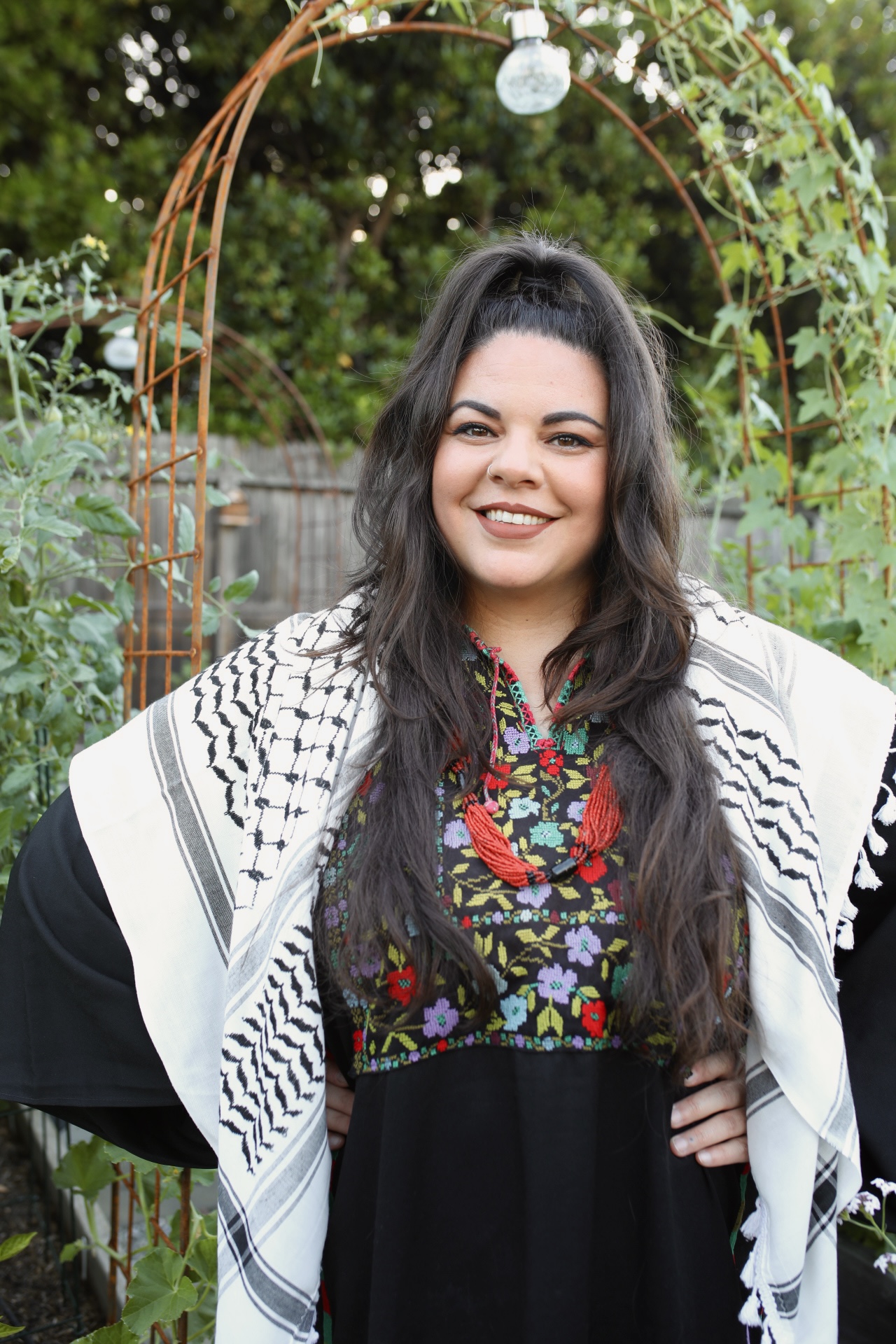
PAIGE AUSTIN IS THE ARTIST, ACTIVIST AND CREATOR BEHIND THE INSTAGRAM ACCOUNT @HOOBZEHOOJIBNEH. That’s bread and cheese in Arabic (خبز و جبن) for those like Lina who struggle with the English spelling without a ‘K’.
Paige dove right into tatreez within a few months and has already showcased her tatreez art in an exhibition, built out an online shop, and has a feature in an upcoming Artist’s Book anthology project.
If you’ve ever felt overwhelmed by the idea of starting tatreez but wanting to get started, tune into this conversation!
And while you’re listening, make sure you check out the pendant necklaces from broken Palestinian pottery from Paige’s online shop Wandering Camel Goods.
You’ll hear about:
>> 1:31: Paige’s connection to Palestine
>> 4:33: How Paige got started with tatreez
>> 7:34: Paige’s first project
>> 9:32: How Paige describes her tatreez style
>> 10:50: Paige’s relationship with her Teta post-starting tatreez
>> 13:50: Some advice and why tatreez matters for Palestinians in the diaspora
>> 21:27: Tatreez helps build Paige’s confidence in Palestinian identity
>> 24:00: Projects on the horizon
>> 34:07: Major life lessons from tatreez
Rate, Review, & Follow on Your Favorite Podcast Platform
“I love Palestinian embroidery and Tatreez Talk.” <– If that sounds like you, please consider rating and reviewing our show! This helps us elevate the vibrant narratives of Palestinian embroiderers and support more tatreez-ers — just like you — in learning more about tatreez and connecting with each other. You can find us on Spotify, Apple Podcast, and others -- just scroll to the bottom, tap to rate with five stars, and select “Write a Review.” Then be sure to let us know what you loved most about the episode!
Also, if you haven’t done so already, follow the podcast. We’re adding a bunch of bonus episodes to the feed and, if you’re not following, there’s a good chance you’ll miss out. Follow now!
Links mentioned in this episode:
>> Tatreez 101 with Lina’s Thobe (digital course for those looking to learn tatreez)
>> Traditional Palestinian Costume by Hanan Karaman Munayyer
>> Besan from Thobna
>> “Flower Power” and “Spring of Return” Tatreez Art by Paige
>> Palestinian artist Ren Allathkani
Boycott Resolute RGL. Click here for more information.
Boycott ZARA and all Inditex brands—Bershka, Massimo Dutti, Pull & Bear, Stradivarius, Oysho, ZARA Home. Click here for more information.
Follow us @tatreeztalk
Follow Amanne @minamanne & Lina @linasthobe
Links mentioned