
Transcriptsyncs with video
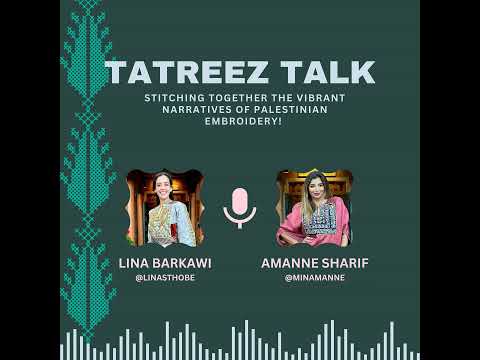
Hi stitchers, welcome to Taltriz Talk, where we share conversations about Palestinian embroidery. Join me, Lina, and my co-host Imani as we chat with talented embroiderers and artists, sharing their stories, inspirations, and the cultural significance behind their work. Fellow listeners, grab your Taltriz project, thread your needle, press play, and let the stories unfold. One stitch at a time.
Hello everyone. Welcome to Tetris Talk. I am Amani from Min Amani Designs and I'm here with my co-host, Lina. You want to introduce yourself? Hi listeners.
Welcome to the first full episode. We're super excited to have you guys here. Yay. Um, yeah, we are so excited to have everyone here. We're excited to kind of jump into this whole world and really see what this podcast becomes.
I think, you know, we are very excited to get to connect with more people in the tatami community, to share tatamis stories. Also just, you know, for you guys to have something to listen to while you stitch, because I know I need some good background while I stitch. So we're really excited to bring that all to you all. Absolutely. And I'm hoping also that there are some new tatamis artists that come out of this podcast as well.
That would be a dream come true for all of us, I think. Yeah, definitely. And, you know, reach out to us. Let us know if you guys have questions. We love to answer.
We love to connect with people in the Thitidis world. Reach out to us if you guys have your own Thitidis journey stories that you want to share. Please do. We'll share our contact information at the end of the episode. Um, but yeah, we want to hear from you all.
I mean, we're doing this for the Tetris community. Um, we kind of nerd out on our own and have these conversations all the time. So we figured it would be, uh, nice to record the conversations and share them with other stitchers. Absolutely. And so for today, you know, speaking of stories and individual connection to Tetris, we're here to tell you guys a little bit about our stories just to give you a sense of who your co-hosts are on this podcast, um, and get a sense of how we learned, how we got introduced to the art form, what it means to us, um, and what we're hoping to see come out of it in the future.
So super excited to kind of chat a little bit about our journeys, and then each episode afterwards will be somebody else's journey to basically jump right into while you're stitching. Yeah. So, I mean, Lena and I, we actually met through the threes. Um, so our journeys at one point, uh, intertwined, but I know you, you started stitching when you were pretty young, right? You didn't necessarily start with Palestinian, uh, tetherees.
Yeah, so for those who don't know already, I'm actually half Palestinian. The other half is Panamanian, so my mom is 100% Latina. And when I say Panamanian, she's not one of those Palestinians who immigrated to Central America like someone I know here. I don't feel attacked. No, not at all.
But she is definitely not one of those, so she's like true, true, true Panamanian born and raised. And, um, you know, tatreez, which means embroidery in Arabic, is, uh, the actual techniques are pretty global. Like, the idea of embroidery in general is pretty global, right? And so I know, and this is from my own experience, that the, the more popular form of embroidery that we see, as that we think is tatreez, is actually the cross stitch. And this technique is, is a practice everywhere.
And so my mom taught me the cross stitch when I was, I don't know, maybe like 12, I would say. I was definitely younger. And I remember vividly, like one of my first big projects was this duck running around with a backpack on. And I made it, I made it for my cousin's first birthday. That was the gift that I made for her.
That's so cute. That makes it even better. Yeah, her mom, I have her mom and I have the same hair. We both have really, really curly hair. And so Growing up, you know, people would like mistake us as being like sisters or mom and daughter, and, and it's because of our hair basically.
And so her daughter was very special for me growing up, and I was really excited to— there's something very different about giving something that you make by hand, which we should talk about that in a future episode. But, um, something really special about that. So yeah, so my mom taught me cross stitch very, very young, and I was doing things that basically looked like different images, so ducks and like words, you know, someone's name with a date and some hearts around it. And then there are some really, really detailed cross-stitch projects that you can do that take up so many different colors. And it's such a pain in the butt when you have to switch colors a lot, which you don't necessarily do in toldriz, which is why I think I also just love it so much more.
And, and I actually didn't really make the connection that the cross-stitch was the exact same technique as all the toldriz items that we had in the house because we have, we have had all these items for years and years. Like I think the pillows that we have on my parents' sofa is from the '90s and from Ramallah, that when my parents went on a trip, and we have things on the wall. And of course, like, athwab in the family all has tatreez, and I just never connected the dots. And then about 6— I think it's been 6 years, which is crazy, time is flying— 6 years ago, my mom found a class by Wafaa Qneim from Tatreez and Tea, who we will also have on the podcast. And yes, and this was pre-COVID, so the classes were in person There was zero virtual component.
That was not a thing back then. And my mom found the class in DC, which we lived in the suburbs of Virginia. She's like, oh, what a great mother-daughter activity. You know, we get to go do embroidery and it can connect me to my heritage, the other half of my heritage. And then we get to this class and Wafaa introduces me to the history and the significance of this art form.
And I was completely mind blown. And then we get into like the actual tutorial of the stitching and I'm like, what? This is it? I've been doing this my whole life.
I've been doing this since I was 12. And then I became— that's when the obsession began. I went home and I like noticed everything that was cross-stitched in the house that was also Palestinian. And I said, I'm gonna do this and I'm gonna do this and I'm gonna do that. And I ended up doing a series of projects.
The first one I ended up framing, the second one I ended up making into a pillow. And then I did my own, you know, historical journey through a thesis that I was doing as part of a master's program that I was enrolled in at the time. And fell even more in love with just the entire evolution of this art form from our ancestors of centuries and centuries ago. And, and yeah, then of course I undertook my thobe, which was like a massive, massive project. It was worth it.
It's beautiful. If you guys haven't seen it, it's— go to her Instagram, Lina's Thobe. It's beautiful and it's even better in person, believe it or not. It was definitely worth it, but yeah, it was definitely some moments when I was doubting what the hell I was doing with this project. Oh my goodness.
But yeah, and then here we are. I'm still obsessed, still going. And, um, and now I just want to bring that, that, I guess that light bulb moment that I had to the rest of the world. And I hope this podcast can be a part of that. And, um, yeah.
So Amani, how did you learn? Tell us all. Oh man. So I actually did not learn when I was younger. My, My grandma, she definitely, like, she was a stitcher, um, but I wasn't really interested at the time, um, when I was younger.
Um, it just, it didn't appeal to me at all. And, um, when I honestly, it wasn't, I think it was like 2017 or 2018 is when I decided I was like, I want something like artsy artsy and crafty that like can just be a hobby. And I honestly really went into it like that. I was like, oh, I just want something fun to do. And like, oh, something Palestinian, that's cool.
Um, at the time my grandma was too old to teach me. My mom never learned, um, so it wasn't something that she could teach me. Um, and it was pre-COVID, so no, like there was no virtual classes. And the only person was Wafaa, actually. Yeah, that's like a part of everyone's little journey.
Um, but You know, she was the only person doing classes at the time and it was all in person. And I had just moved back to California from New York a few years prior. So I was like, oh, I missed her. And I actually, I think I did a deep dive. The only thing I could find online were YouTube videos from Roba, who we both know.
Oh, yes. And she has a few YouTube videos in Arabic and just very basic, like this is what it is. I wasn't even familiar with cross stitch. So it didn't even think, I didn't even think, oh, let me like search for cross stitch and like learn the technique, the basics. Although I will say Western cross stitch does not care about the back like we do.
And we'll talk about that later. We'll talk about that in another episode. But yeah, so I watched her videos, um, and that's kind of how I started learning. Um, and at the time, like, there was no— like, there were no patterns that you could find. There was nothing.
Like, I started collecting books because I think she had a video about all the different books, and I started collecting books. Um, and then Wafaa came out with her book, and I got that. And then I took my first class during COVID so I was already like 2 years into stitching by the time I took my first class. And then it just kind of flourished from there. You know, I haven't made my thobe yet.
It's on the list. It's coming. It's coming very soon. I think we're going to talk about it in an episode in 2024. I can feel it.
Yes. Oh yeah, no, for sure it's happening. But, you know, I really just— I think I dove into the beauty of tatris and like beautifying things with tatris. That's what really like appealed to me. And then I think what I didn't know when I first started tatris, which has like become probably my favorite part, and I know we talk about this a lot, is the community that comes out of tatris.
I had no, like, like I said, I just like wanted to do something like, oh, I just wanna do something fun and crafty, whatever. And I didn't really think about, I didn't think about the history about it before I dove in. I didn't think about, again, the community. I didn't think about the meaning. I was just like, I just want to do something pretty.
And then the more and more I stitched, the more and more I learned, the more and more people I met, like you, Lina. Yeah. And, you know, it really opened my eyes and my heart to like the true meaning of the piece. And yeah, I just like love the journey. It's been, it's been amazing.
And I hope it just like continues. And, you know, I think to echo your sentiments, um, I do hope that more people become interested in Tetris as more information is out there. Um, you know, we, we welcome everyone into the Tetris community. Um, we want to, we want to connect with you and get to know you. Um, we want to learn from each other, we want to be inspired by each other.
Um, and just, you know, positive vibes because, God, we, we need it. Absolutely. Yeah, no, I 100%, 100% feel everything that you're saying, especially about the community piece. It's something that I didn't even know was that gonna come with the practice. Like, I, I think I picked it up after her class, and then I went— I mean, I was— that was pre-COVID, it was like right before COVID and I started practicing on my own.
And like, it helped, it gave me what I needed as an individual, but yeah, like in an individual setting and like my own space and my own time and like for my own very specific needs in terms of grappling with whatever I'm facing at work or, you know, at home and, um, you know, anything that maybe was causing me some sort of anxiety. Uh, but then COVID happened, and I think we should talk about it because COVID happened and made everything so much more accessible. Um, COVID made it possible for us to meet, for example, because all of us are all over the place. Like, we're not all in like You know, historically people were doing this in their village. They were doing this with people that they saw and met with and were working with every single day.
With their cousins. With their cousins, with their family members. Like, it was like family, right? And then we all in the diaspora got separated from each other and we didn't even know that we were missing each other until this happened, right? And that was like, I could never have foreseen the community that we've built, the friendships that we've built, and just like the way that we can just be so natural in each other's presence.
And we're all kind of coming together and we're all practicing the same art form. But the relationships are, is really like, so there's like no, you can't, there's no value that you can put against that. It's just like really, really incredible. Yeah, definitely. And it's, I think it's beautiful that we all are connected through Taqriyyah.
Like we have people in our Taqriyyah community and our little Taqriyyah family who aren't even Palestinian. And they still have this deep connection to Palestine, to Palestinian liberation, to Palestinians because of their love of tatreez. And I think we all have that in common, which makes it feel so natural. You know, we, like you said, we met during COVID which we met during like a virtual circle during COVID And funny enough, I don't know if I ever told you this, Lena, but I remembered it as you were saying about like all the projects that you were doing. I think it was— was it your pillow?
Was your pillow your first like big sewing project? Yeah, so I think it was that like got posted and I was following like the #TheThrees hashtag, um, and I saw it and I was like, oh yes, queen! And I like liked it and I think I might have started following you after that. And then we met shortly after during, um, at a virtual circle, um, but like just seeing your work, I was like, yes, I love this! And I was like, I'm gonna follow this girl, um, you know, like we didn't even know each other and we were already connected, literally just through your art.
Exactly. Uh, which— there is an appreciation, there's an appreciation that only comes when you do it by hand yourself. Like that time— oh my God, yes, there is only appreciation when that— when you've done it with your hands, because otherwise you just— you'll never understand. Truly, you'll never understand. Yeah, no, it's so true.
It's, it's crazy. Like when I tell people how long— because we know, if you know me Lena knows, like, I love an aggressively big piece. Um, I don't know why, I don't know what's wrong with me. I love a dense and very detailed— very detailed. I don't know what's wrong with me, but they take me forever.
And when I take them to the framer and I tell him how long they take, and I'm a little nerd because I have a little app that tracks and I love my stats. Yeah, people are like, what is wrong with you? I'm like, no, but it's so soothing, I swear. I love it. That's amazing.
And it's like such a special moment. You'll get it framed. I I love getting things framed because it's like you've literally, you created this masterpiece and you put it in front. And honestly, like every single time, and it's not because like I'm amazing at this art, it's because the art is just so beautiful. And it's, it just like by itself, it's just beautiful.
Every time I go to like a Michaels Framers or, 'cause I'm, you know, kind of a little cheap on that side and it's just really expensive to get any framing done in this country. It's ridiculous. Never will share how much I spend. We need to have a tatuerista person start a framing business because that would be huge. And we can support a fellow Palestinian to do that for all the Tathreez pieces that we're going to be doing.
But I always, every time I go, everyone around who's walking stops to look and linger around the piece while they're like picking the frame and doing the sizing and everything. And it's always like, oh, can I— like, I remember there was actually two people who tried to buy it. They thought they could buy it from Michaels. I remember you told me that. Yeah.
I remember. And the guy was like, uh, it's not Michaels, it's hers. And they're like, oh, can I buy it? I'm like, no, I'm at the framers, are you crazy? Like, absolutely not, sir.
It's funny because I was— so I went earlier in the year, I was in, um, Copenhagen for work, and, um, you know, Scandinavian countries have, um, a deep history of, uh, a tradition of, um, stitching and cross stitch. And that was somewhere where I got so much attention and love for my teteris. Like, I spent a lot of time on a plane, obviously, um, at the airport lounge, like chilling around. And I would have my project that I was working on, I would stitch, and there was like so much appreciation for it. Um, which is really nice.
They know. Yeah, I didn't realize that Scandinavian countries did a lot of cross Lost it.
Introducing the drop that nobody asked for: Resolute RGL. The sneaker that takes centuries of Palestinian resistance and sells it back to you in leather. Co-founder Yossi Levin calls it empowerment. We call it exploitation. Same guy who once erased Palestinians from his projects in Haifa, now stitching tatrees into a shoe to build his quote-unquote multimillion-dollar brand.
They say it's bridging local and global.
Translation: Palestinian women stitch, Europe profits, Israel wins. Limited edition, unlimited hypocrisy. Don't buy the hype, boycott Resolute RGL. This anti-ad was produced by Tautriz Talk. We stitch, we talk, we boycott.
Oh yeah, they do. Um, I actually, when I was there, I was trying to like bounce around to some embroidery stores, and unfortunately the one that was like highly recommended was closed. Uh, yeah, I know. Was it like materials or was it like finished pieces or materials? Yeah, okay, materials and stuff like that.
And honestly, okay, like Europe in general does this so well. I mean, I don't know if it's all Europe, but I went to— and when I was in Spain last time, um, I also— I know this is a habit now, I look up like the top embroidery like things in a country Yeah, same. And so I'm in Madrid, okay? And I Googled like the top embroidery shop and everyone was talking about this one spot in Madrid. And I go to the place and they have very specific hours.
And I went towards the, near the, like just after the opening time and there was a line, okay? Out the door and around the corner for this shop. And I was like, okay, forget it. I'm already late to this thing that I'm like, we had plans for something. We had like a tour or whatever.
So I was like, okay, let me just come back later. So I come back later, like late at night, which Spain is like, I love Spain. We can talk about that. I know. I love the late night.
Beautiful. Oh, so good. And I get back the other, like the, during the night and the line is better, but I didn't realize that going to an embroidery store in Spain is an experience. It's not like you go in and you browse. No, it's like you go in and you find a person to help you and you have to tell them what you're looking for and then they go and retrieve you like a bunch of options.
And then you can go and pay and they measure out the fabric for you. They measure out like— so I was like flustered. I thought it was gonna be like a Michaels or Joann's where I just walk around the aisles and like find things. Like, no, you need to be very specific about what you want. But what's really fascinating is if you don't know what you want— so like I was thinking I have a new project idea that I want to include lace in.
So I was like, okay, this is a great place to get lace. Let me just check it out. So I told him I'm just looking for lace, I don't know what kind. He brought me this, um, this like, uh cardboard thing that had like 6 very different types of lace. He asked me to pick one that I liked, so I did.
And then he went and got this massive, massive book of like just pages and pages and pages of samples of lace. And I'm like, I'm just thinking like, why don't they do that in the US? They don't have an appreciation for this space. This is the thing, like imagine a taulerie store where you walk in and you have all the different types of fabrics for a thwab. You have all the different colors of DMC.
You have all of like, you have all the designs, you know, like if you want to like start exploring designs, maybe they have like samples of like the, the chess piece or, oh, just like, and then kits, you know, and separate designs that you can just purchase and like just flip through. And, and like we really, we spent like, and they don't kick you out, you can stay as long as you want, but like you have to work with this person. And so we spent like 30 minutes, 40 minutes just looking through this book and And it's like an experience. It's like part of the process of creating something beautiful is like taking your time and enjoying it. And, you know, ah, I just, I love it.
I feel like that's lacking still in the telugu community, but I hope that it's something that comes about in the near future. We'll see. Yeah. I'm going to need the name of that store. Um, one of my, one of my friends lives in Madrid and I, there you go.
Yeah, there you go. Have her on, have you on FaceTime, make sure you can like go through and feel through it virtually. She'll kill me, but it's fine. That's what friendship is.
Okay, I want to ask you, so how did you go from, all right, I'm gonna like explore tatris and try it out and practice, to I'm going to create my own TOB, I'm gonna design patterns, I'm gonna be teaching, like How did we get to the obsession? The obsession, see, I honestly, the obsession, I'm telling you, the obsession began like right after that class. When I got home and I noticed all the tatris at home, the obsession just like took its own force and took over me.
I mean, I remember telling my parents like, oh, I'm going to take on this pillow project. I'm going to get a sewing machine. And they laughed at me. They're like, why are you going? Why?
Why do you want to do this right now? And I'm like, no, like, why not? Like, this is so cool. I can recreate what we have in the house. And then I did it and I was like, oh, sewing's not that bad.
Like how, how like a pillow is not that big of a deal, you know, like a thobe is going to be a breeze. Like it's not, maybe I'll have to learn a few things here and there, but like, you know, whatever, YouTube, you know. And that was incorrect. The thobe is a lot more work than just doing a pillow. And I did a very simple sewing, like technique for the pillow, like it was one that didn't require, um, like changing, uh, like, like I, it was just a lot easier.
I didn't have to do any like hand stitching to finish it up or anything. It was just the simplest pattern that I could find on YouTube. And the thob was like, and the thob, okay, the thing is with the thob, it's such a, in the grand scheme of things, in this, in the world of sewing, it's actually a pretty simple garment. Like it's, it's not, doesn't have zippers. It doesn't have to be fitted in a certain place.
It's, you know, it's just like one fabric that you're working with, maybe two, but like really it's not that complicated in the grand scheme of things. You know, there are like some people who are doing those crazy couture, you know, dresses and stuff, like forget it. But this, it's actually not, it's a, it's a pretty good project for a beginner-ish. Um, maybe not the full thing, but like, you know, most of it, I think the sleeves are probably the trickiest, like the, you know, the connection to the, to the, to the dress and stuff, but It's actually not that bad. So in that way, I think I was kind of blessed, you know, I was kind of guided in that direction just organically and it worked out.
But yeah, I think for me, like it all, you know, when I look back at my journey, it all makes sense now that I'm looking back at it. And I don't think I could have done anything like in a different order. So I started with the smaller pieces, graduated to this very basic sewing project. Then started thinking about the, the thobe, and then I started thinking about, okay, how do I bring this to the rest of the world? Like, I've all— now that I've experienced this and I feel like I have the knowledge, like, at least to a certain extent, I feel like there's something here.
And I think the thing that's driving me, like, through all of this is that there is this connection to Falasteen, to Palestine, that doesn't require the language, doesn't require physically being there, doesn't require you know, this idea that you have to be full, half and half, like not this half and half, you know, thing that I am. And there's like no— I don't feel any sense of like identity crisis when I'm doing Totris. Like it feels so whole for me. And I think that's the reason I'm still going is because the connection is so vividly clear in my, in my soul, in my heart. And yeah, I don't know.
I like— what does that mean to you? Yeah, no. Oh God, I love that. No, I very much resonate with that. So for me, you know, you threw a little shade earlier, but my family— it wasn't shade, I was just being weird.
I know, I was just messing with you. People who listen to this will soon enough understand I am a clown and I'm always joking. But no, so my family, my mom's family, they were displaced in '48 from El Gbab, Ramleh. And then they were displaced again in '67, and they wound up permanently relocating to Brazil. And so my mom was born and raised in Brazil, as were her siblings, until she came to San Francisco for college.
And my father came from the Arab world. He came to San Francisco for college as well. Um, but growing up, you know, I never— like, to this day, I actually haven't been to Palestine. Um, but I grew up in a— when people ask me if I'm Palestinian, my response is always, I'm aggressively Palestinian. Um, I grew up in an aggressively Palestinian household.
For our listeners, what does that mean? Don't scare them too much. That means you cannot meet me or anyone in my family and not know we're Palestinian. We are very proud of our identity and we will let you know from the jump. Like, I talk to people about me being Palestinian as if it's like, you should just already know that.
Like, that should be like an assumed thing. Like, they'll just meet me and I'm like, anyways. So, you know, I think one of the things that I actually struggled with, which is why I resonate with it's, you know, you talk about, um, and we've talked about this as well, about being half Palestinian, half Panamanian, and sometimes not always feeling like Palestinian enough. Um, and I will say, if you have a drop of Palestinian blood, if you feel that you are Palestinian, you are Palestinian. Yeah.
Um, you know, but, um, you know, for me, even though both of my parents were Palestinian I actually got some people in the community who, you know, gave me a lot of grief about not being Palestinian enough. Um, and yeah, I got, I got, you know, some grief about being too Brazilian. And it wasn't really, if I'll be honest, it wasn't really on me, it was on my mom, you know, because my mom wasn't the typical, um, you know, Arab Palestinian Muslim mom. But that was something, you know, when I was younger. And what it actually made me do is want to hold on to my Palestinian identity even stronger.
And my grandmother, ala rahmah, she really, really, really ingrained my Palestinian identity in me. And like, you know, I always say, like, she taught me the meaning of resistance through existence, um, and that is something— she spent most of her life in Brazil, you know, she spent far more time in Brazil than she ever did living in Palestine, and she was Palestinian to her core, and that's something she instilled in me, and you know, like I said, when I kind of started stitching, it was really about like the beauty and the art of it, and then it just became so much deeper. It became you know, this connection to Palestine, a place that I've never been to, but I have been to in my heart and my soul. And, you know, I always say, like, you know, sometimes I'm corny, guys, uh, and I always say, like, each stitch is very much a connection to our ancestors. Um, you know, I feel like when we are stitching, it's kind of stitching back together our history and our stories.
Um, and that's just continues to draw me into tatavís. And I know we'll talk about this in future episodes, um, probably a few guests, but, um, and we talk about this a lot, but tatavís is also very much healing for me. Yeah. Um, it is something that feels therapeutic at times and Sometimes I have a stressful job. I love my job, but it's stressful.
Um, and you know, it's nice to just sit and stitch. And there is something very therapeutic about the repetitive motion of your hands going in and out. Um, there is something therapeutic about the geometricness of the patterns, the repetitiveness of the patterns. Um, that's very soothing for me. So it definitely connects me.
And honestly, I think really, I said this before, but like the community is, was the surprise for me that really drew me in. Um, and like, and even beyond like our Palestinian Ink That Reads community, like I've been a part of like Western cross stitch and embroidery communities and we've had some bumps in the road, um, with a certain group that is a little too Zionist friendly. And quite frankly racist. But I've also just from individuals, they've been very supportive and positive even before, you know, the genocide. You know, they were very— these are people who clearly appreciate needlework and appreciate fiber arts and can really appreciate the culture and the history behind it.
So yeah, that's been It's been the best part for me is the community and like building that out and, you know, just wanting to share that with everyone. And I just, I get excited when I meet people who are like, I just started my stitching journey. Yes. Yes. I love that.
Keep doing it. So good. It's so good. And I think like one of the things that came out in that, that I thought of as you were talking was, um, Like every stitch that we take is also a way for us to kind of be in Palestine without being in Palestine. Yes.
And I will say I have been to Palestine. Like the last time I went was in 2011. So I do remember my experience there. And inshallah, you go very, very soon. And inshallah, you go to a free Palestine.
But I can already confirm and validate and just like, I already know that when you set foot there, there is like this sense of being home that is very, very bizarre, especially because I wasn't— I also wasn't born, I didn't live in Palestine. I spent some years in the Khalij, but I didn't really— like, I always knew I was a foreigner when I was living in like Kuwait and Saudi, and then one step, one step into Palestine, and it's like, wait, these people look like me, they talk like my tata, they are familiar, we're like, they look like my family, and you just feel immediately at home. And I think the nice thing, the beauty of tatreez, is you get that feeling when you're doing the tatreez. Like, it's, it's not the exact same, of course, but it's as close as you can get without actually being in Palestine. And I think there's something so uniquely profound about tatreez that other forms of art just can't offer for someone who has been disconnected from their community because of an occupier and because of ethnic cleansing and all of these things that are occurring in Palestine.
And then the other thing that, you know, you're talking about in terms of healing is it's, it's so true. I wonder if there's a study done on this. Like, um, there are— there is— I'm sure there's like so much research around art therapy, but I'm curious if people have evaluated like westernized cross-stitch versus tatris and like the differences in the practice and how that impacts the person practicing. Because as someone who has done both, like after a while, because tatris is so repetitive and because the motifs are really familiar and they're all geometric and they, they kind of just like just go very smoothly, it's a lot of just over and over and over again. You memorize, right?
You memorize the number of stitches that you need to do. And so you no longer have to think. And the other thing is what I love about Totteries, I think this is why I got so, um, interested in it, is you also don't have to change colors. Change it, I'm telling you, those like, there are some gorgeous, I mean, you've seen those pieces on those embroidery groups, right? They have some gorgeous things that are like, you know, looks like a real life poodle or something, but they have to use a kajillion grays to make that happen.
And their backs are a nightmare. They're disgusting. Yeah, they're— sorry, friends. But that's honestly, you know, in their defense, in their defense, honestly, I don't think you can do without having a messy back because you go in and out with the thread so much, right? So, you know, no, no shades, no shade.
When I throw shade, you'll know. You'll make it vividly clear. Oh my goodness. But no, really, like, that, that repetitive nature, the same color, you don't have to change your thread all the time. Like, there is something so, like, therapeutic about that practice, and it just lets you— like, there's always something with your hands.
Even, like, I know that my husband loves baking, for example, and that just puts him into, like, a zen, you know, moment of zen, because you're using your hands, you're kneading the dough, you're stitching, you're using your hands. And it's also been something really, really important during the past couple months in particular, witnessing what's happening in Gaza. And the West Bank, and also just like what we witness at work. I mean, I don't know about you, Amani, but I'm not particularly inspired by the leadership in my day job. And I think there's, you know, Salfouris has been a really great outlet for me to just take a step back and remember, like, they cannot remove our Palestinian-ness from us.
That is something that we own. It's something that we will continue to take and to move forward with. And inshallah, we pass it on to our kids as well. And Thaqlis can be one tool to do that.
This season's hottest look: genocide. From the brand that brought you fast fashion comes fast-track complicity. Zara just opened its largest-ever store in Israel, 45 square meters of settler chic, while Gaza buries its dead. Their Israeli franchisee hosted far-right minister Itamar Ben-Gvir, who calls for shooting civilians and expelling Palestinians. His review: "Beautiful clothes, beautiful Israelis." Our review: ugly politics.
And yes, the jacket ad? Mannequins shrouded like Palestinian bodies next to rubble? Zara called it a "misunderstanding" and kept cashing apartheid checks. Boycott Zara and all Inditex brands: Bershka, Massimo Dutti, Pull&Bear, Stradivarius, Oysho, Zara Home. Because genocide is never in season.
This anti-ad was produced by Tahrir Talk. We stitch, we talk, we boycott.
Yes, definitely. You know, send your kids to Khatla Amani. She will teach them how to tahrir, how to be aggressively Palestinian. Okay, there needs to be an asterisk there. Must be okay with aggressively Palestinian outcomes.
Listen, I taught my 4-year-old nephew how to sing, then we fell asleep. So I'm just saying the program works. Oh my goodness. Oh my goodness. One thing I, um, I wanted to ask you too is like, you know, with your journey with your tul, right?
I know you did, and we'll talk, we'll do another episode where we really, really dive into this. Um, but I know storytelling, um, through your thobe was an important part, and I know you got to that, um, through your master's thesis. Uh, and you've interviewed— you interviewed a ton of people. You interviewed me. I did interview you.
That was also— that was— you made me cry. Did I really? I don't remember that. No, not in like a bad— like, not in a bad way, like emotional, like, oh, okay. Yeah, yeah.
No, not good. She did not bully me. Lina is a sweetheart. I love her. Oh my God, you know, that was actually one of the, you know, speaking, okay, speaking about community and just like that positive surprising thing that came out of tatreez, that was the surprising thing that came out of those interviews because I felt like I actually developed such great relationships because for those who don't know, my thesis, it included like some background on the history and the evolution of the practice of tatreez, especially in Palestine, but the bulk of my thesis was around practicing Telugu in the diaspora and very specifically in the US.
And so part of that included, I think it was 14 women who I was able to interview in the US. And this was before like Instagram was like that big in the Telugu world. Like it was just beginning, you know, like people were posting here and there, but now we have like incredible artists just doing these really cool reels. Some really talented people. So, and like interweaving with you know, other art forms and stuff.
And that's my favorite. So good, so good. But yeah, so before all that, I was interviewing just these women. And I think this is part of what I love about this podcast is it's almost like an extension of that, because I remember very, very clearly that I— every time I had one of those interviews, I was like— I would like take a moment after we would hang up and I'd be like, wow, this is so cool. This is just so, so cool because every single person had a story that they were telling through their talkeries, and I was just completely fascinated by it, completely.
Like, I think it's very different than, it's very different than like hearing an interview on a, like on TV or something. It's, 'cause it's, I don't know, maybe it's because I practice it myself, but there's something like, there's an immediate connection with that person and just hearing them talk so passionately about this thing that I completely understand why they're passionate about. Gave me so much joy and connected us on a very different level. But yeah, so I did all these interviews and I think one of the things that I basically, I don't know, my thesis, this was my takeaway was that the continuation of storytelling is still there within the diaspora was one of the takeaways that I had. And it's because I remember thinking, it was so fascinating to me that before 1948, the women who were stitching would wear the piece themselves.
There was not much of this, purchasing a thobe from a different, from a third party who then commissioned somebody else to make it happen. And back then it was like the woman stitched it for herself. So she, everything that she stitched, everything that was on that thobe was her. It was like her personality. It was her identity.
It was her like life. It was her day-to-day experiences. It's like, it was what she saw and her surroundings. And I thought that was so fascinating because you don't really hear that many stories of Palestinian women in pre-1948. Like, I feel like there's a lot more coverage of maybe men, and even Palestinian voices in general is pretty— I feel like there could be so much more, but women in particular, it's kind of hard.
And also, like, I feel like as Arab women, we tend to be maybe on the private side, and like, these are stories and conversations that we have with people that we trust and that we care about, and that these are like within our inner circle. And so For me, as someone who, you know, I feel I was, I always felt like I was a little bit on the outside. I don't feel that way anymore, but I used to feel that I was a little bit on the outside. I had a hard time accessing those stories. And so to hear it come from women through this art form was really, really cool to me.
And so that was the reason I put so much significance on creating this thobe. And it was part of like the motivation behind it, because I wanted to recreate that tradition of embedding not just me as someone who is part Palestinian, but as me, who I am as Leena, like all of me. I am also, you know, I'm also, you know, I've also had these experiences. I also have specific tastes. Like people who know me know that my color palette is very like fall and I don't tend to go outside of that palette.
We should give people the behind the scenes of us trying to come to an agreement on a color palette. Yes. And for those who don't know, Amani also has. Okay. Thank you very much.
She also has.
Has a very specific color palette. It is within the pinks, okay? Only pinks and monochrome. It's loud and bright. And monochrome and monochrome.
And it's beautiful. It's beautiful. But like, see, you don't see that much anymore because the creator is separated from the wearer, you know? And that's something that I think we are going to be reclaiming. I think it's happening as we speak.
I think people are starting to reclaim this tradition of embedding not just your identity as Palestinian, but your identity as an individual. And there's so much power in that because Palestinians are diverse, they are fierce, they are strong, they are so many things. That's okay. Not to like continue talking, but like the other thing that I thought was so remarkable is like how diverse we are. Like truly, even like for those who don't know, Amani and I also hosted a retreat with another friend of ours, Bayan, who runs Beden Collective.
And this retreat, we didn't all know everyone, but one of us knew at least one other person. And I remember just like sitting at one of the sessions where we were stitching and just like looking at everybody and just thinking, wow, this group is so, so diverse. It's so incredible. Like career-wise, age-wise, experience-wise, like personality-wise, humor-wise, like all of these things are so— they're remarkable. And it's And it's so important that we highlight the diversity in our, in our, in our community.
I think it's so beautiful. Yeah, no, I agree. It, like, to that point and to what you were talking about, you know, joking about the different styles, but like, it's true. And that's why I always say, I'm like, there can never be enough tatris artists. If you have a desire, please pick up your needle and thread, because everyone does have a different perspective.
Everyone does have a different style and different story to tell, you know. Um, I sell patterns and kits and I have a specific style. Uh, we have our friend Bayan from Bedouin Collective, she also sells kits. We have our friend Iman from Hint of Tatreez, um, Wafaa from Tatreez and Tea, and we all have like different styles. And if you're obsessive like Leena and I, um, you know, there's never enough tatreez in like her life.
Yeah, but you know, it's definitely different styles. And I think too, like, as you develop as an artist, you start developing— like, I didn't realize that, like, my style was going to be these, like, vibrant monochromatic— you didn't know that? You didn't know? No, I totally did not expect that to be my style, um, you know. And it just kind of evolved into that.
And I think it's cool, like, you know, I did not— it took a while for me to identify myself as an artist because I was like, well, you know, like, I've sold pieces, but it was like for charity. And like, you know, I wasn't— I didn't have like patterns and stuff like that. I wasn't doing all of that yet. I was just stitching for myself. Um, and it took a while to like identify as an artist.
And now I really embrace that, and I try to encourage other people. I'm like, you know, embrace that. Like, if you stitch, you are an artist. Like, you'll get to a point where you start creating your own things in your own style and your own way. But everyone can be an artist, and I think that's also something that's beautiful about Tetris.
Um, you know, I think a lot of people— we'll talk about this in a different episode too, about so many— I know, yeah, about the devaluation of Tetris. But I also, you know, I work in the beauty industry, um, as my day job, and And this gets talked about a lot, and I talk about this a lot, of the devaluation of things that women enjoy. Um, you know, like, I mean, even like, take outside the seas, right? You talk about reality TV versus sports, right? And women get mocked, um, for liking reality TV, and it's a quote-unquote guilty pleasure and all that, but it's okay that you know, football is like serious, sports are serious.
And I think that's someone who likes sports. But, um, you know, I think that art forms like embroidery, which were traditionally a woman's art, um, you know, gets devalued and doesn't get appreciated the way it should, and definitely has not gotten appreciated as an art form. Um, and I'm very, I'm very adamant about Tetris's art Absolutely. I'm very adamant about a lot of things, but that's definitely, you know, definitely Tiffany's is an art. And whether you create your own designs or you are stitching a pattern or a replica from a book or a picture, um, you are a Tiffany's artist.
100%. And you know, there's also like, even as like you and I are both, we now sell patterns, for example, but I love just not having to think about what pattern I'm going to make and just following somebody else's pattern. Oh, and there's something so like, that's like, that's the thing. Like you can be an artist and a practitioner and like it can be also a hobby. It can be whatever you want it to be truly.
But ultimately the output is always art because it's going to be something really, really beautiful no matter whether you designed it yourself or you found it from someone else or you bought the pattern from, you know, an artist who's selling it. And, and make sure you do buy the pattern from somebody who's selling it. Don't just try to copy. Please do. Please do.
I can go on my own rant about that. Another episode, another episode. Oof, oof. I don't know if you want to hear that one.
No, but really, I think, um, I'm really excited. I feel like the— I feel like this podcast in particular, like its genesis, um, is, is because the Tathagata's love is growing and growing and getting a lot more, um, accessible, becoming more accessible and having farther reach. And I'm just I'm just really excited about what's to come, and I'm just excited to have this conversation with you, with other people as well, and just see where it takes us. And I'm— I already have a feeling like we're gonna get some new ideas, we're gonna start thinking about new like launches. I have, I have a good feeling about all of it.
Definitely. And I mean, I selfishly was like, I want to do this podcast because I want to meet dope tatris artists. I want to connect with people from all over. Um, but yeah, no, I'm, I'm really excited to dive in and dive in with you, my Tetris sis. Um, and really, yeah, just see who we meet, like what stories we unfold.
And you know, we also want people, like if you're listening to this, like share your stories with us. Um, let us know what you want to hear about. Let us know questions that you might have. If there is somebody that you love that you think we should have as a guest, let us know. We have a long list of guests that we want to have on, but there are so many people who are connected to Tatris in different ways, and we're just excited to, to really connect with those people and have those conversations and bring the rest of you along.
Yeah, 100%. Thank you guys so much for listening to Talk. This, this finishes up our first episode, which is super exciting. Like Amani said, we want to hear about your Talk journey. Share your stories with us, or make whoever it is that you think we should interview share their story with us.
You can email us at Talk@gmail.com, and we really look forward to having you on an upcoming episode. And please just don't forget to subscribe to the podcast on your favorite listening platform. And be sure to leave a 5-star review. You can follow me, Lina, @linasthobe, and Amani @minamani on Instagram. And make sure you follow the podcast on Instagram as well, @talktreetalk.
Until next time, talk to you later. Bye!
About this episode
1. OUR TATREEZ JOURNEY
THE CO-HOSTS BEHIND TATREEZ TALK: THE PODCAST TO ACCOMPANY YOU WHILE YOU STITCH.
Lina (@linasthobe): Palestinian Panamanian who learned the cross-stitch from her brilliantly talented latina mother and made the connection that the main Palestinian embroidery technique is one and the same as the cross-stitch in 2019 after taking an in-person tatreez class with Wafa Ghnaim from Tatreez & Tea.
Amanne (@minamanne): Learned the cross-stitch on her own using YouTube videos by Roba in 2018. Initially dove into the beauty of tatreez and using tatreez to beautify things but then fell in love with the community, history, and meaning and significance that tatreez has to offer as she learned more.
Lina & Amanne discuss all things tatreez, including appreciation for handmade things, getting pieces framed (any Palestinian framers out there that we can recommend for all of our projects?!), the process of creating something beautiful, the remarkable community, and the healing, soothing, therapeutic aspects of tatreez.
You’ll hear about:
>> 2:52: Introduction to Lina’s Tatreez Journey
>> 7:36: Introduction to Amanne’s Tatreez Journey
>> 12:39: The impact of COVID on tatreez (hint: community)
>> 14:21: Amanne and Lina get introduced
>> 21:20: Transitioning from Lina’s individual practice to a thobe and teaching
>> 24:00: What does tatreez mean to us? (hint: connection to Palestine, healing, community)
>> 31:00: The feeling of home in Palestine through tatreez
>> 35:39: Storytelling through tatreez
>> 40:50: Diversity in the tatreez community
>> 42:30: Tatreez as art and the stitcher as an artist
Links mentioned in this episode:
>> Wafa Ghnaim from Tatreez & Tea (instagram/website)
>> Roba’s Tatreez YouTube Videos in Arabic
>> Almacén de Pontejos in Madrid for an experience buying needlework materials
>> Tatreez kits: Min Amanne, Badan Collective, Hint of Tatreez
Boycott Resolute RGL. Click here for more information.
Boycott ZARA and all Inditex brands—Bershka, Massimo Dutti, Pull & Bear, Stradivarius, Oysho, ZARA Home. Click here for more information.
Follow us @tatreeztalk
Follow Amanne @minamanne & Lina @linasthobe
Links mentioned